
Bespoke Staircases London 2026 — Premium Design & Installation
London is the most demanding market in the UK for bespoke staircase commissioning. Period townhouses with awkward openings, prestige Kensington and Chelsea projects with architect-led briefs, listed building constraints, restricted access, and clients with refined design expectations — every London staircase project carries a layer of complexity that doesn't exist on a typical Home Counties commission. This guide covers what bespoke staircase design and installation in London actually involves in 2026: pricing across central London boroughs, the design process, materials and configurations that work in London property types, Building Control specifics, and what to look for when selecting a bespoke staircase manufacturer for a Greater London project. Continox installs bespoke contemporary staircases across all 32 London boroughs, with completed projects in Kensington, Chelsea, Hampstead and beyond.
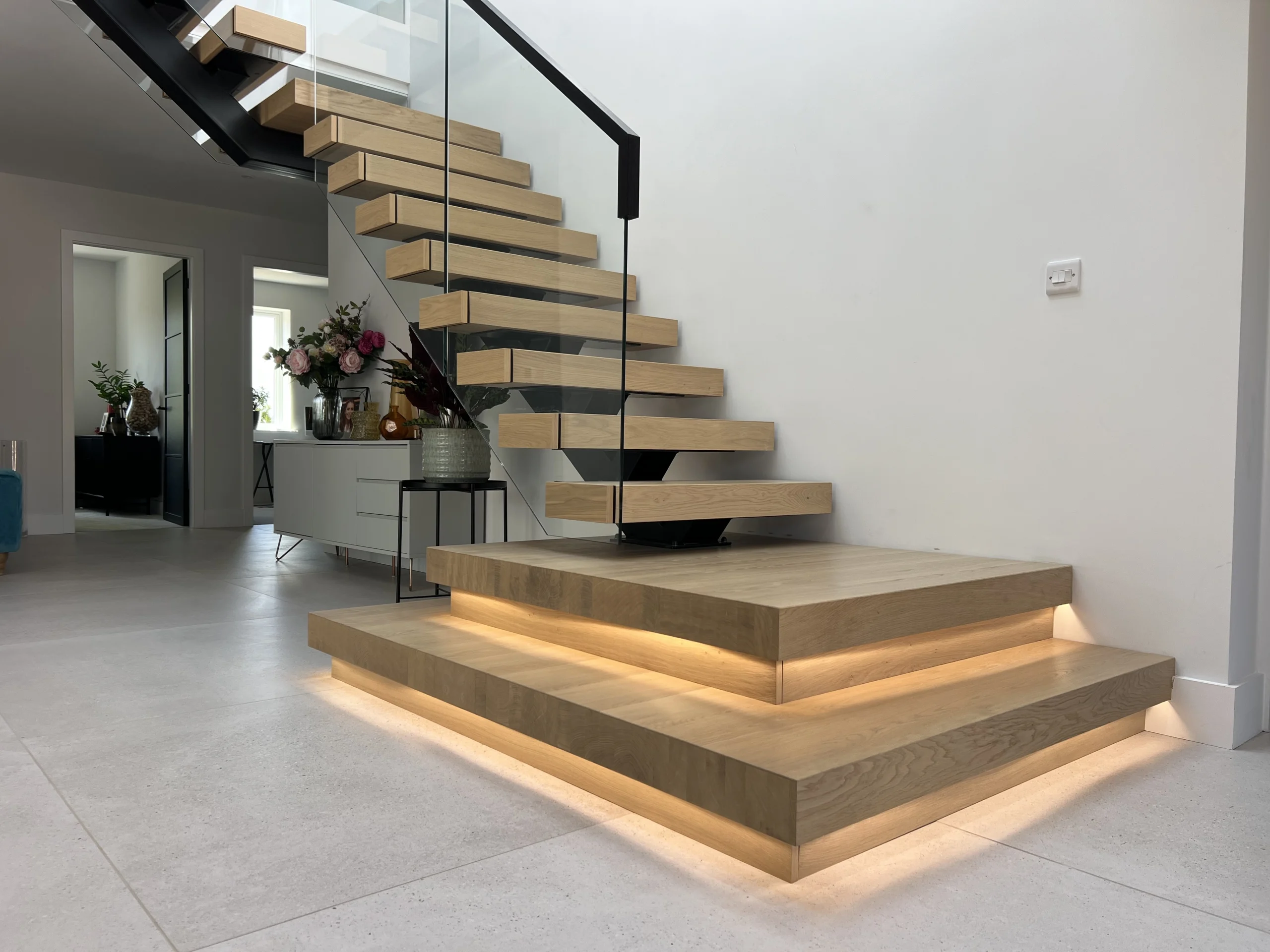
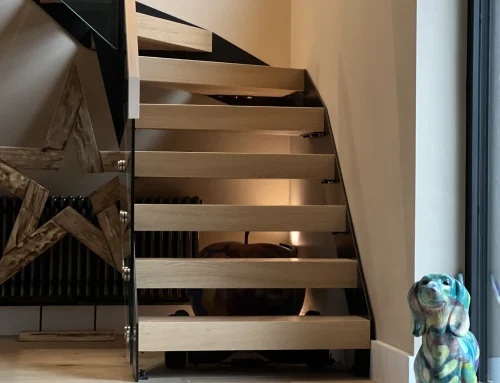
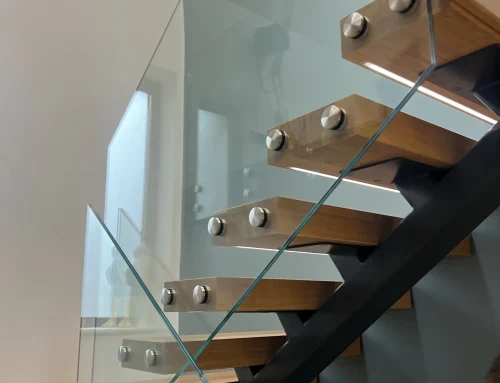
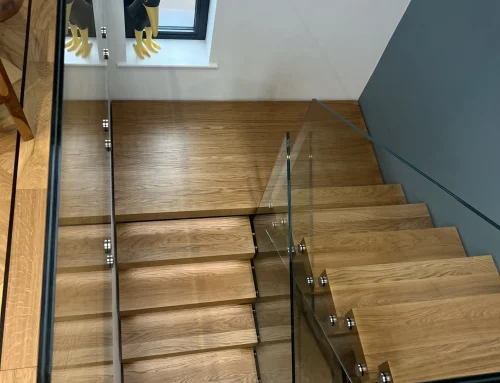
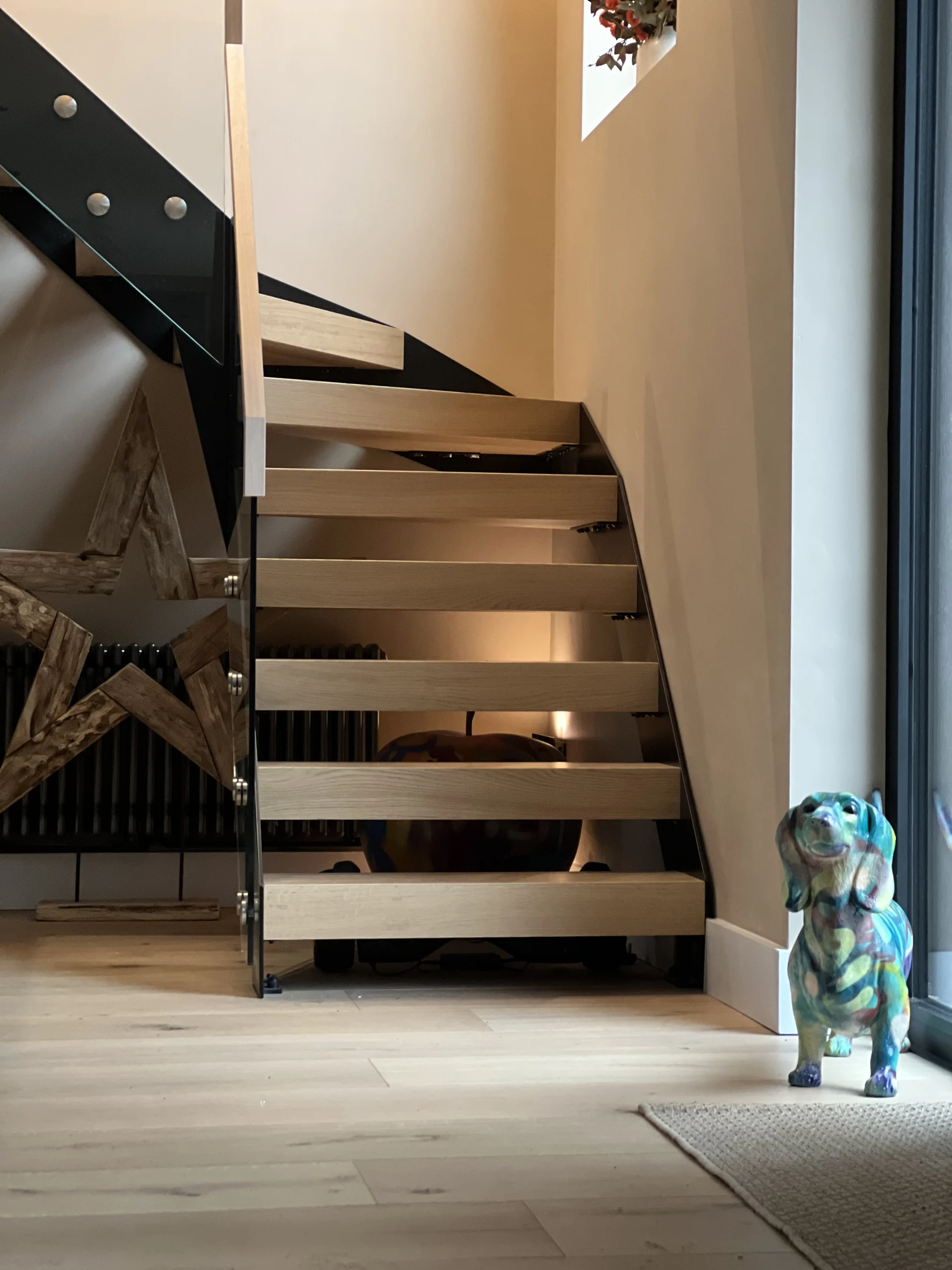
Bespoke L-shape floating staircase — RAL 9005 matte black spine, solid oak treads, frameless glass balustrade
Bespoke staircases in London 2026 start at £7,900 for a contemporary floating flight with oak treads, £9,500 for a central spine staircase with steel substructure, and reach £15,000–£35,000+ for fully custom curved or helical designs in prestige projects. Continox prices flat across the UK — a London project pays the same as a project anywhere else, with no London surcharge. All quotations are fixed-price following a free on-site survey, include design and 3D visualisation, in-house fabrication, professional installation, Building Regulations sign-off and removal of the existing staircase. Typical project timeline: 6–8 weeks from order to completed installation, with on-site install consistently 2–3 days. Coverage across all 32 London boroughs and the Greater London area.
Why London Bespoke Staircase Projects Demand More
Most cost guides and supplier websites treat the UK as a single market. London is not the same market. The combination of period property stock, planning sensitivity, restricted street access, architect involvement, and the design literacy of typical London clients means that what works on a typical detached home in Surrey will not work on a Notting Hill townhouse or a Hampstead Georgian conversion. Five factors define the difference.
1. Period property stock. The majority of London bespoke staircase commissions sit in pre-war buildings — Georgian, Victorian, Edwardian — with structural timbers and floor levels that were never designed to be modified. Existing openings are rarely square. Floor-to-floor heights vary between flights. Ceiling levels in stairwells are often irregular due to historic ductwork or service runs. Every dimension on a London project has to be surveyed individually rather than assumed from drawings.
2. Listed buildings and conservation areas. Around 19,000 buildings in Greater London hold listed status, and substantial portions of central London sit within designated Conservation Areas. Replacing a staircase in a listed building requires Listed Building Consent separate from Building Regulations approval — a process that can add 8–14 weeks to project timeline and tightly constrains material choices and visible alterations.
3. Restricted site access. London terraced properties, mews houses and apartments above ground floor present access challenges that simply don't apply to suburban projects. Installation crews need to consider parking permits, congestion charge zones, narrow staircases used for delivery, lift access in apartments, and protective covering of communal areas. Continox factory-prepares all components in pre-finished sub-assemblies that can be moved through standard 760mm doorways — a deliberate design choice for the London market.
4. Architect-led briefs. London bespoke staircase commissions are far more likely to come through a project architect than direct from the homeowner. The implication: the design dialogue happens in technical CAD format with full structural calculations, the material specification has been considered against the wider interior scheme, and the staircase has to integrate with cabinetry, lighting and flooring details that are also being designed in parallel. Continox's CAD process, structural calculations and 3D visualisation outputs are formatted to integrate directly into architect-managed design packs.
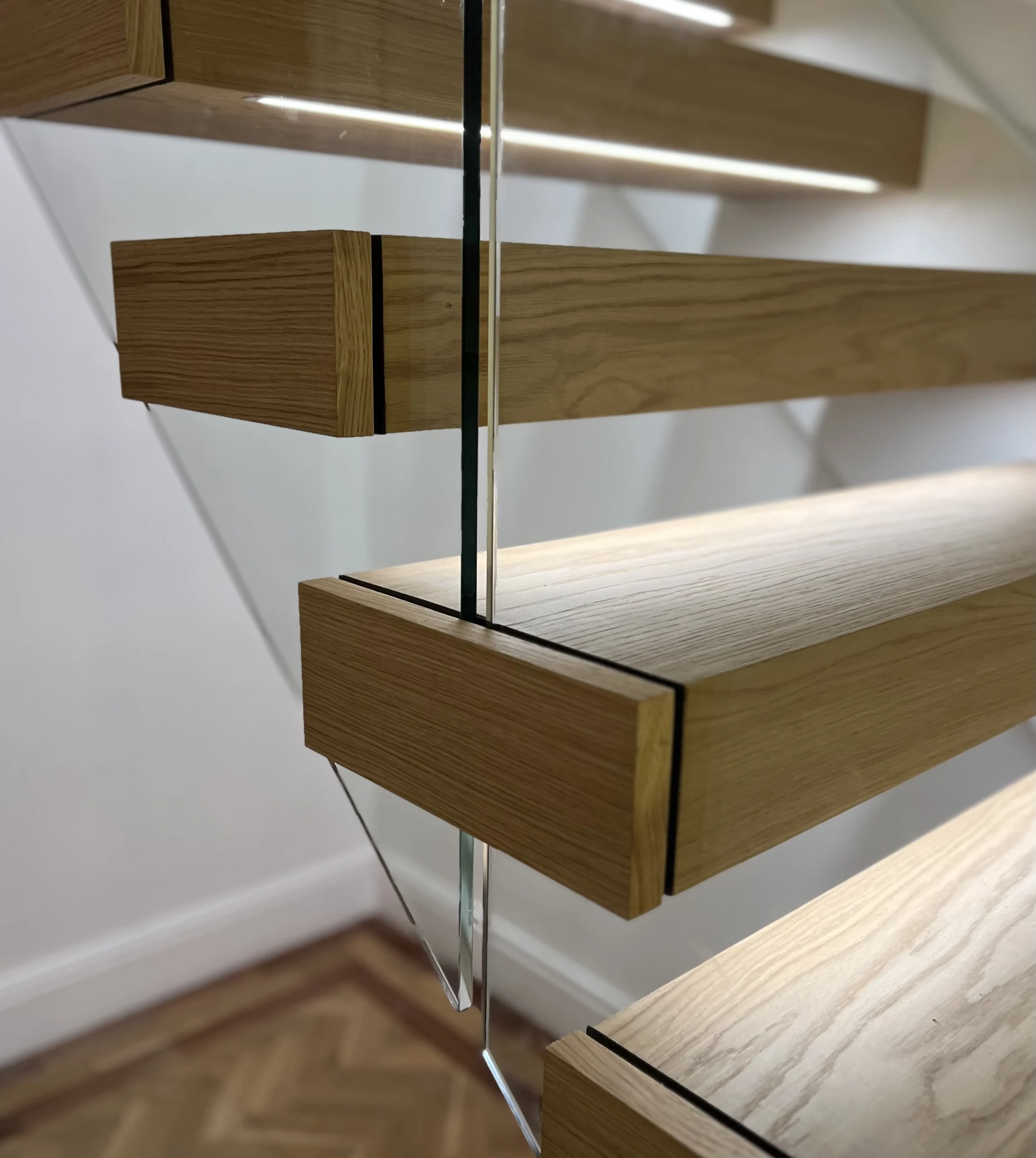
5. Design expectations. London clients typically arrive at a bespoke staircase commission having seen reference projects in design press, on Instagram and in physical property tours. The bar for what counts as "premium" is set higher than the national average. Visible junctions, mismatched timbers, inconsistent powder coat tone, or any visible compromise reads immediately and undermines the project. Premium-tier specification — RAL 9005 matte powder coat, factory-finished oak with closed-pore matte oil, frameless 17.5mm laminated toughened glass, factory-integrated LED — is the baseline rather than the upgrade.
Three Bespoke Staircase Tiers Specified in London
Across Greater London commissions in the past 18 months, three pricing tiers account for around 90% of bespoke contemporary staircase projects. Where a project sits within the tiers depends on the configuration, the material specification, and whether the staircase is the primary architectural feature of the ground-floor layout.
Concealed steel substructure, solid oak treads, framed or frameless glass on one side. Suits townhouse and apartment projects where space is constrained.
- Oak treads 80–100mm
- RAL 9005 powder coat
- Glass balustrade one side
- Optional integrated LED
- Install: 2–3 days
Single rigid steel spine carrying treads on both sides. Y-spine and U-shape variants for double-height open-plan voids. The dominant London bespoke configuration.
- RHS steel spine 150×100×5mm
- Solid oak / walnut treads
- Frameless glass both sides
- Factory-integrated LED
- Install: 2–3 days
Curved, helical or sculptural geometry. Multi-flight, double-height. Specified for prestige listed properties and architect-designed schemes.
- Steam-bent or laminated string
- Unique tread per riser
- Bent or faceted glass
- Architect-led detailing
- Install: 3–5 days
Why Continox prices flat across the UK: Most London staircase suppliers price 15–25% above national average to account for higher local labour rates, regional overheads and access challenges. Continox manufactures at a single facility and dispatches finished staircases nationwide — fabrication cost is identical regardless of installation postcode, and installation is performed by the in-house Continox team, not subcontracted. A central London project pays the same as a Yorkshire project on the same specification. View the full pricing breakdown across all configurations on the bespoke staircase cost guide.
London Boroughs — Where Continox Installs
Continox operates across all 32 London boroughs plus the City of London, with delivery vehicles and installation crews routed centrally from the manufacturing facility on the south coast. The boroughs below are arranged by recent project density — these are the areas where Continox commissions are most frequently specified, although projects across all of Greater London are equally accommodated.
Highest project density. Period townhouses, mews properties, prestige refurbishments. Strong preference for central spine and floating designs with frameless glass. Historic case study: Kensington Gardens central spine.
Apartment refurbishments, mansion blocks, pied-à-terre projects. Restricted access common. Floating staircases dominate. Listed building consent frequent.
Period property conversions, contemporary insertions. Architect-led briefs. Mixed material specification (steel + oak + glass). Conservation Area sensitivity.
New build apartments, riverside developments, family townhouses. Open-plan ground floors with central spine as architectural feature.
Victorian terrace conversions. Loft conversions creating second flights. Restricted street access requires factory pre-assembly approach.
Mid-tier refurbishments to high-end. Family homes opening up traditional layouts. Floating cantilever and L-shape configurations common.
Substantial detached homes, garden-fronted properties. Larger flight runs, U-shape and curved configurations more frequent than central London.
Warehouse conversions, modernist new builds, historic dock developments. Industrial-leaning specification — exposed steel, plate treads, raw finishes.
Outer London boroughs — Bromley, Croydon, Ealing, Enfield, Harrow, Havering, Hillingdon, Hounslow, Newham, Redbridge, Sutton — are equally covered. Project lead time is identical regardless of postcode within the M25.
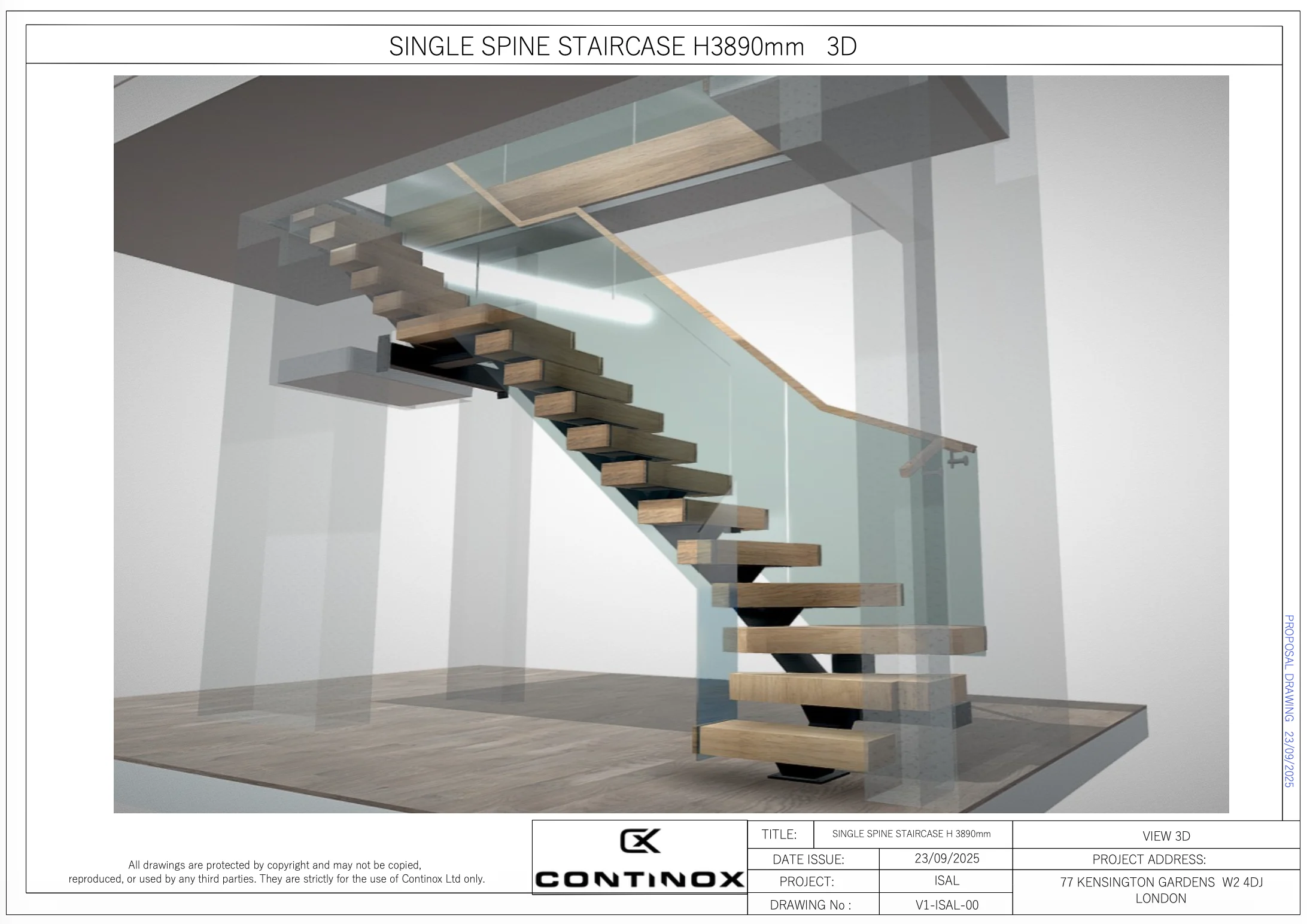
Kensington Gardens — Central Spine Staircase
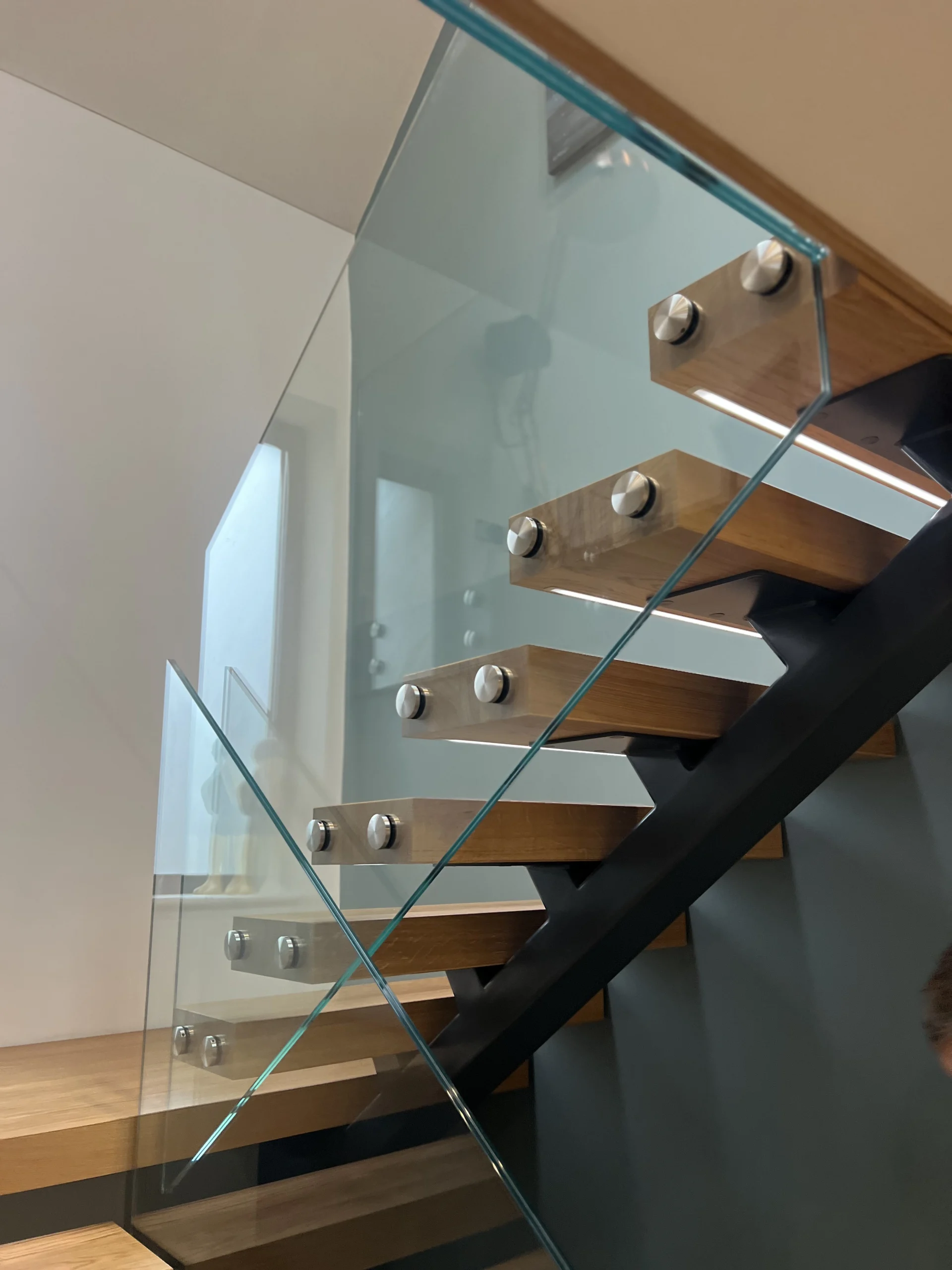
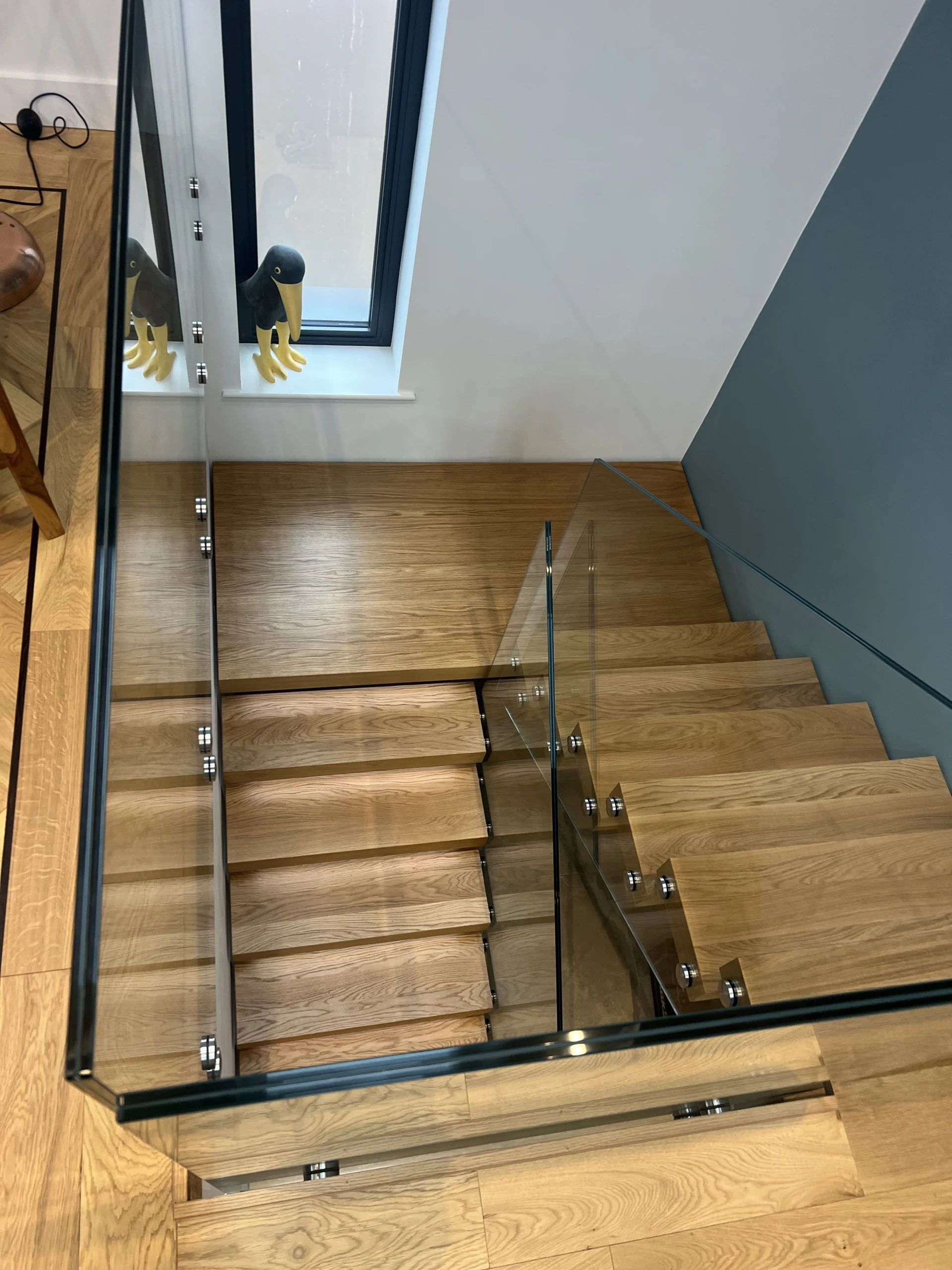
Bespoke central spine staircase commissioned for a Kensington Gardens family home, replacing a tired traditional softwood flight in the central hallway. The brief: a sculptural object that reads as architecture rather than circulation, viewable from the ground-floor open-plan living space and the first-floor landing. Specification: 150×100×5mm RHS steel spine powder coated RAL 9005 matte black, seven unique solid European oak tread profiles routed to match the spine geometry, frameless 17.5mm laminated toughened glass balustrade with point-fixed stainless steel spigots, factory-integrated LED tread lighting at 2700K colour temperature.
The complete project documentation including structural drawings, fabrication detail and on-site installation sequence is published at the Kensington Gardens case study →
The London Bespoke Staircase Design Process
A typical Continox London project runs from initial contact to completed installation in 6–8 weeks. The process is structured into seven defined stages so that architect-led projects, homeowner-led projects, and listed building projects all follow the same audit trail.
Initial Brief & Indicative Pricing
Telephone or email enquiry, sharing initial drawings, photographs or architect's plan. Indicative price range provided within 24 hours based on configuration and material brief. No commitment, no charge.
Free On-Site London Survey
A Continox surveyor visits the London property to take precise measurements, assess structural conditions, photograph the existing opening, identify access constraints, and discuss design preferences directly with the client or architect. Site survey across Greater London is included at no charge.
Design Development & 3D Visualisation
Following the survey, our design team produces CAD drawings and photorealistic 3D visualisation showing exactly how the proposed staircase will appear in the project space, against actual interior finishes. Multiple configurations or material variants can be visualised and compared.
Fixed-Price Quotation
Detailed itemised quotation issued in writing, fixed-price following the on-site survey. Includes design, structural calculations, 3D visualisation, manufacture, delivery, professional installation, Building Regulations sign-off and removal of existing staircase. No hidden extras, no estimates.
Manufacture in Continox Workshop
4–6 weeks. Steel substructure CNC-cut and welded to engineering tolerances, treads CNC-routed in selected timber, glass panels manufactured to BS EN 14449 standard. All components powder coated and oil-finished at the factory before delivery.
London Delivery & Installation
Continox in-house installation team transports the pre-assembled components to the London site, manages access (including restricted access through narrow doorways, lifts and communal areas), and completes installation in 2–3 days. No subcontracted installers.
Sign-Off & Building Control
Following installation, all Building Regulations documentation is provided for Building Control sign-off — structural calculations, BS 6180 compliance evidence, BS EN 14449 glass certification, UKCA marking. For listed buildings, additional documentation supports Listed Building Consent compliance.


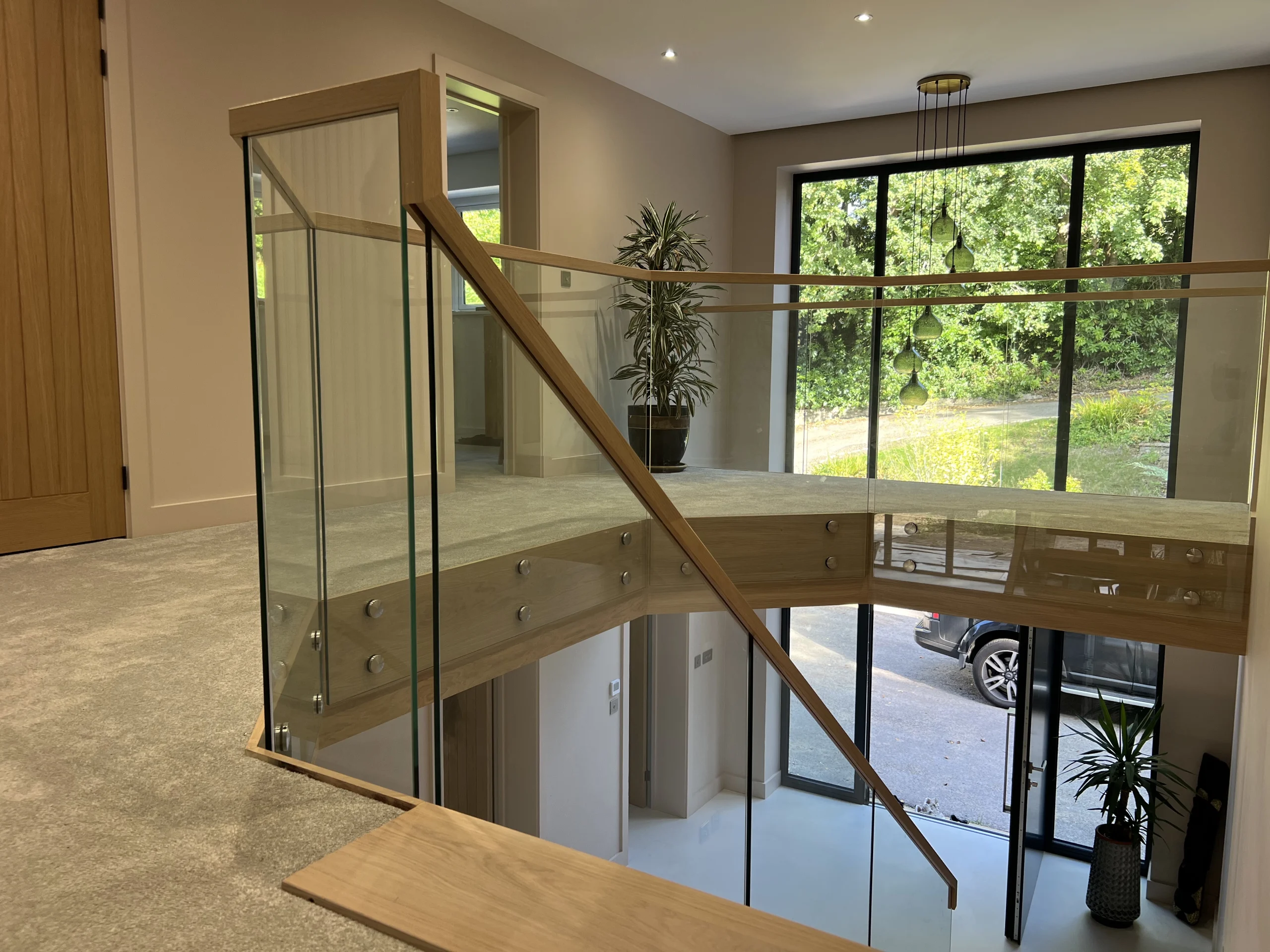
See Completed Continox Projects
Browse the full Continox portfolio of bespoke staircase and balustrade projects across the UK — including London commissions, Home Counties projects, and detailed case studies showing structural drawings, material choices, and on-site installation. Real projects, real specifications.
Browse Project Portfolio →Configurations That Work in London
Not every staircase configuration suits every London property. The decision depends on the existing opening, the floor-to-floor height, sight lines from adjacent rooms, and whether the staircase is replacing an existing flight or being installed in a new opening. The configurations below are the most commonly specified across Greater London commissions.
| Configuration | Best Suited To | From |
|---|---|---|
| Floating straight | Apartments, mews, narrow townhouses | £7,900 |
| Floating L-shape | Period townhouses with quarter turn | £9,500 |
| Central spine straight | Open-plan ground floor, double-height void | £9,500 |
| Central spine L-shape | Family homes, half-landing turn | £11,000 |
| Central spine U-shape | Larger Victorian conversions, full half-landing | £13,000 |
| Y-spine splitting flight | Prestige open-plan, sculptural feature | £15,000 |
| Curved / helical | Listed buildings, prestige refurbishments | £15,000–£35,000 |
| Steel plate treads | Warehouse conversions, modernist schemes | £8,500 |
Full configuration breakdown with specification details on the modern staircase range page, with dedicated pages for the floating staircase and central spine systems.
Materials That Read in London Properties
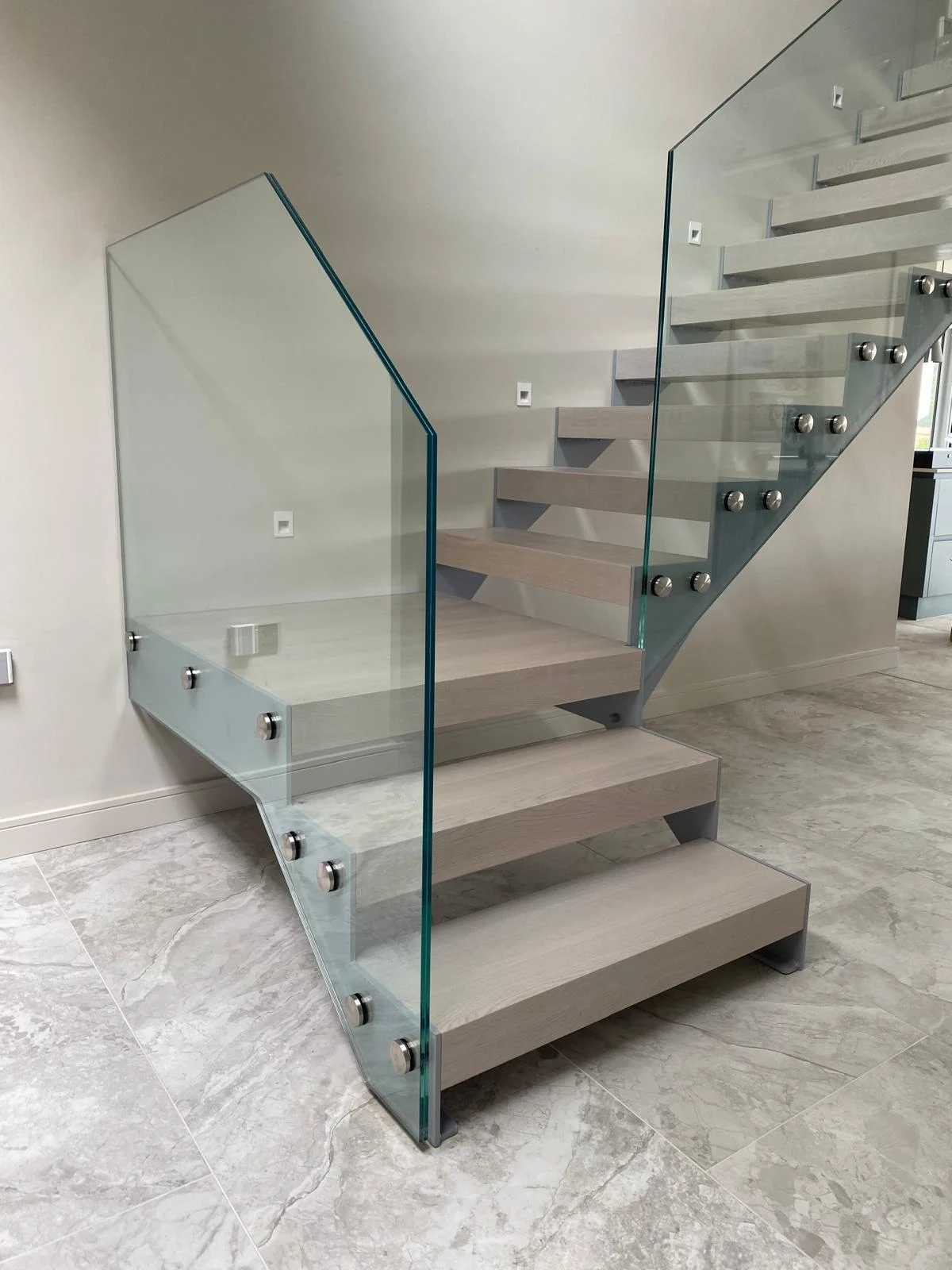
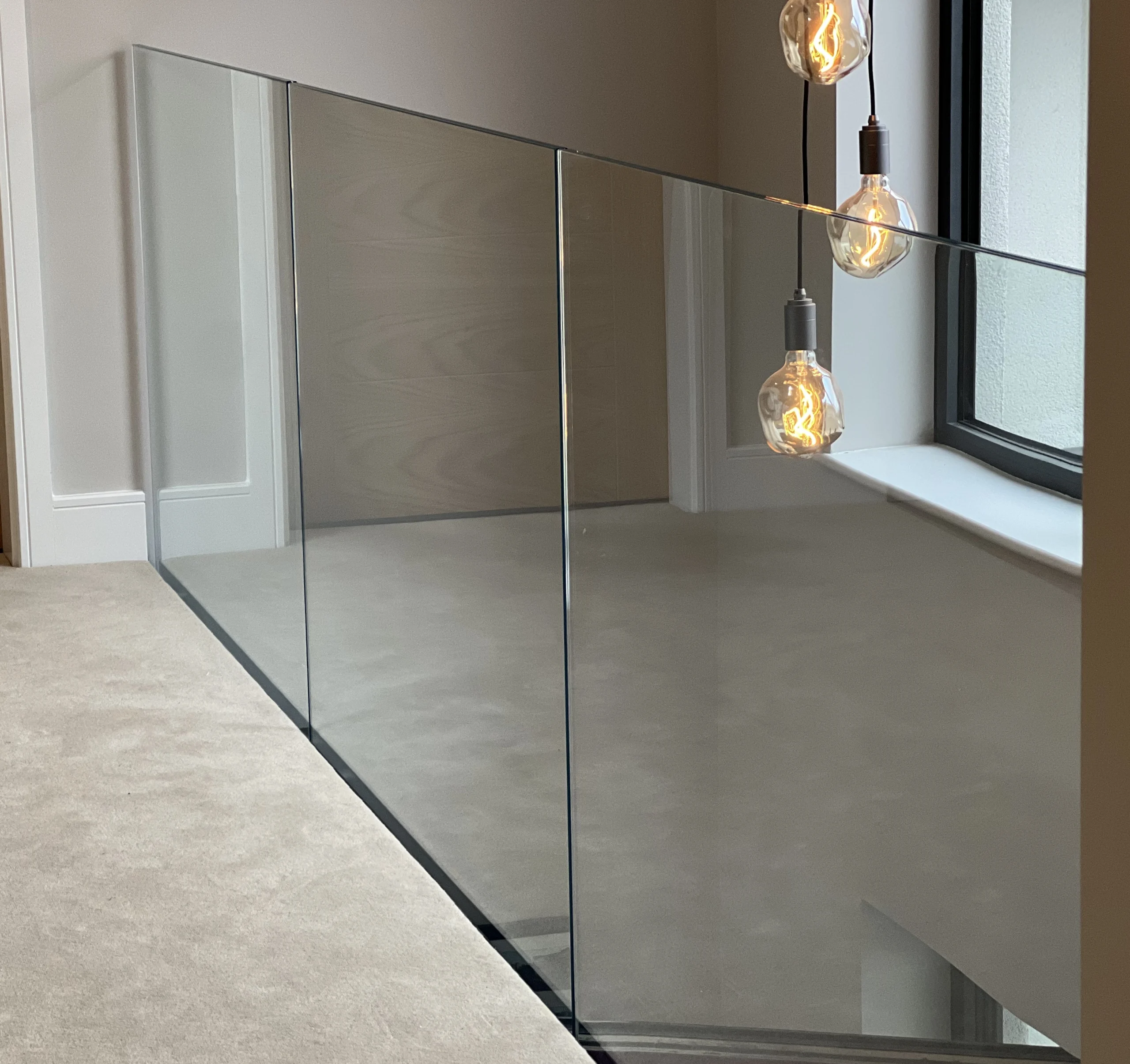
London bespoke staircase clients tend to specify within a narrower material palette than the broader UK market. Across recent projects, the dominant specification combines powder-coated structural steel, solid European oak treads, and frameless toughened glass balustrade. Premium-tier London projects substitute walnut for oak, and prestige projects sometimes specify low-iron glass for the truly transparent appearance.
| Material | London Specification | Where Used |
|---|---|---|
| European white oak | Closed-pore matte oil finish | Treads, handrail, fascia |
| American walnut | Premium tier, dark chocolate tones | Treads (premium projects) |
| S275 powder-coated steel | RAL 9005 matte / RAL 7016 grey | Spine, brackets, posts |
| 17.5mm laminated toughened glass | BS EN 14449, BS 6180 compliant | Frameless balustrade panels |
| 21.5mm laminated toughened glass | External / commercial / structural treads | Premium balustrade, glass treads |
| Low-iron glass | +15–20% upgrade for ultra-clear panels | Prestige projects only |
| S275 steel plate | 6–10mm powder coated, patinated finish | Industrial-leaning warehouse projects |
Listed Buildings & Conservation Areas
Around 19,000 buildings in Greater London hold listed status. Replacing a staircase in a Grade I, Grade II* or Grade II listed building requires Listed Building Consent from the local authority — separate from Building Regulations approval. The consent process examines both the staircase being removed (whether the existing flight is itself of historic significance) and the proposed replacement (whether it is sympathetic to the building's character).
For Grade II listed properties — the most common London listing category — Listed Building Consent is generally achievable with a sympathetic contemporary design, particularly where the existing staircase is a 20th-century replacement rather than the original flight. For Grade I and Grade II* properties, the process is more constrained and the staircase specification is often required to retain certain visible elements (handrail profile, baluster style, riser proportions) of the original.
Continox supports London listed building projects with a separate documentation pack tailored to the consent process: heritage statement, justification of design choices, structural calculations demonstrating the new flight will not damage existing fabric, and visualisation showing the staircase in context with retained interior features. Lead time for listed building projects extends to 12–16 weeks to accommodate the consent process.
Conservation Area implicationEven where the property itself is not listed, sitting within a designated London Conservation Area can affect what's permissible — particularly if the staircase replacement involves any external visibility (for example, a roof terrace balustrade visible from the street). The local authority's Conservation Officer should be consulted at the design stage rather than as a retrospective compliance step. Continox supports Conservation Area projects with appropriate documentation as part of the design process.
What to Look For in a London Bespoke Manufacturer
Selecting a bespoke staircase manufacturer for a London project is a higher-stakes decision than for a general UK project. The combination of access challenges, design expectations, listed building constraints and architect involvement means that low-cost online manufacturers and general joinery firms rarely deliver acceptable results in central London. Six factors separate genuine London-capable specialists from suppliers who merely accept London commissions.
1. Direct in-house installation team — not subcontracted. London access challenges mean installation has to be performed by experienced staircase fitters, not by general carpenters drafted in for the project. Continox installation is performed by the in-house team that fabricated the staircase — they know exactly how the components are sized and how they were intended to fit together.
2. Factory pre-assembly approach. Components designed to fit through standard 760mm doorways, lift access in apartment buildings, narrow Victorian hallways. The alternative — on-site fabrication — produces inferior results and longer install timelines.
3. Proven London project portfolio. Look for completed London commissions in the supplier's portfolio with detailed case studies showing the structural drawings, material choices and installation sequence. The Continox project portfolio includes the Kensington Gardens central spine staircase, Salisbury Shady Bower glass balustrade, and additional London-area projects.
4. CAD output formatted for architect integration. If your project is architect-led, the supplier's drawings need to integrate directly into the wider design pack. Continox issues drawings in DWG / DXF / PDF formats sized for A1 / A3 sheets to architect specification.
5. Building Control documentation as standard. The supplier should provide BS 6180 compliance evidence, BS EN 14449 glass certification, structural calculations and UKCA marking automatically — not as a chargeable extra. London Building Control inspectors are notably more rigorous than rural authorities and will request this paperwork as standard.
6. Fixed-price quotation, not estimates. A quote that says "from £X" is not a quote — it is the start of a negotiation that will end higher than the headline figure. London projects routinely run 30–50% over initial estimates with suppliers who quote in this format. Continox quotations are fixed-price following the free on-site survey, with all line items itemised and agreed in writing before fabrication begins.
London Building Control — What to Expect
Building Regulations approval applies to virtually every staircase replacement in Greater London — even like-for-like internal replacements. London authorities are generally more rigorous than rural Building Control offices, and inspections are typically more thorough. The dimensional and structural requirements are the same as elsewhere in England (Approved Document K, Approved Document B, BS 6180, BS EN 14449) but documentation expectations are higher.
Specifically, London Building Control will typically require: structural calculations for floating cantilever or central spine designs (the masonry connection is the critical element), BS 6180 compliance evidence for glass balustrade loading at 0.74 kN/m residential or 1.5 kN/m for general spaces, BS EN 14449 glass certification for laminated toughened panels, fire safety provisions per Approved Document B if the staircase forms part of a means of escape, and UKCA marking on structural steel components per UK Construction Products Regulations.
Continox provides this documentation as standard with every quotation — there is no separate fee for Building Control sign-off paperwork. For full requirements see the UK Staircase Building Regulations guide and the glass balustrade regulations breakdown.
London Bespoke Staircases — FAQ
Common questions on bespoke staircase commissioning in Greater London for 2026
Free London On-Site Survey + Fixed-Price Quote
Free on-site survey across all 32 London boroughs. Photorealistic 3D visualisation tuned to your interior. Fixed-price quotation within 24 hours — no London surcharge, no hidden extras. Bespoke contemporary staircases from £7,900, designed and installed by the in-house Continox team.