
Bespoke Staircases Kensington & Chelsea — Premium Design Service
The Royal Borough of Kensington and Chelsea is the most demanding micro-market for bespoke staircase commissioning in the UK. Stucco-fronted Victorian terraces in South Kensington, mews properties in Holland Park, mansion blocks in Earls Court, listed townhouses behind Kensington Palace Green, period conversions in Chelsea — every property in the borough carries a layer of architectural and regulatory complexity that simply doesn't exist elsewhere. This guide covers what bespoke staircase commissioning actually involves across SW3, SW7, SW10, W8, W10, W11 and W14: Continox completed projects in the borough, the postcodes covered, design and material specifications appropriate to RBKC property types, the listed building consent process, and the pricing for residential commissions in 2026. Continox installs across all Kensington & Chelsea postcodes from £7,900 — with no London surcharge.
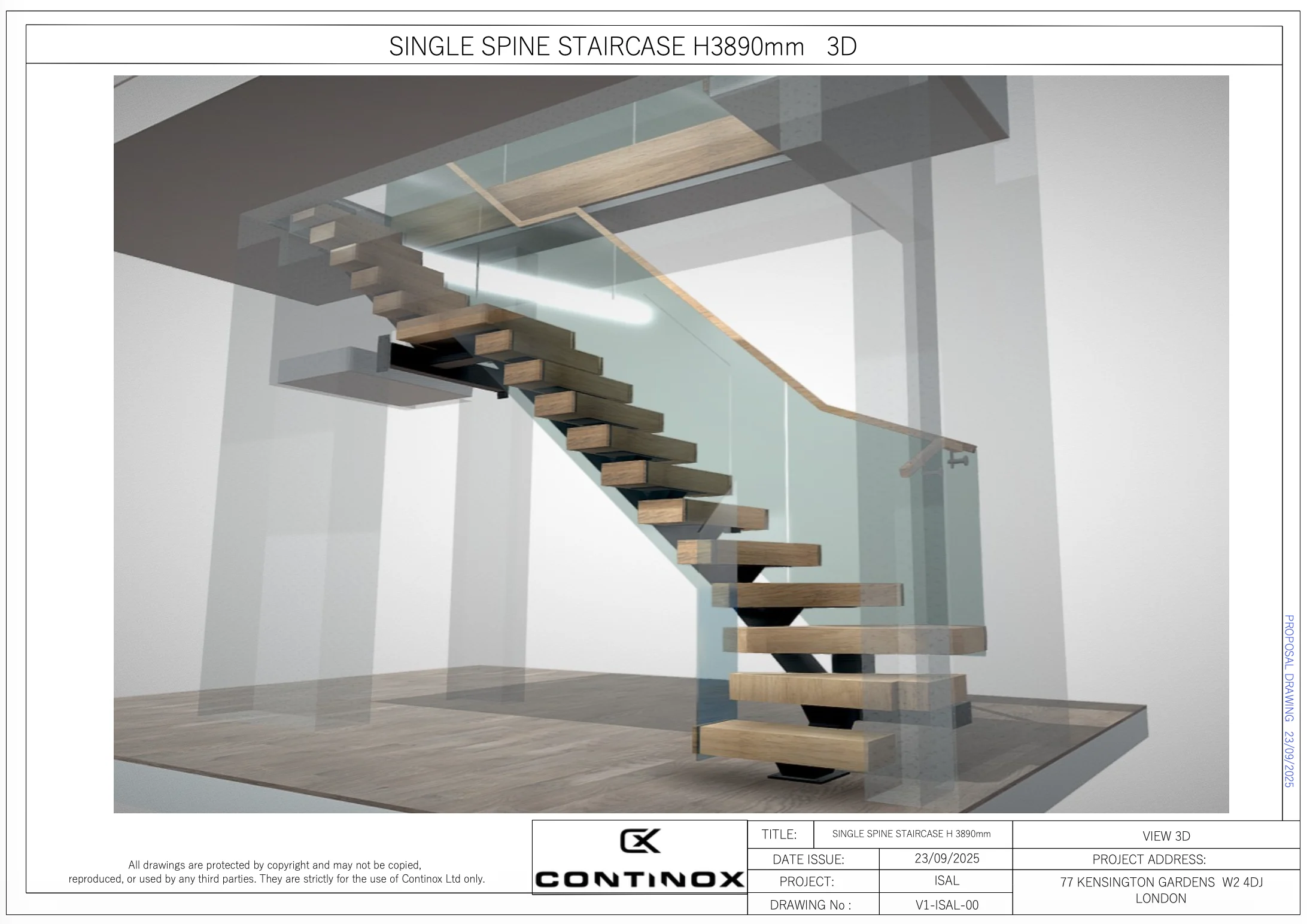
Continox central spine staircase — Kensington Gardens project, RBKC commission, 3D factory rendering
Continox installs bespoke contemporary staircases across all Kensington & Chelsea postcodes — SW3, SW5, SW6, SW7, SW10, W8, W10, W11, W14. Pricing starts at £7,900 for a floating staircase, £9,500 for a central spine staircase, and £15,000–£35,000+ for fully custom curved or helical designs in prestige projects. Continox prices flat across the UK — there is no Kensington or London surcharge — so an RBKC project pays the same fixed price as a project anywhere else. Free on-site survey, photorealistic 3D visualisation, fixed-price quotation within 24 hours. Listed Building Consent supported for Grade II projects. Featured RBKC project: the Kensington Gardens central spine staircase.
Why Kensington & Chelsea Projects Demand Specialists
The Royal Borough of Kensington and Chelsea covers around 12 square kilometres and contains roughly 4,000 listed buildings — the highest concentration in the United Kingdom. Property stock is overwhelmingly pre-war, with stucco-fronted Victorian and Georgian terraces accounting for the majority of residential commissions. Five borough-specific factors define what a serious bespoke staircase commission needs to address.
1. Listed building density. Around 70% of central RBKC residential streets sit within designated Conservation Areas, and the borough has 33 active Conservation Areas covering Kensington Palace, Royal Crescent, Holland Park, Cheyne Walk, Brompton, Boltons and others. Replacing a staircase in a listed property requires Listed Building Consent separate from Building Regulations — typically adding 8–14 weeks to project timeline.
2. Mews and townhouse access. The borough's iconic mews properties (Kensington Court Mews, Holland Park Mews, Cottesmore Gardens) and narrow Victorian terraces present access challenges that defeat many staircase suppliers. Standard 760mm doorways, restricted hallways, and shared-access cobbled mews require components designed and manufactured for pre-finished sub-assembly delivery.
3. RBKC Building Control rigour. Building Control inspectors at the Royal Borough of Kensington and Chelsea are notably more demanding than rural authorities. Structural calculations, BS 6180 compliance evidence, BS EN 14449 glass certification, and UKCA marking are all expected as standard documentation — not as chargeable extras.
4. Architect-led briefs dominate. The majority of RBKC bespoke staircase commissions come through project architects (often RIBA-chartered practices specialising in heritage refurbishment). The implication: design dialogue happens in CAD format, structural calculations need to integrate into the wider design pack, and material specification has to coordinate with cabinetry, lighting and flooring specified in parallel.
5. Design literacy is the highest in the UK. Kensington and Chelsea clients arrive at a bespoke staircase commission having seen reference projects in design press, industry awards (RIBA, Don't Move Improve), and physical property tours. The bar for "premium" is calibrated by design culture, not by general UK consumer expectations. Visible compromise — mismatched timbers, inconsistent powder coat, visible weld lines — undermines the entire project. Every junction, fixing and finish has to be detailed to furniture-quality standards.
Kensington Gardens — Central Spine Staircase
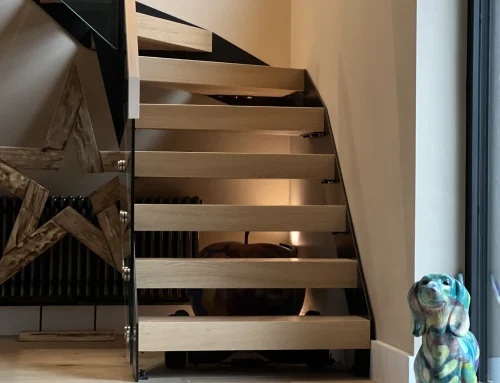
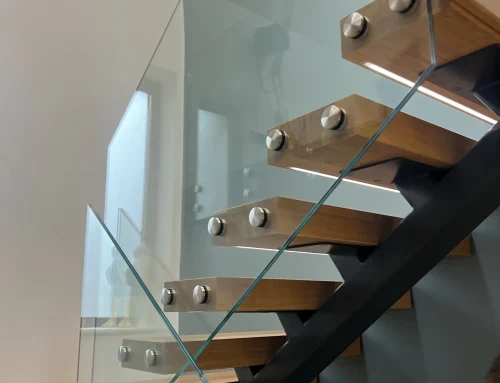
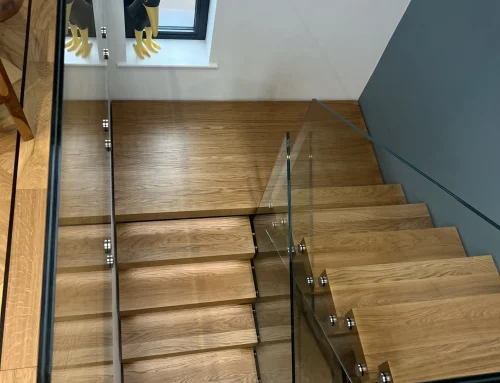
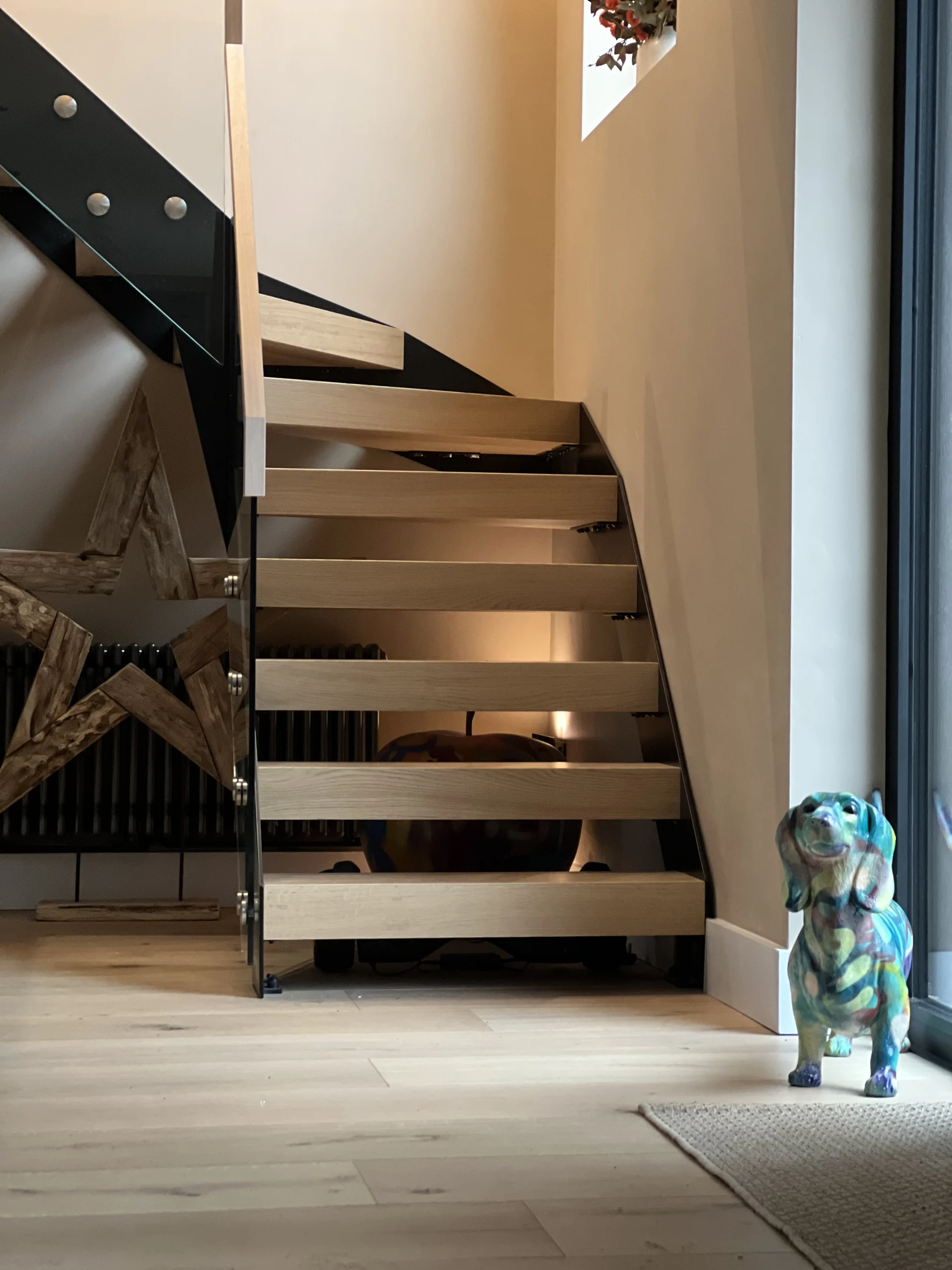
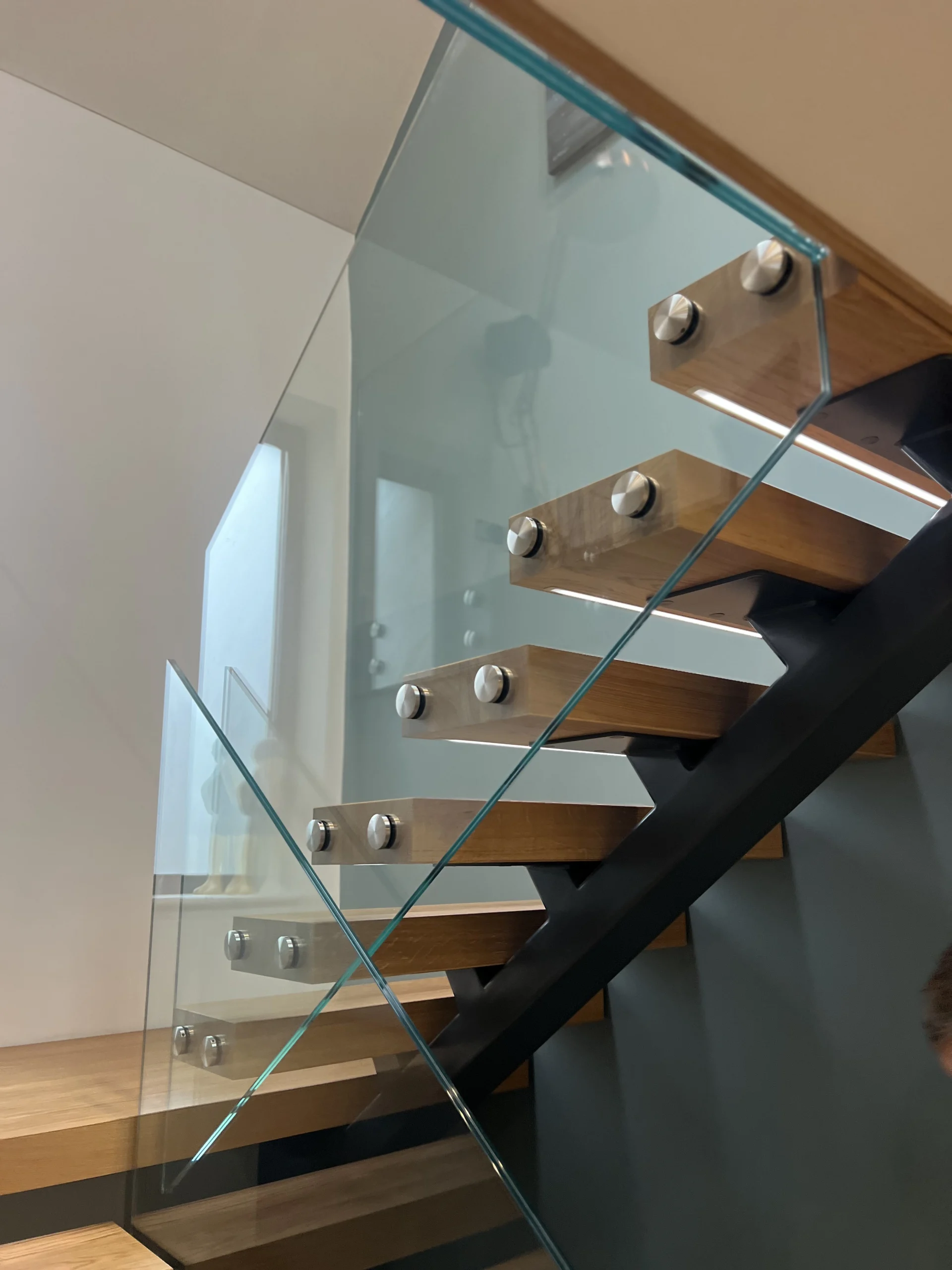
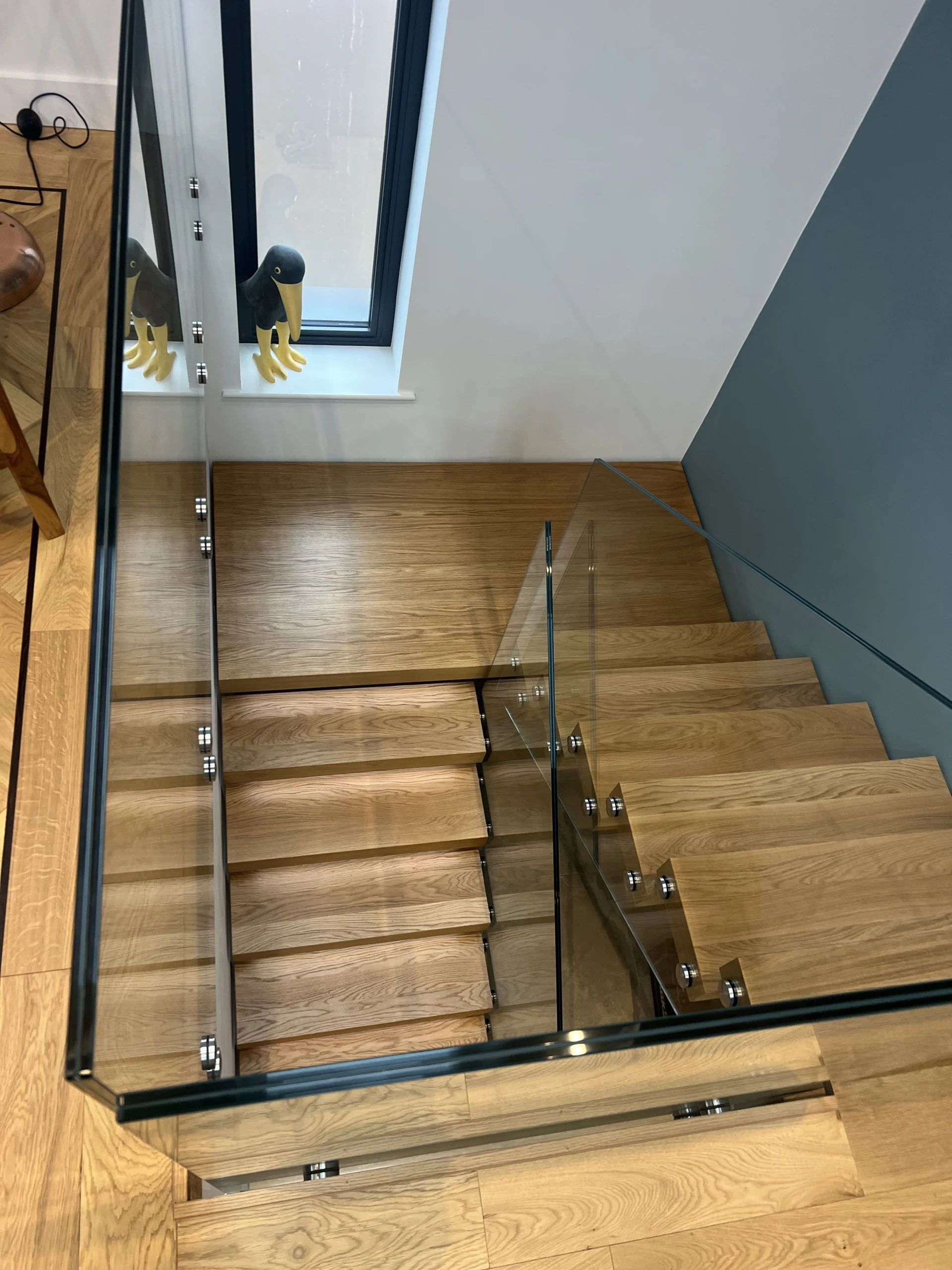
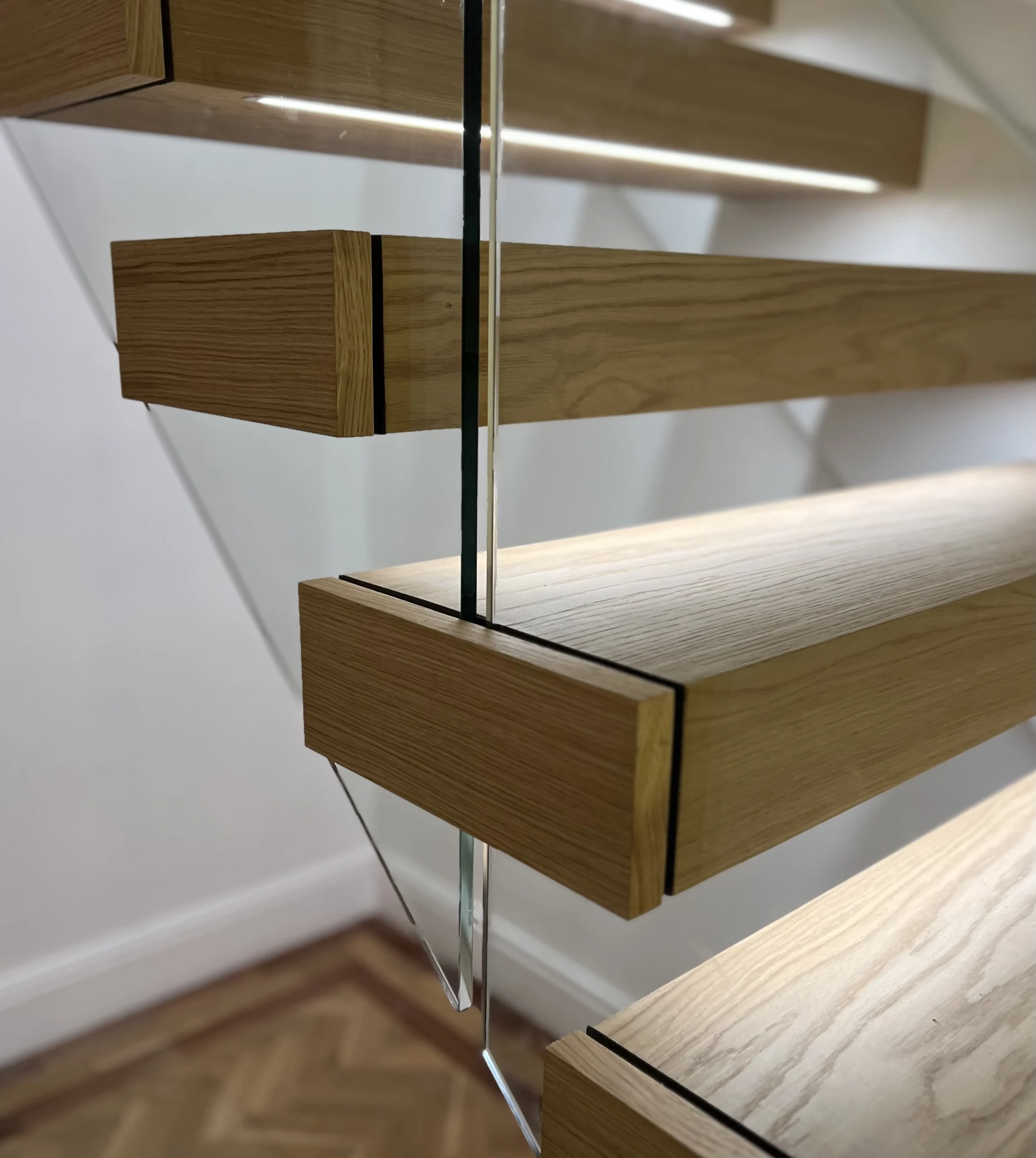
A bespoke central spine staircase commissioned for a Kensington Gardens family home, replacing a tired traditional softwood flight in the central hallway. The brief from the project architect: a sculptural object that reads as architecture rather than circulation, viewable from the ground-floor open-plan living space and the first-floor landing. Specification: 150×100×5mm RHS steel spine powder coated RAL 9005 matte black, seven unique solid European oak tread profiles routed to match the spine geometry, frameless 17.5mm laminated toughened glass balustrade with point-fixed stainless steel spigots, factory-integrated LED tread lighting at 2700K colour temperature.
On-site installation completed in 3 days. The structural drawings, fabrication detail and complete project documentation are published at the Kensington Gardens case study →
Kensington & Chelsea Postcodes Covered
The Royal Borough of Kensington and Chelsea covers seven primary residential postcodes plus shared edge postcodes with neighbouring Westminster and Hammersmith & Fulham. Continox installs across all of them, with delivery vehicles routed centrally from the manufacturing facility on the south coast.

RBKC Property Types — What Works Where
Different RBKC property archetypes call for different staircase configurations. The five most-commissioned configurations across recent Continox commissions in the borough, matched to their typical property contexts:
Onslow Gardens, Cromwell Road, Cadogan Square. Floor-to-floor heights 3.0–3.6m. Existing openings rarely square. Best fit: floating cantilever or central spine straight, retaining the existing opening geometry.
Kensington Court Mews, Cottesmore Gardens, Cheyne Mews. Floor-to-floor often 2.4–2.8m. Restricted footprint. Best fit: floating L-shape or winder configuration with steel substructure.
Earl's Court Square, Phillimore Gardens, Drayton Gardens. Internal staircase replacements within individual flats. Best fit: floating straight or compact spine with frameless glass.
King's Road, Holland Park redevelopments. Open-plan layouts, double-height voids. Best fit: central spine Y-shape or fully bespoke curved as architectural feature.
Cheyne Walk, Holland Park, Kensington Palace Green. Listed Building Consent required. Best fit: sympathetic contemporary insert retaining handrail profile and proportions of original.
Lots Road power station residences, North Kensington warehouse conversions. Industrial-leaning specification. Best fit: steel plate treads or exposed central spine with patinated finish.
Kensington & Chelsea Bespoke Staircase Pricing 2026
Indicative starting prices for bespoke contemporary staircases installed across the Royal Borough. All prices are fixed following a free on-site survey, include design, 3D visualisation, manufacture, factory finishing, professional installation by the Continox in-house team, removal of existing staircase, and Building Regulations sign-off documentation. There is no Kensington or London surcharge — RBKC projects pay the same fixed price as projects anywhere else in the UK.
| Configuration | Best for | From |
|---|---|---|
| Floating straight | Mews, mansion blocks, narrow townhouses | £7,900 |
| Floating L-shape | Period townhouses with quarter turn | £9,500 |
| Central spine straight | Open-plan ground floor, double-height void | £9,500 |
| Central spine L-shape | Family townhouses, half-landing turn | £11,000 |
| Central spine U-shape | Larger period conversions | £13,000 |
| Y-spine splitting flight | Prestige open-plan, sculptural feature | £15,000 |
| Curved / helical | Listed buildings, prestige refurbs | £15,000–£35,000 |
| Frameless glass balustrade | Per linear metre, point-fixed spigots | £450/m |
Full pricing breakdown including upgrades (walnut treads, integrated LED, low-iron glass) on the bespoke staircase cost guide. For balustrade specifications and per-metre options see the glass balustrade range.
Three Typical RBKC Project Specifications
Project briefs commissioned across recent Continox Kensington & Chelsea installations cluster around three configurations. The specifications below reflect typical fixed-price projects in the borough — the headline figures do not include VAT.
Onslow Gardens — SW7 Townhouse Floating Staircase
Replacement of an existing softwood flight in a Victorian South Kensington townhouse. L-shape floating staircase, RHS steel substructure powder coated RAL 9005 matte, 80mm solid oak treads, frameless 17.5mm glass balustrade on the open side, oak handrail. Project total: £11,500–£13,500. Lead time 6–8 weeks. Installation 3 days.
Holland Park — W11 Open-Plan Central Spine
New build replacement in a Holland Park family home. Central spine L-shape staircase, 150×100×5mm RHS spine, factory-integrated LED tread lighting, frameless glass balustrade on both sides, walnut tread upgrade. Architect-led brief. Project total: £14,000–£16,500. Lead time 7–9 weeks. Installation 3 days.
Cheyne Walk — SW3 Listed Townhouse Sympathetic Insert
Grade II listed Chelsea townhouse, ground floor to first floor. Listed Building Consent supported by tailored heritage documentation. Floating cantilever with reduced cantilever, sympathetic 90mm oak tread profile retaining proportional relationship to original, dark grey RAL 7016 powder coat (matched to retained period skirting). Project total: £13,500–£15,500. Lead time 14–16 weeks (consent + manufacture). Installation 3 days.

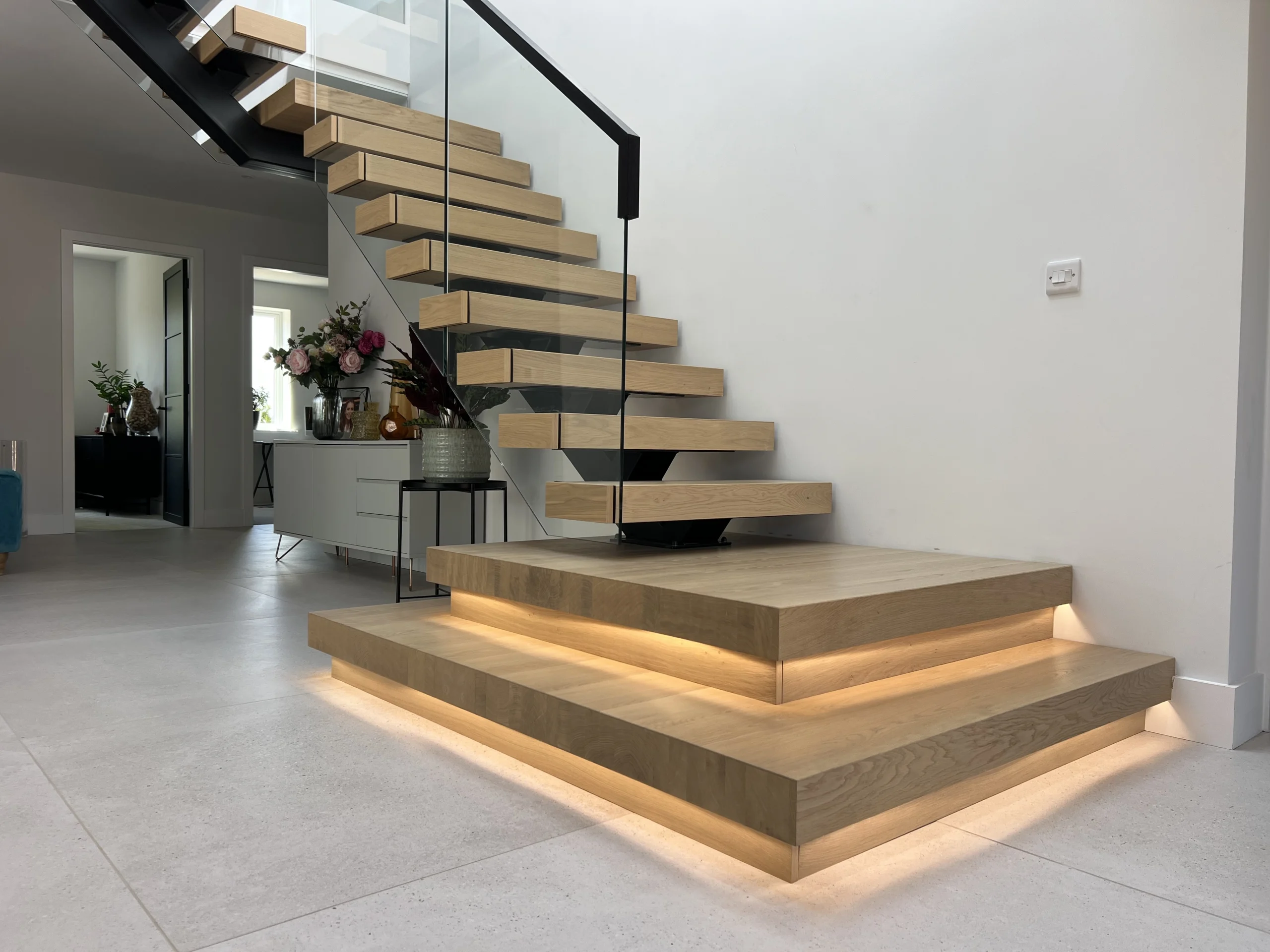
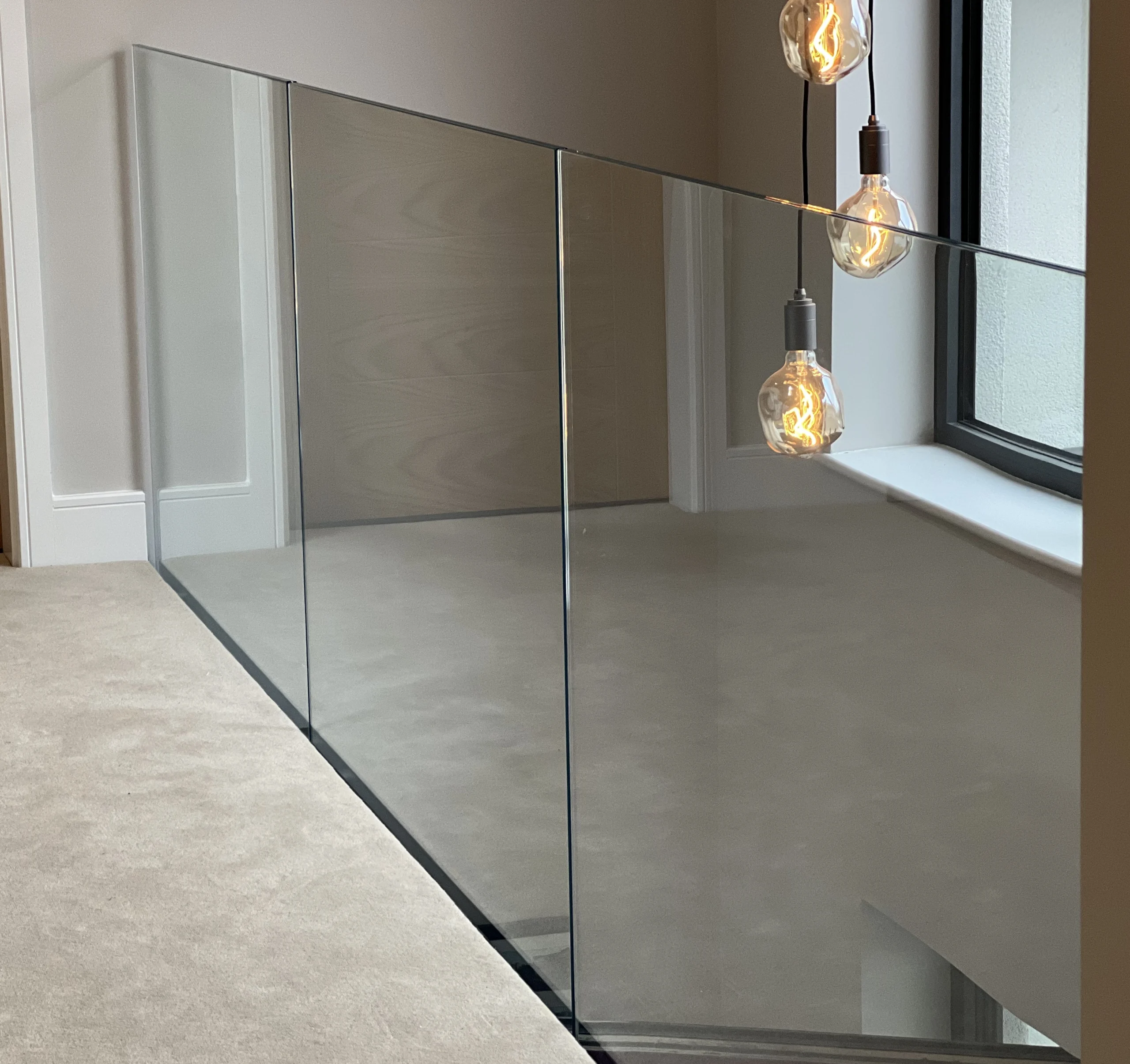
See Continox RBKC & London Projects
The full Continox project portfolio includes the Kensington Gardens central spine staircase, plus completed projects across London, the Home Counties and the south coast. Browse structural drawings, material specifications, and on-site installation photography.
Browse Project Portfolio →Listed Building Consent — RBKC Process
Around 4,000 of the borough's residential properties hold listed status, the highest concentration of any UK local authority. Replacing a staircase in a Grade I, Grade II* or Grade II listed property requires Listed Building Consent from RBKC's Planning Department, separate from Building Regulations approval. The consent process examines both the existing staircase (whether it itself is of historic significance) and the proposed replacement (whether it is sympathetic to the building's character).
For Grade II properties — by far the most common RBKC listing — sympathetic contemporary designs are generally achievable, particularly where the existing staircase is a 20th-century replacement rather than original fabric. The consent process typically requires: heritage statement justifying the design choices, structural calculations demonstrating the new flight will not damage retained original elements, visualisation showing the staircase in context with the wider interior, and material justification showing why the proposed materials are appropriate.
Continox supports RBKC listed building projects with a complete documentation pack tailored to the consent process. Lead time for listed projects extends to 12–16 weeks from initial enquiry to completed installation, accommodating both the consent process (typically 8 weeks) and the standard manufacture window. Grade I and Grade II* projects typically take longer — 16–22 weeks — and require closer engagement with the Conservation Officer.
RBKC Conservation AreasEven where the property itself is not listed, sitting within one of RBKC's 33 active Conservation Areas can affect what is permissible, particularly if the staircase replacement involves any external visibility (for example, a roof terrace balustrade visible from the street). The borough's Conservation Officer should be consulted at design stage rather than retrospectively. Continox supports Conservation Area projects with appropriate documentation as part of the design process.
RBKC Building Control — What to Expect
Building Regulations approval applies to virtually every staircase replacement in the Royal Borough. RBKC Building Control inspectors are notably more rigorous than rural authorities — inspections are typically more thorough and documentation expectations are higher. The dimensional and structural requirements are the same as elsewhere in England (Approved Document K, Approved Document B, BS 6180, BS EN 14449) but evidence demands are different.
Specifically, RBKC Building Control will typically request: structural calculations for floating cantilever or central spine designs (with masonry connection detail), BS 6180 compliance evidence for glass balustrade loading at 0.74 kN/m residential, BS EN 14449 glass certification for laminated toughened panels, fire safety provisions per Approved Document B if the staircase forms part of a means of escape, and UKCA marking on structural steel components per UK Construction Products Regulations.
Continox provides this documentation as standard with every quotation — there is no separate fee for Building Control sign-off paperwork. The complete Building Regulations framework is covered in the UK Staircase Building Regulations guide, and for glass balustrade specifically see the glass balustrade regulations breakdown.
Working with RBKC Architects
The majority of Continox commissions in Kensington & Chelsea come through project architects rather than direct from homeowners. RIBA-chartered practices specialising in heritage refurbishment, contemporary insertions in period property, and prestige residential work account for the largest proportion of recent RBKC briefs. The Continox process is designed to integrate seamlessly into architect-managed design packs.
CAD output formats. Continox issues drawings in DWG, DXF and PDF formats sized for A1 / A3 sheets to architect specification, with structural calculations formatted to integrate directly into the wider design pack. 3D visualisation can be supplied in the resolution and viewing angles requested, including isometric and architectural section views.
Material samples for client presentation. Physical samples of timber (oak, walnut, ash), powder coat colours (RAL 9005, RAL 7016, RAL 9011), glass thickness specifications, and tread profile mock-ups can be delivered to the architect's office or directly to the project site for client meetings.
Site survey coordination. Free on-site RBKC surveys are scheduled to coincide with architect site visits where requested, ensuring design dialogue happens in the actual project space rather than via drawings alone.
Project documentation. Complete handover packs at installation include as-built drawings, structural calculations, BS compliance certificates, UKCA marking documentation, and material specification — formatted to integrate into the architect's project archive.
Kensington & Chelsea Bespoke Staircases — FAQ
Common questions on bespoke staircase commissioning across SW3, SW7, SW10, W8, W10, W11 and W14
Free Kensington Survey + Fixed-Price Quote
Free on-site survey across all RBKC postcodes — SW3, SW7, SW10, W8, W10, W11, W14. Photorealistic 3D visualisation tuned to your interior. Fixed-price quotation within 24 hours — no Kensington surcharge, no hidden extras. Bespoke contemporary staircases from £7,900, designed and installed by the in-house Continox team.