

Glass Balustrade Regulations Germany — DIN 18008-4 Architect's Guide
Complete reference for German glass balustrade compliance under DIN 18008-4 — Kategorien A/B/C absturzsichernder Verglasungen, Pendelschlagversuch impact testing, VSG/ESG/TVG glass types, Geländerhöhe rules, point-fix vs linear support, and how DIBt allgemeine Bauartgenehmigungen handle non-standard configurations.
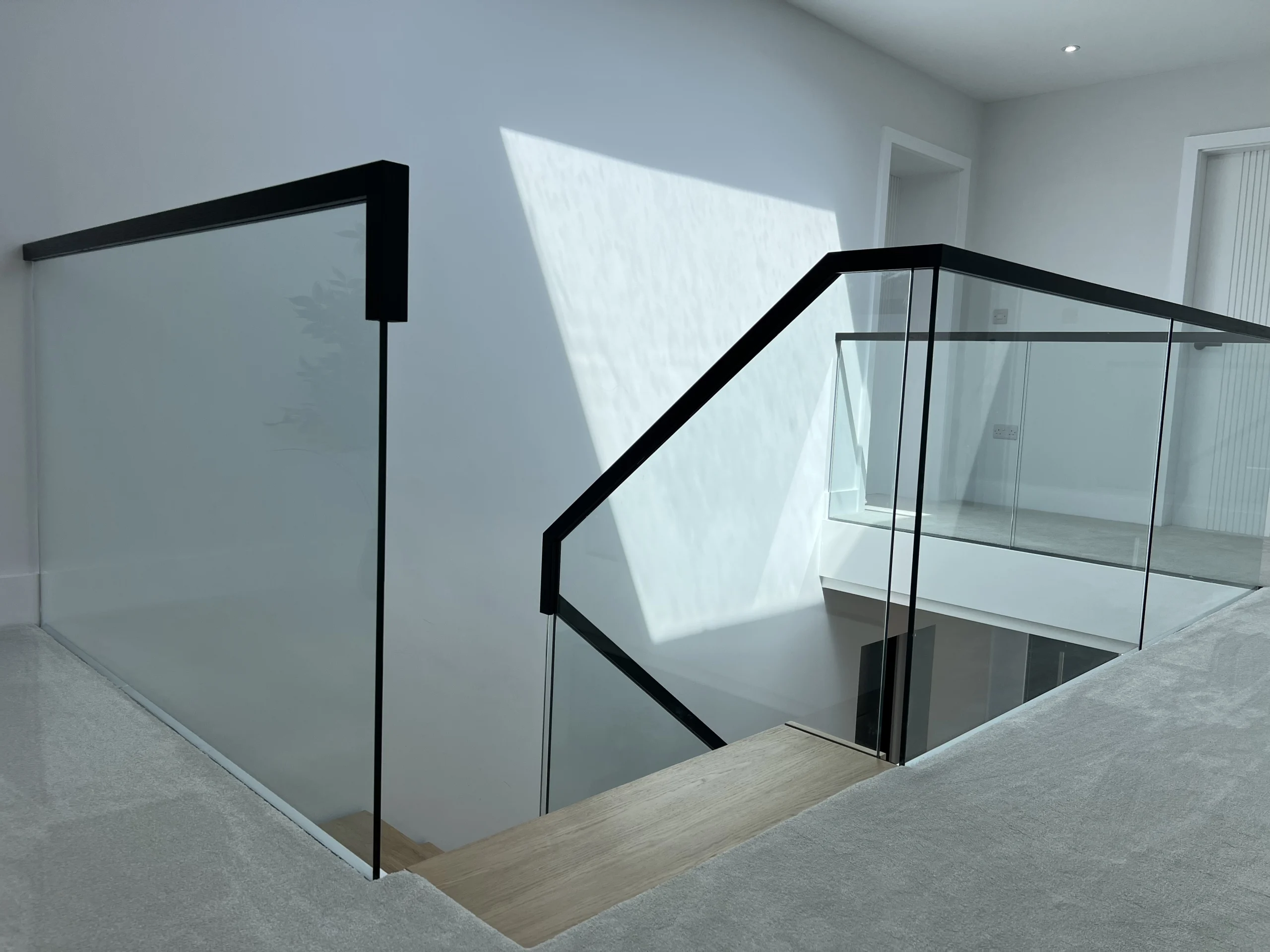
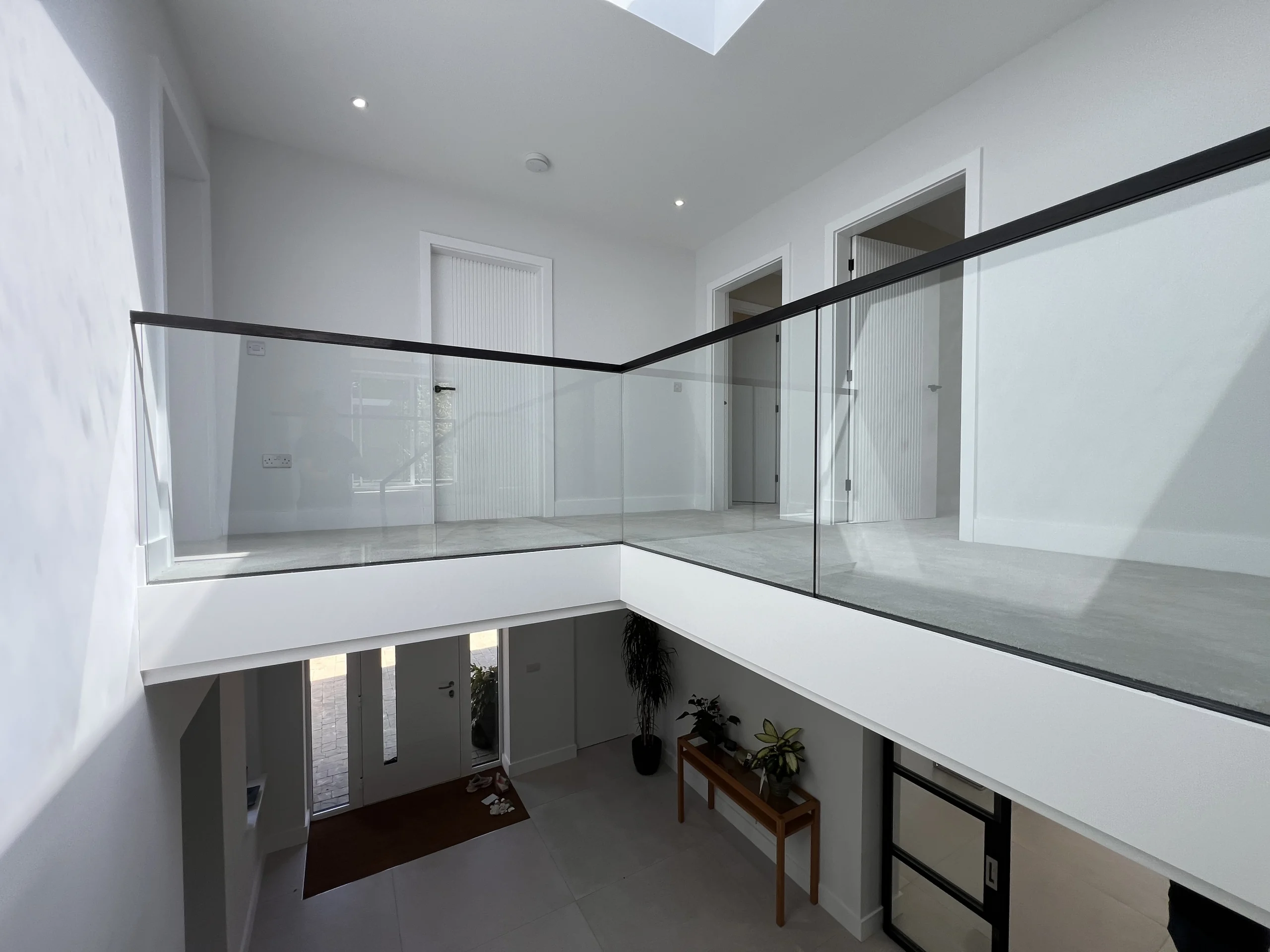
Kategorie B absturzsichernde Verglasung — VSG laminated glass with continuous Handlauf at top edge, the standard configuration for Mehrfamilienhaus communal landings, satisfying DIN 18008-4 Anhang B.3 with Pendelschlagversuch drop height 700 mm
For German architects, structural engineers and Brandschutzplaner specifying glass balustrades — whether internal Geländer for villa staircases, Mehrfamilienhaus communal Treppenraum balustrades, or französische Balkone (juliet balconies) — the central technical norm is DIN 18008-4:2024-12 "Glas im Bauwesen — Bemessungs- und Konstruktionsregeln — Teil 4: Zusatzanforderungen an absturzsichernde Verglasungen". The norm replaces the older TRAV (Technische Regeln für die Verwendung von absturzsichernden Verglasungen) issued by the DIBt in January 2003, while preserving the underlying three-Kategorien framework. Combined with the Geländerhöhe rules from DIN 18065, the Eurocode line load requirements (DIN EN 1991-1-1/NA), and the relevant Landesbauordnung absturzsichernde Bauteile provisions, German glass balustrade compliance is among the most rigorously regulated frameworks in Europe. This guide covers the eight technical factors driving every specification — Kategorien A/B/C definitions, Pendelschlagversuch impact testing, glass type selection (VSG, ESG, TVG, ESG-HF), Kantenschutz edge protection, line-supported vs point-fixed configurations, DIBt allgemeine Bauartgenehmigungen for non-standard designs, and how Continox supplies DIN 18008-4 compliant Geländer with the full Bauantrag pack. For the complementary staircase guide see our DIN 18065 Staircase Regulations Germany Guide; for use-classification framework see Notwendige vs Nicht Notwendige Treppen Guide; for the wider German market overview see /de/modern-staircase-germany/; and for the full UK product range see /glass-balustrade/, /balcony-railings/, /modern-staircase/ and /work/.
DIN 18008-4 classifies absturzsichernde Verglasungen into three Kategorien based on how the glass interacts with the building element protecting against falls. Kategorie A — glass alone provides fall protection (raumhohe Verglasung without Riegel/Holm); Kategorie B — glass with continuous Handlauf at top edge (the standard Geländer-with-handrail typology); Kategorie C — glass as Ausfachung (infill) only, with separate load-bearing structure (C1 with independent Handlauf, C2 with Riegel through glass, C3 with vorgesetzter Holm). Stoßsicherheit (impact safety) is verified by the Pendelschlagversuch (twin tyre pendulum impact test per EN 12600) at category-specific drop heights: Kat A = 900 mm, Kat B = 700 mm, Kat C = 450 mm. VSG (Verbund-Sicherheitsglas) is mandatory for Einfachverglasungen of Kat A and Kat B; Kat C permits more flexibility. Geländerhöhe minimum 90 cm (Δh ≤12 m) or 110 cm (Δh >12 m) per DIN 18065 + Landesbauordnung. Horizontalkraft minimum 500 N/m residential, 1.0–3.0 kN/m commercial per DIN EN 1991-1-1/NA.
- Regulatory Framework — DIN 18008-4 Replaces TRAV
- Factor 01 — The Three Kategorien (A, B, C)
- Factor 02 — Pendelschlagversuch Impact Testing
- Factor 03 — Glass Type Selection (VSG, ESG, TVG, ESG-HF)
- Factor 04 — Geländerhöhe & Lichter Abstand Rules
- Factor 05 — Linear vs Point-Fixed Lagerung
- Factor 06 — Kantenschutz Edge Protection
- Factor 07 — Horizontalkraft & Eurocode Line Loads
- Factor 08 — DIBt Allgemeine Bauartgenehmigung & ETA
- DIN 18008-4 vs Spanish CTE vs UK BS 6180
- How Continox Documents DIN 18008-4 Compliance
- FAQ — German Architects Ask
Regulatory Framework — DIN 18008-4 Replaces TRAV
Until 2014/15, German glass balustrade compliance was governed by the Technische Regeln für die Verwendung von absturzsichernden Verglasungen (TRAV) issued by the DIBt (Deutsches Institut für Bautechnik) in January 2003. TRAV was a bauaufsichtliche Regelung — formally introduced into the technical building provisions of each Bundesland via the Muster-Verwaltungsvorschrift Technische Baubestimmungen (MVV TB).
The TRAV framework was superseded by DIN 18008-4 when the new norm series came into force. The bauaufsichtliche legal basis transferred from the standalone TRAV document into the DIN 18008 family. The current edition is DIN 18008-4:2024-12, replacing the 2013-07 version with updated normative references, refined definitions, and clarifications based on a decade of practitioner experience.
Despite the formal replacement, the term TRAV-Verglasung remains widely used in everyday architectural practice in Germany. When a Bauamt, Brandschutzplaner or glazing specialist refers to "TRAV-Verglasung" today, they typically mean an absturzsichernde Verglasung complying with DIN 18008-4. The technical content is largely preserved — the Kategorien A/B/C, the Pendelschlagversuch testing, the VSG mandate for Kat B — all carry over from TRAV into DIN 18008-4 with relatively minor updates.
The Six Regulatory Layers for Glass Balustrades
| Document | Legal Status | What It Governs |
|---|---|---|
| DIN 18008-4:2024-12 | Bauaufsichtlich via MVV TB | Absturzsichernde Verglasungen — Kategorien A/B/C, Pendelschlagversuch, glass type rules |
| DIN 18008-1, -2, -3 | Bauaufsichtlich | Glass design fundamentals (Part 1), linear-supported glazing (Part 2), point-supported glazing (Part 3) |
| DIN 18065:2020-08 | Bauaufsichtlich | Geländerhöhe (90/110 cm), Lichter Abstand (≤12 cm), Handlauf dimensions |
| DIN EN 1991-1-1/NA | Eurocode + German national annex | Horizontalkraft / line loads — 500 N/m residential, 1.0–3.0 kN/m public/commercial |
| 16 Landesbauordnungen | State law | Brüstungshöhe variations (Bremen 50 cm, BW 60 cm), Geländer state-specific overrides |
| DIBt allgemeine Bauartgenehmigungen / ETA | Project-specific approval | Non-standard configurations beyond DIN 18008-4 (e.g. cantilevered structural glass per EAD 090040) |
The Three Kategorien (A, B, C)
DIN 18008-4 classifies absturzsichernde Verglasungen into three categories based on the structural role the glass plays in the fall protection system. Selecting the correct category at design stage is critical — it determines glass type, thickness, fixing method, edge protection, and Pendelschlagversuch test parameters.
Glass Alone Provides Fall Protection
Raumhohe Verglasung without Riegel or Holm at handrail height. The glass itself bears horizontal Nutzlasten and is the sole barrier. Includes both linienförmig gelagerte (linear) and punktförmig gelagerte (point-fixed) configurations.
Typical: floor-to-ceiling glass walls in Hotellobby, atria, glass façades without separate GeländerGlass With Continuous Handlauf
Glass supported at bottom (linear, in U-channel or clamp), with a continuous Handlauf at top edge connecting individual glass panes. The Handlauf carries horizontal Nutzlasten; the glass primarily resists impact (Pendelschlag) and panel forces.
Typical: villa staircase Geländer, balcony Geländer, Mehrfamilienhaus Treppenraum landing balustradesGlass as Ausfachung (Infill Only)
Glass infill panel that does not transfer horizontal loads — load transfer goes through the surrounding structure. Three sub-types: C1 (independent Handlauf), C2 (Riegel through glass at handrail height), C3 (vorgesetzter Holm in front of glass).
Typical: framed Geländer with steel frame and glass infill, Pfosten-Riegel facades, Geländer with horizontal mid-rail through glassSub-Categories of Kategorie C
Kategorie C is further subdivided by the type of supplementary load-bearing element:
- Kategorie C1 — Glass infill panels for Geländer or Brüstungen with an independent Handlauf not connected to the glass. Glass takes only its own self-weight + impact load. Typical Mehrfamilienhaus Geländer with steel posts and continuous handrail above.
- Kategorie C2 — Glass with a Riegel (transom) passing through the glass at the required handrail height. The Riegel breaks the glass plane horizontally and acts as the primary horizontal-load bearer. Typical Pfosten-Riegel facades.
- Kategorie C3 — Glass with a vorgesetzter Holm (front-mounted handrail) positioned in front of the glass at handrail height. The Holm bears horizontal loads, glass remains continuous. Typical bodentiefe Verglasungen (floor-to-ceiling glazing) with separate horizontal handrail.
Most modern villa and Mehrfamilienhaus Geländer applications fall into Kategorie B (with continuous Handlauf). Continox's standard frameless laminated glass Geländer with oak or stainless steel Handlauf typically specifies as Kat B. Pure Kat A frameless Geländer (no Handlauf) requires significantly thicker laminated glass build-up — typically 2 × 12 mm ESG with PVB interlayer minimum — and is more common in commercial atria than residential settings.
Frameless glass Geländer at landing — point-fixed VSG laminated glass configuration, satisfying DIN 18008-4 Kategorie A requirements with Pendelschlagversuch drop height 900 mm verification, typical specification for villa atrium and prestige landing applications
Pendelschlagversuch — Impact Testing
The Pendelschlagversuch (pendulum impact test) is the German standard for verifying Stoßsicherheit (impact safety) of absturzsichernde Verglasungen. The test method follows EN 12600 with the German DIN 18008-4 Anhang specifying the application criteria. The test simulates a person falling against the glass — the impactor is a twin tyre pendulum released from a category-specific drop height.
Test Configuration
Pendelschlagversuch — Test Parameters per DIN 18008-4
- Impactor: Twin tyre pendulum (50 kg total mass, EN 12600 specification)
- Drop heights: Kat A = 900 mm, Kat B = 700 mm, Kat C = 450 mm
- Number of impacts: 2 impacts at the most unfavourable hit point
- Hit point selection: Per DIN 18008-4 Anhang B (linear) or Anhang B.2 (point-fixed) — typically panel centre and edge midpoint
- Failure criteria: Pane must not break OR after granular breakage must retain Resttragfähigkeit (residual load capacity) — verified with secondary impact at 100 mm drop height
- Edge protection test: 10 Nm (Kat C) or 20 Nm (Kat A, B) steel ball impact on accessible edges before twin tyre test
Resttragfähigkeit (Residual Load-Bearing Capacity)
A critical innovation in DIN 18008-4 versus older TRAV is the explicit requirement for Resttragfähigkeit after glass breakage. The norm specifies that even after the glass breaks under impact:
- Bruchstücke (fragments) must remain held together in the laminate (Splitterbindung)
- The pane must not fall as a single unit from the fixings
- Personen must not be seriously injured by herabfallende Bruchstücke (falling fragments)
- The Standsicherheit of the system must be preserved sufficient for evacuation
Pendelschlag Verification Routes
DIN 18008-4 provides three alternative verification paths:
- Anhang A — Bauteilversuche (component testing): Full-scale Pendelschlagversuch of the actual configuration. The most rigorous and most expensive route, typically required for non-standard configurations.
- Anhang B — Tabulated configurations: Standard configurations (panel size, glass build-up, support type) listed in DIN 18008-4 tables that have been pre-verified. Most projects use this route for both linear-supported (B.1) and point-fixed (B.2) Kat A and Kat C, plus Kat B (B.3).
- Anhang C — Calculation methods: Numerical analysis using validated material models. Used for unusual panel sizes or hybrid build-ups.
Exemption — Narrow Panes
For glass panes narrower than 300 mm (Kat A) or 500 mm (Kat B and C), no Pendelschlagversuch verification is required. The narrow geometry inherently limits impact energy distribution. This exemption is sometimes useful for narrow Geländer corner panels and stair turn details — but the rest of the panel still requires verification.

Glass Type Selection — VSG, ESG, TVG, ESG-HF
DIN 18008-4 specifies which glass types are permitted for each Kategorie. The selection follows from the requirement that broken glass must not produce hazardous fragments and that absturzsichernde Verglasungen must retain Resttragfähigkeit.
The Four German Safety Glass Types
| Type | German Name | Description | Breakage Behaviour |
|---|---|---|---|
| VSG | Verbund-Sicherheitsglas | Laminated safety glass — typically two glass panes bonded with PVB or SentryGlas interlayer | Glass breaks but fragments remain held by interlayer; high Resttragfähigkeit |
| ESG | Einscheiben-Sicherheitsglas | Toughened safety glass — heat-treated for ~5× annealed strength | Breaks into small Krümel (granules); poor Resttragfähigkeit alone |
| TVG | Teilvorgespanntes Glas | Heat-strengthened glass — partially toughened (2× annealed strength) | Breaks into larger fragments than ESG; better as VSG component than alone |
| ESG-HF | Heißgelagertes Einscheiben-Sicherheitsglas | ESG + heat-soak test (HST) for nickel sulphide (NiS) inclusion screening | Same as ESG but with NiS spontaneous breakage risk reduced |
Permitted Glass Types per Kategorie
DIN 18008-4 — Glass Type Rules by Kategorie
- Kategorie A — Einfachverglasung: VSG only (mandatory)
- Kategorie A — Mehrscheiben-Isolierverglasung: Minimum one pane must be VSG; angriffsseitige (impact-side) pane requires VSG
- Kategorie B — Einfachverglasung: VSG only (mandatory)
- Kategorie B — Mehrscheiben-Isolierverglasung: Both panes must be VSG (because the Handlauf protects only against falls, not impact)
- Kategorie C — Einfachverglasung: VSG, ESG, TVG, or ESG-HF permitted depending on configuration
- Kategorie C — Multi-pane Isolierverglasung: Angriffsseitige Scheibe minimum VSG, ESG or VSG-aus-ESG; backside pane has flexibility
Why VSG is Mandatory for Kategorie A and B
VSG with PVB interlayer is the only glass type that retains full Resttragfähigkeit after impact-induced breakage. ESG alone — despite its 5× breakage strength — fails catastrophically into Krümel that may not retain the broken pane in position; the entire pane can fall as a unit, leaving a fall hazard. For Kategorie A (glass alone provides fall protection) and Kategorie B (glass with Handlauf), this Resttragfähigkeit requirement makes VSG the only acceptable Einfachverglasung.
VSG Build-Up Recommendations
Continox's standard VSG build-ups for German projects:
- Kat B residential Geländer: 8.8.2 VSG (2 × 8 mm float + 1.52 mm PVB) — 17.52 mm total nominal
- Kat B Mehrfamilienhaus communal: 10.10.2 VSG (2 × 10 mm float + 1.52 mm PVB) — 21.52 mm total
- Kat A frameless atrium: 12.12.4 VSG (2 × 12 mm ESG + 1.52 mm PVB) — typically with low-iron upgrade for clarity
- Kat A point-fixed (Tellerhalter): 2 × 10 mm ESG + 1.52 mm PVB (DIN 18008-3 + DIN 18008-4 verification)
- Kat C1 infill: 8.8.2 VSG or 10 mm ESG-HF with edge protection
Heat-Soak Test (HST) for ESG
Standard ESG carries a small but non-negligible risk of spontaneous breakage from nickel sulphide (NiS) inclusions — a manufacturing defect that can cause failure years after installation. The Heat-Soak-Test per DIN EN 14179-1 sorts the manufactured ESG glass at 290°C for 4 hours, eliminating most NiS-defective panes before installation. ESG-HF (heißgelagert) designation indicates HST has been performed.
For Mehrfamilienhaus, public concurrence and high-rise applications where spontaneous breakage would create significant safety risk, ESG-HF is the standard specification. Continox specifies ESG-HF as default for all Kategorie A and Kategorie C projects in Germany requiring ESG components.
Geländerhöhe & Lichter Abstand Rules
The dimensional Geländer rules sit in DIN 18065:2020-08 and the relevant Landesbauordnung — DIN 18008-4 governs the glass technical requirements but defers to these other documents for height and gap dimensions.
Geländerhöhe (Height)
| Fall Height (Δh) | Min Geländerhöhe | Source | Application |
|---|---|---|---|
| > 100 cm and ≤ 12 m | ≥ 90 cm | DIN 18065 | Standard residential and most public |
| > 12 m | ≥ 110 cm | DIN 18065 | High-rise, atria, mall mezzanines |
| < 100 cm | Not strictly required | DIN 18065 | Geländer recommended but not mandatory |
Lichter Abstand (Clear Gap)
For glass balustrades, the Lichter Abstand (clear gap) rules govern any gaps in the balustrade — between the glass edge and adjacent structure, between glass panels, between the glass top edge and the Handlauf. Where unsupervised young children may be present (essentially all Wohnungsbau and Mehrfamilienhäuser):
- Lichter Abstand maximum 12 cm in any direction
- Applies up to 60–70 cm above floor level (the height a young child can reach)
- Frameless glass balustrades inherently satisfy this rule on the panel itself; the rule applies to gaps at edges and between panels
Erschwernis gegen das Überklettern (Climbability Prevention)
For Gebäude im Allgemeinen, the Geländer must include Erschwernis gegen das Überklettern — features impeding climbing by unsupervised young children. DIN 18065 describes this as avoiding horizontal climbable elements between 30 cm and 70 cm above floor level. Frameless glass balustrades inherently satisfy this — the continuous vertical glass face has no climbable horizontal elements. Multi-rail or post-and-rail systems must be designed carefully to avoid climbable horizontals in this zone.
Bundesland-Specific Variations — Brüstungshöhe
The Brüstungshöhe (parapet height for floor-to-ceiling Verglasung) varies by Bundesland: Bremen — 50 cm, Baden-Württemberg — 60 cm, most other Bundesländer — 70 cm (per DIN 18065 example), Bavaria — varies by Wohnungstyp. Continox engineers verify the applicable Brüstungshöhe at enquiry stage from the relevant LBO and applies it to the Geländer specification.
Linear vs Point-Fixed Lagerung
DIN 18008-4 distinguishes between two fundamental glass support mechanisms — linienförmige Lagerung (linear support) and punktförmige Lagerung (point-fixed support) — each governed by its parent norm and with different design rules.
Linienförmige Lagerung — DIN 18008-2
Linear support means the glass is held continuously along one or more edges:
- U-channel base fixing (Bodenprofil): Most common for Kat B Geländer — glass slot-fitted into stainless steel or aluminium U-channel at base
- Pressleisten (clamping bars): Glass held between continuous strips top and bottom or sides, typically in commercial Pfosten-Riegel
- Schrauben-Pressleisten: Bolted clamping with maximum Schraubenabstand 300 mm in the Glashalteleiste per DIN 18008-2
Linear support distributes loads along the entire fixed edge, allowing relatively thin glass (8.8 VSG or 10.10 VSG) for residential Geländer. Engineering verification follows DIN 18008-1 (general) and DIN 18008-2 (linear-specific) plus DIN 18008-4 for the absturzsichernde requirements.
Punktförmige Lagerung — DIN 18008-3
Point-fixed support means the glass is held by individual fixings (typically Tellerhalter — disc holders, sometimes Klemmhalter — clamp holders, or bolt-through Senkkopfhalter):
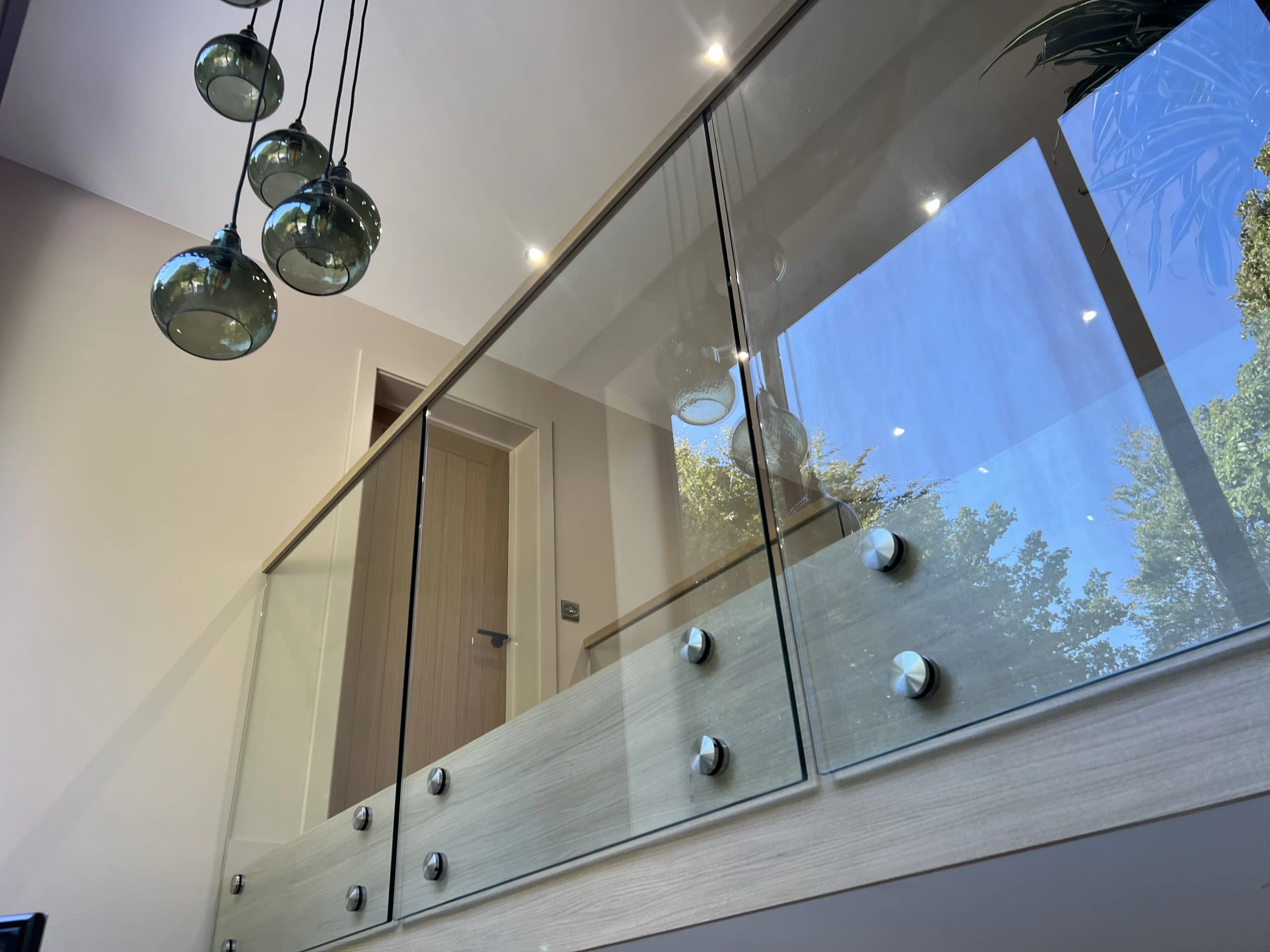
- Tellerhalter (disc holders): Stainless steel discs typically 50 mm diameter, with Glashalterungen at axis distances ≤1200 mm; for axis distances >1200 mm minimum diameter increases to 70 mm
- Charakteristische Tragkraft: Per fixing minimum 2.8 kN for Kategorie A point-fixed configurations
- Senkkopfhalter (countersunk through-bolt): Glass with countersunk bores, fixings recessed flush with glass face
- Lagesicherung mit Tellerhaltern: When VSG is held by Tellerhalter per DIN 18008-3, the Kantenschutz (edge protection) requirement may be waived
Point-fixed configurations are visually striking but engineering-intensive — typical specification for villa atria, prestige Mehrfamilienhaus lobbies and statement public buildings. The glass must include drilled bores, which weakens the panel locally; thicker laminated build-ups (typically 2 × 10 mm ESG VSG) compensate.
Linear vs Point-Fixed — Design Choice
| Aspect | Linienförmig (Linear) | Punktförmig (Point-Fixed) |
|---|---|---|
| Visual aesthetic | Top + bottom rail visible | Most transparent — minimal visible structure |
| Glass thickness | Standard (8.8.2 or 10.10.2 VSG) | Heavier (2 × 10–12 mm ESG VSG) |
| Engineering complexity | Lower | Higher |
| Cost | €350–€450/m typical | €450–€700/m typical |
| Edge protection (Kantenschutz) | Required (typically integral to U-channel) | Required, except when Tellerhalter per DIN 18008-3 |
| Application sweet spot | Standard residential, Mehrfamilienhaus communal | Villa atria, prestige Lobby, atrium glazing |
Kantenschutz — Edge Protection
Glass edges are the weakest point of any absturzsichernde Verglasung. DIN 18008-4 requires Kantenschutz (edge protection) for Kategorie A and Kategorie C glazings to prevent stoßartige (impact) damage. The protection requirement is detailed in Anhang B of the norm.
Kantenschutz Requirements
- All accessible edges (zugängliche Kanten) must be protected against impact
- Distance ≤30 mm between glass edge and adjacent protective structure (Pfosten, Riegel, Wand, benachbarte Scheibe)
- Kantenschutzprofile — dauerhaft ausreichend widerstandsfähige (durably sufficiently resistant) profiles
- Steel ball test: Pre-Pendelschlag verification with 10 Nm (Kat C) or 20 Nm (Kat A, B) steel ball at edge protection points
Sample Kantenschutz Configurations
DIN 18008-4 Anhang B includes Musterkantenschutzprofile (sample edge protection profiles) — pre-verified configurations that don't require additional testing:
- U-shaped stainless steel cap profile — 2 mm wall thickness, covering glass edge plus 30 mm onto each face
- Aluminium edge cap with EPDM gasket — for outdoor exposed Kantenschutz
- Steel L-section corner protection — for vertical glass-to-wall transitions
- Pfosten-integrated edge protection — when glass meets a steel post directly with appropriate gasket
Kantenschutz Exemption — Tellerhalter
Per DIN 18008-4: "Sofern Verbundsicherheitsgläser durch Tellerhalter nach DIN 18008-3 lagegesichert sind, kann auf die Verwendung eines Kantenschutzes verzichtet werden." When VSG is point-fixed by Tellerhalter complying with DIN 18008-3, the Kantenschutz requirement is waived. This is the engineering basis for Continox's frameless point-fixed atrium specifications — the Tellerhalter system inherently protects edges against impact through the laminated PVB interlayer's load transfer.
Schraubenabstand and Halter Geometry
DIN 18008-4 Fixing Geometry Rules
- Linear support — Schraubenabstand: Maximum 300 mm in Glashalteleiste
- Point-fixed Tellerhalter — Diameter: Minimum 50 mm; if axis distance >1200 mm, minimum 70 mm
- Point-fixed — Charakteristische Tragkraft: Minimum 2.8 kN per Glashalterung
- Point-fixed — Bohrungen und Ausschnitte: Not permitted in glass for Kategorie A configurations except at the Tellerhalter locations
- Tellerhalter axis distance: Maximum 1200 mm typical; greater spacings require larger diameter discs
Horizontalkraft & Eurocode Line Loads
While DIN 18008-4 governs the glass technical requirements, the structural loading on the Geländer is specified by DIN EN 1991-1-1/NA (Eurocode 1 — Actions on structures, with German national annex). The Eurocode line loads vary by use category and apply to the Handlauf or top edge of the Geländer at the required Geländerhöhe.
Horizontalkraft Categories
| Use Category (DIN EN 1991-1-1/NA) | Horizontalkraft (Line Load) | Typical Application |
|---|---|---|
| Kategorie A — Wohnflächen | 0.5 kN/m | Villa Geländer, Mehrfamilienhaus internal Wohnungen |
| Kategorie B — Bürogebäude | 1.0 kN/m | Office buildings, professional services |
| Kategorie C1–C3 — Versammlung mit Sitzplätzen | 1.0 kN/m | Theatre, concert hall, classroom |
| Kategorie C4 — Sport, Tanz | 2.0 kN/m | Sports halls, gymnasiums |
| Kategorie C5 — Versammlung Stehplätze | 3.0 kN/m | Sports stadium, festival venue |
| Kategorie D — Verkaufsräume | 0.8 kN/m | Retail, shopping centre |
| Kategorie E — Lagerflächen | 2.0 kN/m | Warehouse, industrial |
| DIN 18065 minimum | 0.5 kN/m (500 N/m) | Floor for residential Geländer per DIN 18065 |
Worked Example — Munich Mehrfamilienhaus Communal Geländer
Mehrfamilienhaus communal Treppenraum balustrade specification:
- Use category: A (Wohnflächen) — but the communal stair serves multiple apartments → some Brandschutzplaner specify Kategorie C1 (Versammlung mit Sitzplätzen) for safety margin → 1.0 kN/m
- Δh: 9 m above ground at top floor → Geländerhöhe 90 cm
- Horizontalkraft applied at: 90 cm above tread surface
- Pendelschlag verification: Kategorie B with Handlauf → drop height 700 mm, twin tyre 50 kg
- Glass specification: 10.10.2 VSG (10 mm float + 1.52 mm PVB + 10 mm float)
- Lichter Abstand: ≤12 cm at all gaps and edges
- Resttragfähigkeit: Verified — VSG retains broken-pane carrying capacity for evacuation period
Eurocode Vertical & Pendelschlag Combination
For staircase Geländer, DIN EN 1991-1-1/NA also specifies vertical loads on the Handlauf — typically 0.5 kN concentrated load downward or upward. The Geländer must satisfy both static (line load + concentrated load combinations) and dynamic (Pendelschlag impact) load cases independently. Continox structural calculations verify both governing cases for every German project.
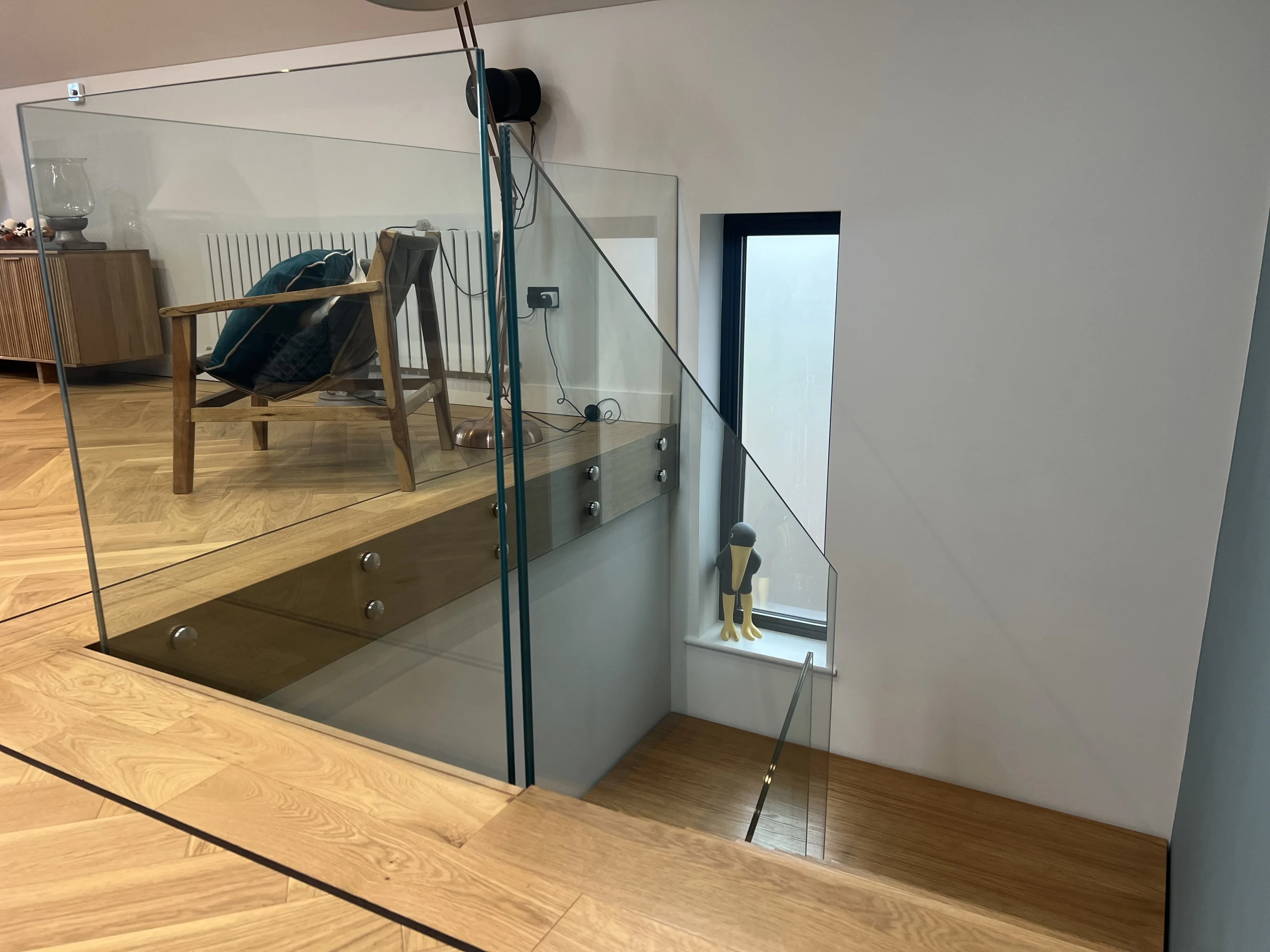
Frameless internal glass Geländer satisfying DIN 18008-4 Kategorie A — VSG laminated build-up with point-fix Tellerhalter, Lichter Abstand ≤12 cm at every gap, Geländerhöhe 90 cm verified per DIN 18065
DIBt Allgemeine Bauartgenehmigung & ETA
Where a glass balustrade configuration deviates significantly from DIN 18008-4 — for example a fully cantilevered structural glass railing without any Handlauf or top fixing, or a unique Tellerhalter geometry — additional approval is required from the DIBt (Deutsches Institut für Bautechnik).
Allgemeine Bauartgenehmigung (aBG)
The DIBt issues allgemeine Bauartgenehmigungen (general construction technique approvals) for non-standard configurations that satisfy the building regulations through alternative engineering means. The aBG references the project-specific test data and engineering analysis, providing legal certainty to the Bauamt that the unusual configuration meets equivalent safety performance.
European Technical Assessment (ETA)
For products without harmonised European product norms, manufacturers can obtain a European Technical Assessment (ETA) based on the relevant European Assessment Document (EAD). The most relevant for glass balustrades:
- EAD 090040-00-0404 — "Cantilevered structural glass railing/balustrade" (March 2016, Decision EU 2022/381) — covers einseitig eingespannte Brüstungsverglasungen (one-side clamped balustrade glazing) where the glass is the sole structural element
- EAD documents for Tellerhalter — specific to point-fix glass holding systems
- EAD documents for Pfosten-Riegel-Konstruktionen — facade systems
When DIBt Approval is Needed
Most standard Continox Geländer configurations (linear-supported Kat B with Handlauf, point-fixed Kat A with Tellerhalter, framed Kat C1 with independent handrail) fit within DIN 18008-4 Anhang B tabulated configurations and do not require DIBt aBG. DIBt approval becomes relevant for:
- Cantilevered structural glass without top Handlauf and without Tellerhalter (pure clamped-base configuration)
- Unusually large panel sizes beyond Anhang B tables
- Hybrid build-ups not listed in DIN 18008-4 (e.g. SentryGlas + ESG combinations not in tables)
- Custom fixing geometries beyond standard Tellerhalter / Klemmhalter ranges
For these cases, Continox coordinates with the project's Brandschutzplaner and structural engineer to obtain the appropriate DIBt approval before manufacture. Lead times for aBG are typically 8–12 weeks — these configurations should be specified during Vorentwurfsplanung phase, not during late Ausführungsplanung.
DIN 18008-4 vs Spanish CTE vs UK BS 6180
German architects working on Spanish or UK projects (or vice versa) need to compare DIN 18008-4 against CTE DB-SUA (Spain) and BS 6180 (UK) frameworks for glass balustrades. The three regulations cover the same protective intent but differ in classification structure and testing methodology.
| Aspect | Germany — DIN 18008-4 | Spain — CTE DB-SUA | UK — BS 6180:2011 |
|---|---|---|---|
| Primary classification | 3 Kategorien (A, B, C with C1/C2/C3) | Use class (residential / commercial) | Loading category (1, 2, 3, 4, 5) |
| Impact test method | Pendelschlagversuch EN 12600 (twin tyre 50 kg) | Pendulum impact UNE EN 12600 | BS EN 12600 + Class A/B/C classification |
| Drop heights (Class A typical) | Kat A: 900 mm, Kat B: 700 mm, Kat C: 450 mm | ~1200 mm for safety classification | 1200 mm for Class A glass |
| Min Geländerhöhe (typical residential) | 90 cm (Δh ≤12 m) | 90 cm (Δh ≤6 m) | 900 mm internal landings |
| Min Geländerhöhe (high) | 110 cm (Δh >12 m) | 110 cm (Δh >6 m) | 1100 mm landings (some cases) |
| Sphere/gap rule | Lichter Abstand ≤120 mm | Ø100 mm sphere rule | Ø100 mm sphere rule |
| Horizontal load (residential) | 500 N/m (DIN EN 1991-1-1/NA) | 800 N/m (CTE DB-AE) | 740 N/m (BS EN 1991-1-1) |
| Mandatory laminated for fall protection | VSG mandatory (Kat A + B) | Laminated mandatory residential | Class A laminated mandatory |
| National approval body | DIBt (allgemeine Bauartgenehmigung) | Marcado CE + DIT | UKCA mark + structural calcs |
Key practical differences:
- Germany has the lowest Pendelschlag drop heights (450–900 mm) — Spain and UK use 1200 mm for top safety class. This reflects Germany's use of separate categories for different protective roles rather than a single highest-class test
- Germany's 12 m fall threshold for 110 cm Geländerhöhe is more permissive than Spain's 6 m — German residential buildings less commonly trigger the 1100 mm height
- Germany permits 120 mm Lichter Abstand vs 100 mm sphere rule in Spain/UK — slightly more permissive on baluster spacing
- Germany's Kategorie distinction (A/B/C) creates explicit design pathways that the Spanish and UK systems handle implicitly through configuration choice
A glass balustrade designed to satisfy DIN 18008-4 Kat B with VSG laminated build-up will satisfy CTE DB-SUA and BS 6180 in nearly all cases. For deeper Spanish reference see our Glass Balustrade Regulations Spain CTE Guide.
How Continox Documents DIN 18008-4 Compliance
For every Continox glass balustrade supplied to Germany, the technical pack includes a comprehensive DIN 18008-4 compliance schedule:
Continox Glass Balustrade Compliance Pack
- Kategorie declaration: A / B / C1 / C2 / C3 with rationale and structural drawing
- Glass specification: VSG / ESG / TVG / ESG-HF build-up (e.g. 8.8.2 VSG with 1.52 mm PVB) per Kategorie requirements
- Pendelschlagversuch verification route: Anhang A (component test) / Anhang B (tabulated, with table reference) / Anhang C (calculation)
- Resttragfähigkeit confirmation: VSG configuration retains residual capacity after Pendelschlag impact
- Lagerung type: Linienförmig (DIN 18008-2) or punktförmig (DIN 18008-3) with fixing specification
- Geländerhöhe: 90 cm or 110 cm per DIN 18065 + Δh verification
- Lichter Abstand: Maximum gap dimensions verified ≤12 cm in any direction
- Horizontalkraft Eurocode: Line load applied at handrail height per DIN EN 1991-1-1/NA use category
- Kantenschutz specification: Edge protection profiles per Anhang B Musterkantenschutz, or Tellerhalter exemption justification
- EN 14449 + EN 12150 / EN 12600 certificates: Glass marcado CE + Declaration of Performance
- EN 1090-1 EXC2 Declaration of Performance: Steel components (Pfosten, Handlauf, Tellerhalter)
- DIBt allgemeine Bauartgenehmigung / ETA: Where applicable for non-standard configurations
- Landesbauordnung-specific Brüstungshöhe: 50 cm Bremen / 60 cm BW / 70 cm standard etc
- Compliance pack signature: UK Chartered Structural Engineer (IStructE)
The pack supports the German-registered architect's Bauantrag submission to the relevant Bauamt and integrates into the Brandschutzkonzept. Final compliance verification, Bauabnahme by the Bauamt and any required Standsicherheitsbescheinigung remain the legal responsibility of the project's German-registered architect or Bauleiter.
Specifying Glass Balustrades for a German Project?
From €350/m framed and €450/m frameless, delivered across all 16 Bundesländer with full DIN 18008-4 compliance pack — Kategorie declaration, Pendelschlagversuch verification, glass build-up specification, EN 14449/12150/12600 certificates, EN 1090-1 EXC2 DoP, Landesbauordnung-specific Brüstungshöhe. Free 3D visualisation, fixed-price quote within 48 hours, intra-EU supply (1–3 working days).
Get Free QuoteFAQ — German Architects Ask
What is DIN 18008-4 and how does it relate to TRAV?
DIN 18008-4:2024-12 "Glas im Bauwesen — Bemessungs- und Konstruktionsregeln — Teil 4: Zusatzanforderungen an absturzsichernde Verglasungen" is the central German technical norm for fall-protection glazings. It superseded the older TRAV (Technische Regeln für die Verwendung von absturzsichernden Verglasungen) issued by the DIBt in January 2003. The Kategorien A/B/C framework, Pendelschlagversuch testing methodology, VSG mandate for Kategorie A and B, and edge protection rules carry over substantially unchanged from TRAV into DIN 18008-4. The term "TRAV-Verglasung" remains in everyday architectural use to mean "absturzsichernde Verglasung complying with DIN 18008-4".
What's the difference between Kategorie A, B and C?
Kategorie A — glass alone provides fall protection (raumhohe Verglasung without Riegel or Handlauf). Glass takes horizontal Nutzlasten directly. Pendelschlag drop height 900 mm. Kategorie B — glass with continuous Handlauf at top edge connecting individual panes; Handlauf carries horizontal Nutzlasten while glass resists impact. Pendelschlag drop height 700 mm. Kategorie C — glass as Ausfachung (infill) only; surrounding structure carries horizontal loads. Three sub-types: C1 (independent Handlauf), C2 (Riegel through glass), C3 (vorgesetzter Holm). Pendelschlag drop height 450 mm. Most modern villa Geländer applications fall into Kat B; Kat A is more common in commercial atria; Kat C is typical for framed glazing systems.
What is the Pendelschlagversuch and how does it work?
The Pendelschlagversuch is the German pendulum impact test for verifying Stoßsicherheit (impact safety) of absturzsichernde Verglasungen. The test method follows EN 12600 — a 50 kg twin tyre pendulum is released from a category-specific drop height (900 mm Kat A, 700 mm Kat B, 450 mm Kat C) and impacts the glass at the most unfavourable hit point. Two impacts at the same point. Failure criteria: pane must not break, OR if broken must retain Resttragfähigkeit (residual capacity) verified by secondary impact at 100 mm drop. Edge protection is pre-tested with steel ball impact (10 Nm Kat C, 20 Nm Kat A/B). DIN 18008-4 provides three verification routes: Anhang A (full component testing), Anhang B (tabulated pre-verified configurations — most common), Anhang C (calculation methods).
Which glass type do I need — VSG, ESG, TVG, or ESG-HF?
VSG (Verbund-Sicherheitsglas — laminated) is mandatory for Kategorie A and Kategorie B Einfachverglasungen because only VSG retains Resttragfähigkeit after impact-induced breakage. ESG (Einscheiben-Sicherheitsglas — toughened) alone is not permitted for Kat A or B because broken ESG fails as a unit and may fall from fixings. TVG (teilvorgespanntes Glas — heat-strengthened) is typically used as a component within VSG laminates for additional strength. ESG-HF (heißgelagert — heat-soak tested) is ESG with NiS spontaneous breakage screening per DIN EN 14179-1; standard for Mehrfamilienhaus and high-rise applications. Continox specifies ESG-HF as default for all Kat A and Kat C projects in Germany requiring ESG components.
What's the minimum Geländerhöhe and Lichter Abstand?
Per DIN 18065:2020-08: Geländerhöhe minimum 90 cm where fall height (Δh) is between 1 m and 12 m, increasing to 110 cm where Δh exceeds 12 m. The Lichter Abstand (clear gap) maximum 12 cm in any direction wherever unsupervised young children may be present (essentially all Wohnungsbau and Mehrfamilienhäuser), applying up to 60–70 cm above floor level. Frameless glass balustrades inherently satisfy the Lichter Abstand rule on the panel itself. Brüstungshöhe (parapet for floor-to-ceiling Verglasung) varies by Bundesland: Bremen 50 cm, Baden-Württemberg 60 cm, most others 70 cm. Continox engineers verify the applicable state-specific Brüstungshöhe at enquiry stage.
What's the Horizontalkraft requirement for residential vs commercial?
Per DIN EN 1991-1-1/NA (Eurocode 1 with German national annex): Kategorie A — Wohnflächen: 0.5 kN/m (500 N/m) — villa Geländer, Mehrfamilienhaus internal Wohnungen. Kategorie B — Bürogebäude: 1.0 kN/m. Kategorie C1–C3 — Versammlung mit Sitzplätzen: 1.0 kN/m. Kategorie C4 — Sport/Tanz: 2.0 kN/m. Kategorie C5 — Versammlung Stehplätze: 3.0 kN/m. Kategorie D — Verkaufsräume: 0.8 kN/m. Kategorie E — Lagerflächen: 2.0 kN/m. The Horizontalkraft is applied at handrail height (90 cm or 110 cm depending on Δh). DIN 18065 specifies 500 N/m as residential floor; Eurocode use category provides the project-specific value.
When do I need a DIBt allgemeine Bauartgenehmigung?
Most standard Continox Geländer configurations (linear-supported Kat B with Handlauf, point-fixed Kat A with Tellerhalter complying with DIN 18008-3, framed Kat C1) fit within DIN 18008-4 Anhang B tabulated pre-verified configurations and do not require DIBt aBG. DIBt allgemeine Bauartgenehmigung becomes relevant for: cantilevered structural glass without top Handlauf and without Tellerhalter (pure clamped-base configuration — see EAD 090040-00-0404), unusually large panel sizes beyond Anhang B tables, hybrid glass build-ups not listed in tables, custom fixing geometries beyond standard Tellerhalter ranges. DIBt aBG lead times are 8–12 weeks — these configurations should be specified during Vorentwurfsplanung phase.
What's the difference between linear and point-fixed Lagerung?
Linienförmige Lagerung (linear support) — glass continuously held along one or more edges (U-channel base fixing, Pressleisten, Schrauben-Pressleisten) per DIN 18008-2. Maximum Schraubenabstand 300 mm in Glashalteleiste. Loads distribute along entire fixed edge — relatively thin glass acceptable (8.8.2 or 10.10.2 VSG). Standard residential cost €350–€450/m. Punktförmige Lagerung (point-fixed support) — glass held by individual fixings per DIN 18008-3 (Tellerhalter, Klemmhalter, Senkkopfhalter). Tellerhalter minimum 50 mm diameter, charakteristische Tragkraft minimum 2.8 kN per fixing, maximum axis distance ~1200 mm. Point-fixed visually striking but engineering-intensive — typical specification for villa atria and prestige buildings, cost €450–€700/m. When VSG is point-fixed by Tellerhalter, Kantenschutz (edge protection) requirement may be waived.
What is Resttragfähigkeit and why does it matter?
Resttragfähigkeit (residual load-bearing capacity) is a critical innovation in DIN 18008-4 vs older TRAV. The norm requires that even after the glass breaks under Pendelschlag impact: Bruchstücke (fragments) must remain held together in the laminate (Splitterbindung), the pane must not fall as a single unit from the fixings, Personen must not be seriously injured by herabfallende Bruchstücke, and the Standsicherheit must be preserved sufficient for evacuation. This is why VSG (with PVB or SentryGlas interlayer) is mandatory for Kategorie A and B — only VSG retains full Resttragfähigkeit after breakage. ESG alone, despite higher breakage strength, fails as a unit and cannot satisfy this requirement.
How does Continox handle DIN 18008-4 documentation?
Continox supplies a full DIN 18008-4 compliance pack with every German project: Kategorie declaration with rationale, glass specification (VSG/ESG/TVG/ESG-HF build-up per Kategorie), Pendelschlagversuch verification route (Anhang A/B/C with table reference where applicable), Resttragfähigkeit confirmation, Lagerung type (linear DIN 18008-2 or point-fixed DIN 18008-3) with fixing spec, Geländerhöhe verification per DIN 18065 + Δh, Lichter Abstand maximum gap verification, Horizontalkraft Eurocode line load per use category, Kantenschutz specification or Tellerhalter exemption justification, EN 14449/EN 12150/EN 12600 marcado CE certificates, EN 1090-1 EXC2 Declaration of Performance, DIBt allgemeine Bauartgenehmigung where applicable, and Landesbauordnung-specific Brüstungshöhe. Final Bauabnahme remains the legal responsibility of the project's German-registered architect.
Ready to Specify a DIN 18008-4 Compliant Glass Balustrade?
From villa Kategorie B with Handlauf to Mehrfamilienhaus communal Geländer, frameless atrium Kategorie A with Tellerhalter, and complex Kategorie C framed configurations — Continox supplies bespoke glass balustrades with full DIN 18008-4 + DIN 18065 + Eurocode + Landesbauordnung compliance pack. Free 3D visualisation, fixed-price quote within 48 hours, intra-EU supply (1–3 working days).
Get Free Quote