
How long does a galvanised fire escape staircase last? The answer depends on three measurable factors: the zinc coating thickness, the corrosion category of the environment, and whether the staircase has a secondary coating (duplex system). With average UK atmospheric zinc corrosion rates below 1μm per year, a standard 85μm galvanised coating provides over 85 years of maintenance-free structural protection in most inland locations. Coastal and industrial environments accelerate corrosion — but even in Category C4 conditions, a duplex-finished staircase (galvanised + powder coat) delivers 40–60+ years of service life. This guide provides the technical data that property managers, facilities teams, and building owners need to assess, maintain, and extend the life of galvanised fire escape staircases.
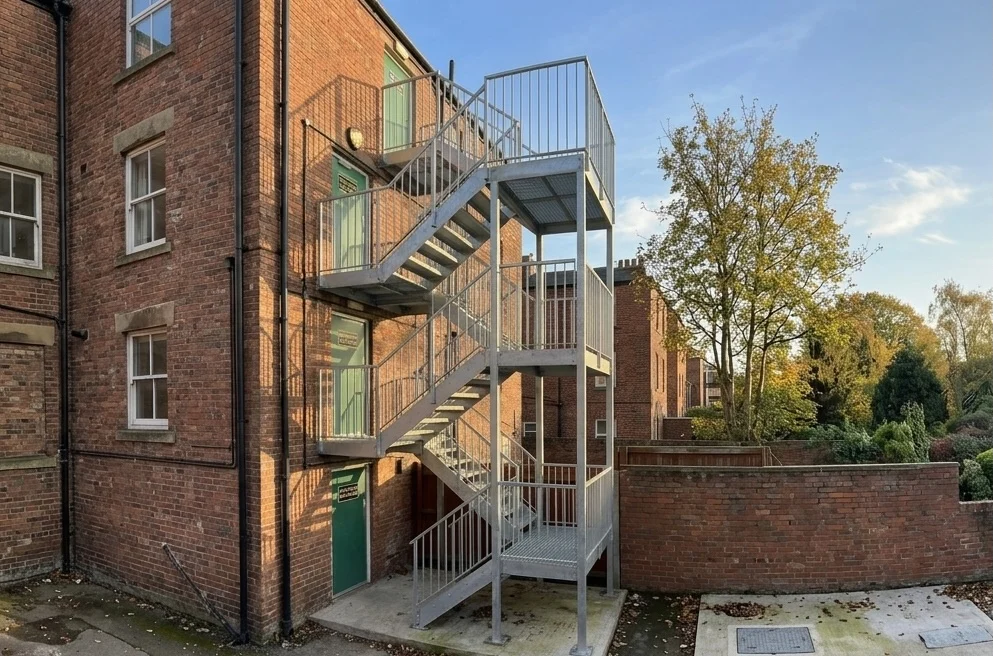
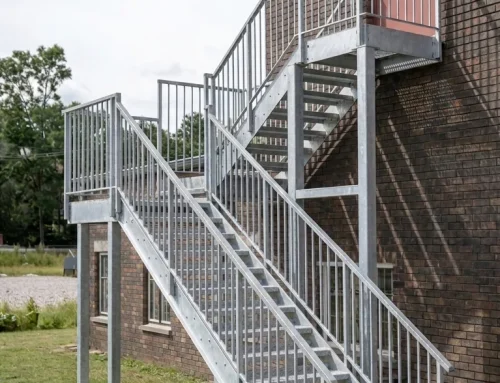
A hot-dip galvanised fire escape staircase — ISO 1461 compliant, 85μm+ zinc coating
A galvanised fire escape staircase lasts 25–100+ years depending on the environment and coating system. In rural or suburban UK locations (corrosion category C2), a standard 85μm galvanised coating provides 85+ years of maintenance-free life. In urban or mild industrial environments (C3), expect 50–70 years. In coastal or industrial locations (C4), expect 25–40 years with galvanising alone — or 40–60+ years with a duplex finish (galvanising + powder coat). The coating is governed by ISO 1461:2022, which specifies minimum zinc thicknesses of 55–100μm depending on the steel section thickness. The Galvanizers Association UK provides a corrosion rate map showing predicted zinc coating life for any UK location.
How Galvanising Works — The Science in 60 Seconds
Hot-dip galvanising involves immersing a fabricated steel structure in a bath of molten zinc at approximately 450°C. The zinc reacts with the steel surface to form a series of zinc-iron alloy layers, topped by a layer of pure zinc. This metallurgical bond — not just a surface coating — creates a multi-layered protection system that is fundamentally different from paint or powder coat (which sit on top of the surface without bonding to the metal at a molecular level).
The zinc coating protects the steel in two ways. First, it acts as a physical barrier — preventing moisture and oxygen from reaching the steel surface. Second, it provides cathodic (sacrificial) protection — if the coating is scratched, cut, or damaged, the zinc corrodes preferentially, protecting the exposed steel around the damaged area. This self-healing property is unique to zinc coatings and is the primary reason galvanising outperforms paint and powder coat for long-term corrosion protection on external steelwork.
ISO 1461:2022 — The Galvanising Standard
The international standard governing hot-dip galvanising of fabricated steelwork is ISO 1461:2022 (superseding ISO 1461:2009). This standard specifies minimum zinc coating thicknesses based on the steel section thickness — thicker steel sections naturally develop thicker coatings during the galvanising process.
| Steel Section Thickness | Min Local Coating (μm) | Min Average Coating (μm) |
|---|---|---|
| ≥ 6mm (typical fire escape sections) | 70μm | 85μm |
| 3mm to < 6mm | 55μm | 70μm |
| 1.5mm to < 3mm | 45μm | 55μm |
| < 1.5mm | 35μm | 45μm |
| Castings ≥ 6mm | 70μm | 80μm |
Fire escape staircases are fabricated from structural steel sections typically 6mm or thicker (S275 or S355 grade), which means the minimum average coating thickness under ISO 1461 is 85μm. In practice, actual coating thicknesses frequently exceed the minimum by 20–40% — a typical fire escape staircase galvanised to ISO 1461 will have an actual coating of 100–140μm.
Why this matters: The lifespan of the galvanised coating is directly proportional to its thickness. In a C2 environment (suburban UK) with a zinc corrosion rate of ~1μm per year, an 85μm coating lasts 85 years. A 120μm coating in the same environment lasts 120 years. When specifying a fire escape, asking the galvaniser for the actual measured coating thickness (not just "ISO 1461 compliant") tells you exactly how many years of protection you are getting.
Corrosion Categories — How Location Determines Lifespan
The rate at which zinc corrodes depends on the atmospheric environment. ISO 12944-2 defines corrosion categories C1 to C5 (with CX for extreme offshore environments). The Galvanizers Association UK publishes a corrosion rate map showing the predicted zinc loss per year for any UK location.
| Category | Environment | Zinc Loss (μm/yr) | 85μm Coating Life |
|---|---|---|---|
| C1 (very low) | Heated interiors — offices, schools | <0.1 | 100+ years |
| C2 (low) | Rural, suburban, low pollution | 0.1–0.7 | 85–120+ years |
| C3 (medium) | Urban, mild industrial, coastal (low salinity) | 0.7–2.0 | 40–85 years |
| C4 (high) | Industrial, coastal (moderate salinity) | 2.0–4.0 | 20–40 years |
| C5 (very high) | Marine, heavy industrial, high salinity | 4.0–8.0 | 10–20 years |
Most UK inland locations fall into C2 or C3. Coastal locations within 1–5 miles of the sea are typically C3 or C4. Direct seafront and harbour locations may be C4 or C5. Industrial sites with chemical exposure may be C4 or C5 regardless of distance from the coast.
Gosport / Hampshire coast: Properties in Continox's local area (Gosport, Portsmouth, Southampton, the Solent coast) are typically C3 or C4 due to marine salt exposure. A standard 85μm galvanised coating in a C4 environment has a predicted life of 20–40 years — adequate for many applications, but a duplex finish (galvanising + powder coat) extending life to 40–60+ years is strongly recommended for coastal fire escapes.
Three Coating Systems Compared
| System | Life (C2 Rural) | Life (C4 Coastal) | Cost Premium | Maintenance |
|---|---|---|---|---|
| Galvanising only (ISO 1461) | 85–120+ years | 20–40 years | Baseline | Annual visual inspection |
| Powder coat only (no galv) | 15–25 years | 8–15 years | Similar to galv | Touch-up every 5–10 years |
| Duplex (galv + powder coat) | 120+ years | 40–60+ years | +£800–£1,500 | Annual visual inspection |
Galvanising only
The standard specification for most fire escape staircases. The zinc coating provides long-term barrier and sacrificial protection. Appearance is metallic grey, developing a matt grey patina over time as the zinc oxidises (this is normal and does not indicate deterioration). No colour choice — the finish is always zinc-grey.
Powder coat only
A coloured polymer coating applied electrostatically and cured at 180–200°C. Available in any RAL colour. Provides a decorative finish and moderate corrosion protection — but without the sacrificial protection of zinc. If the powder coat is scratched or chipped (common on fire escapes due to foot traffic and contact with objects during evacuation), the exposed steel corrodes with no self-healing mechanism. Powder coat alone is not recommended for external fire escape staircases.
Duplex (galvanised + powder coat)
The premium specification: the staircase is galvanised first (providing the zinc barrier and sacrificial protection), then powder coated on top (providing colour, additional barrier protection, and UV resistance). The combined system lasts 1.5–2.3× longer than either system alone — the powder coat protects the zinc from atmospheric attack, while the zinc protects the steel if the powder coat is damaged. This is the system Continox recommends for all coastal and exposed locations.
For fire escape staircase specifications and pricing across all coating options, see our fire escape stairs product page and our external staircase range.
 Galvanised finish — standard zinc-grey, 85μm+ coating to ISO 1461
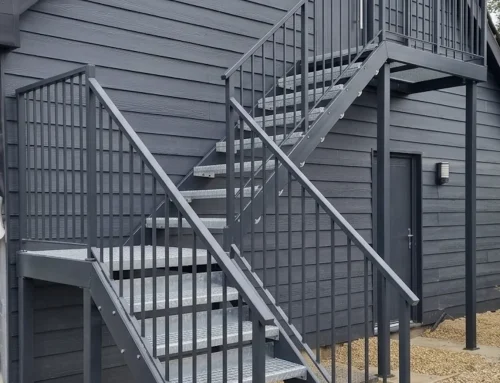
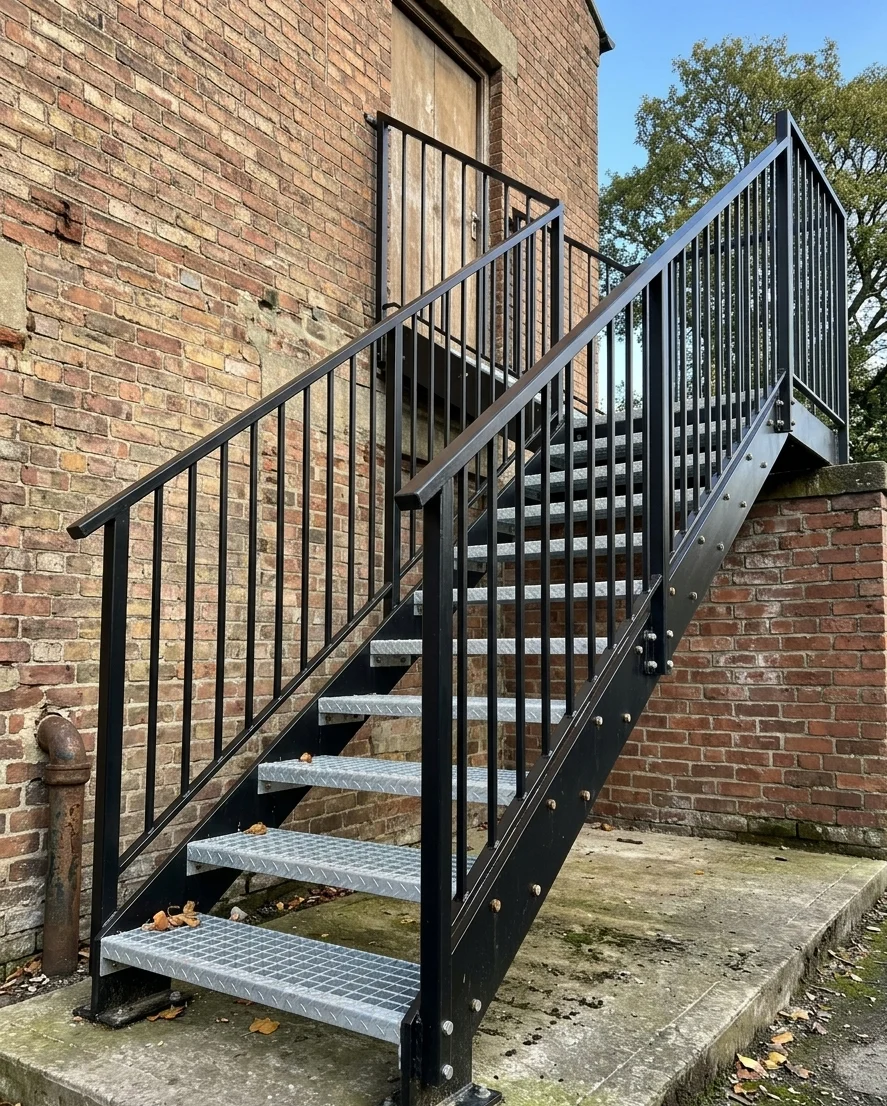 Duplex finish — galvanised + powder coat for 40–60+ year coastal life
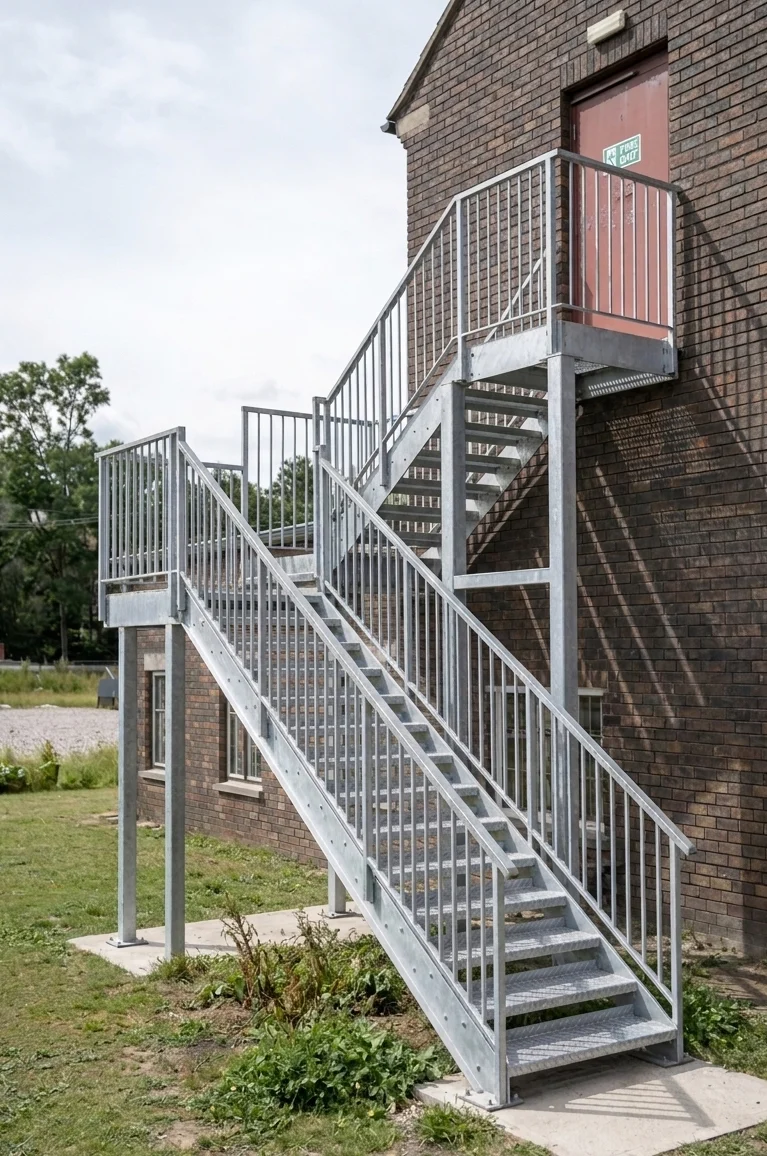
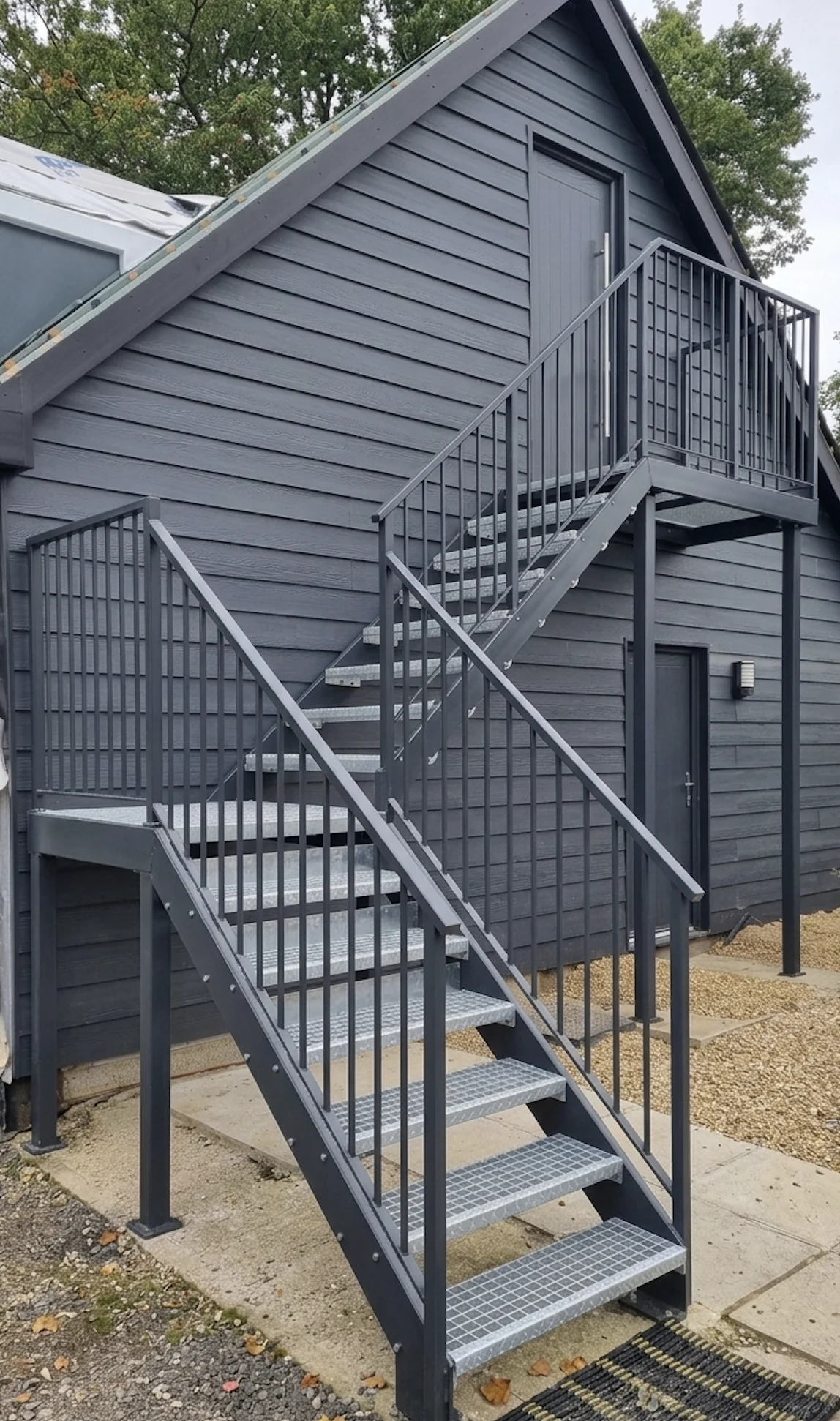 Multi-landing galvanised fire escape — all sections coated uniformly
 Spiral fire escape — galvanising covers complex geometry uniformly
Annual Inspection Checklist — What to Check and When
A galvanised fire escape staircase should be visually inspected at least annually. For HMO, care home, and commercial properties, the fire risk assessment should include the fire escape condition as a standing item. Here is what to check.
1 White rust (wet storage stain)
White, powdery deposits on the zinc surface — caused by moisture trapped against the coating (typically under debris or at drip points). White rust is zinc hydroxide/oxide and is cosmetic, not structural. It does not indicate coating failure. Remove with a nylon brush and water. Prevent recurrence by keeping the staircase clear of debris and ensuring drainage is unobstructed.
2 Red rust
Orange-brown rust staining indicates the zinc coating has been consumed and the underlying steel is corroding. This is a maintenance action trigger — the affected area must be cleaned, treated, and repaired with zinc-rich paint (minimum 90% metallic zinc in the dry film) or zinc thermal spray. If red rust is widespread, the staircase may need re-galvanising or replacement.
3 Mechanical damage
Chips, scratches, and impact damage from foot traffic, furniture, or contact during evacuations. Small areas of damage (up to 10cm² per ISO 1461) can be repaired with zinc-rich paint. Larger areas require more extensive treatment.
4 Fixings and connections
Check all bolted connections for tightness. Check welded connections for cracking (particularly at high-stress joints such as stringer-to-landing connections). Check the wall fixings (expanding or chemical anchors into masonry) for movement or loosening.
5 Treads and nosings
Check anti-slip treads (chequer plate or open mesh) for wear, deformation, or loosening. Worn treads are a slip hazard — particularly in wet conditions. Replace individual treads if the anti-slip profile is significantly worn.
6 Drainage
Ensure landing drainage is functioning — blocked drains cause water to pool on landings, accelerating corrosion of the deck surface and fixings. Clear leaves, moss, and debris from all drainage points.
For HMO landlords: The fire escape staircase condition is checked during HMO licensing inspections and fire risk assessments. A corroded or damaged fire escape can trigger enforcement action, improvement notices, and potentially affect your HMO licence. For the full HMO compliance requirements, see our HMO fire escape requirements guide. For school buildings, see our school staircase regulations guide. For care homes, see our care home fire escape requirements guide.
When to Replace — Not If
A galvanised fire escape staircase does not fail suddenly. The corrosion process is gradual and visible — you can see the coating deteriorating long before the structure is compromised. The decision to replace is based on the overall condition of the coating and the cost-effectiveness of repair versus replacement.
| Condition | Action | Estimated Cost |
|---|---|---|
| White rust only — no red rust | Clean, inspect annually | £0 (routine maintenance) |
| Isolated red rust spots (<5% surface area) | Clean, treat with zinc-rich paint | £200–£500 |
| Widespread red rust (5–20% surface area) | Full surface preparation + zinc-rich coating system | £1,000–£3,000 |
| Structural section loss visible | Structural survey — likely replacement | Replacement from £3,500 |
| Loose fixings, cracked welds, tread failure | Immediate structural assessment — potential prohibition | Repair or replacement |
Replacement fire escape staircases from Continox start at £3,500 for a residential two-landing design and £5,500 for a commercial multi-landing specification. We handle the full process: removal of the old staircase, design, manufacture, galvanising (or duplex finish), and installation. For pricing, see our fire escape stairs page.
Frequently Asked Questions — Galvanised Fire Escape Lifespan
In rural or suburban UK locations (C2), a standard 85μm galvanised coating provides 85–120+ years of structural protection. In urban or mild industrial locations (C3), expect 40–85 years. In coastal environments (C4), expect 20–40 years with galvanising alone, or 40–60+ years with a duplex finish (galvanised + powder coat). The exact lifespan depends on zinc coating thickness and the atmospheric corrosion rate at the specific location.
Galvanising is a zinc coating that bonds metallurgically to the steel, providing barrier protection and sacrificial (cathodic) protection — if scratched, the zinc self-heals by corroding preferentially. Powder coating is a polymer coating applied on top of the surface — it provides colour and barrier protection but no sacrificial protection. If scratched, the exposed steel corrodes with no self-healing. For external fire escapes, galvanising alone or duplex (galv + powder coat) is recommended. Powder coat alone is not recommended.
A duplex system combines hot-dip galvanising with a secondary coating — typically powder coat or wet paint — applied on top. The combined system lasts 1.5–2.3× longer than either coating alone. The powder coat protects the zinc from atmospheric attack, while the zinc protects the steel if the powder coat is damaged. A duplex finish adds £800–£1,500 to a fire escape staircase but extends the service life by 20–30+ years in corrosive environments.
ISO 1461:2022 is the international standard governing hot-dip galvanised coatings on fabricated iron and steel articles. It specifies minimum zinc coating thicknesses (55–100μm depending on steel section thickness), coating uniformity, adhesion, appearance, and testing methods. All Continox fire escape staircases are galvanised to ISO 1461.
Annually — visual inspection for white rust, red rust, mechanical damage, fixing condition, tread wear, and drainage. For HMOs, care homes, and commercial buildings, the fire escape condition should be included in the fire risk assessment, which is typically reviewed every 6–12 months. CQC (care homes) and fire and rescue authorities (HMOs) routinely check fire escape condition during inspections.
In principle yes — the staircase can be disassembled, stripped of the old coating, and re-galvanised. In practice, this is rarely cost-effective for a fire escape staircase because the disassembly, transport, stripping, re-galvanising, and re-installation costs typically approach or exceed the cost of a new staircase. Replacement is usually the better option when the coating has reached end of life.
Galvanised mild steel is significantly cheaper than stainless steel and provides excellent corrosion protection for the majority of UK environments. Stainless steel (Grade 316) offers superior corrosion resistance in extreme marine and chemical environments but at 3–5× the material cost. For most fire escape applications, galvanised mild steel (with duplex finish for coastal sites) is the most cost-effective solution. Stainless steel is typically only justified for direct seafront or chemical plant environments.
A galvanised fire escape staircase from Continox starts at £3,500 for a residential two-landing design and £5,500 for a commercial multi-landing specification. Duplex finish (galvanised + powder coat) adds £800–£1,500. Prices include design, manufacture, galvanising, and installation. Removal of the old staircase is quoted separately based on site conditions.
Need a New or Replacement Fire Escape Staircase?
Continox designs, manufactures, and installs galvanised and duplex-finished fire escape staircases for residential, HMO, and commercial properties across Southern England. ISO 1461 compliant. From £3,500. Free site surveys.