
The string — or stringer — is the structural side panel of a staircase. Whether it is visible or hidden, cut or straight, timber or steel, the string determines the staircase's visual character more than almost any other single element. An open (cut) string exposes the zig-zag profile of the treads and risers, creating a lighter, more detailed appearance. A closed string conceals the steps behind a solid side panel, producing a cleaner, more traditional look. And a mono-stringer — a single central steel beam — eliminates side panels entirely, creating the floating designs that define contemporary interiors. This guide explains the differences, compares costs, and helps you decide which string type is right for your project.
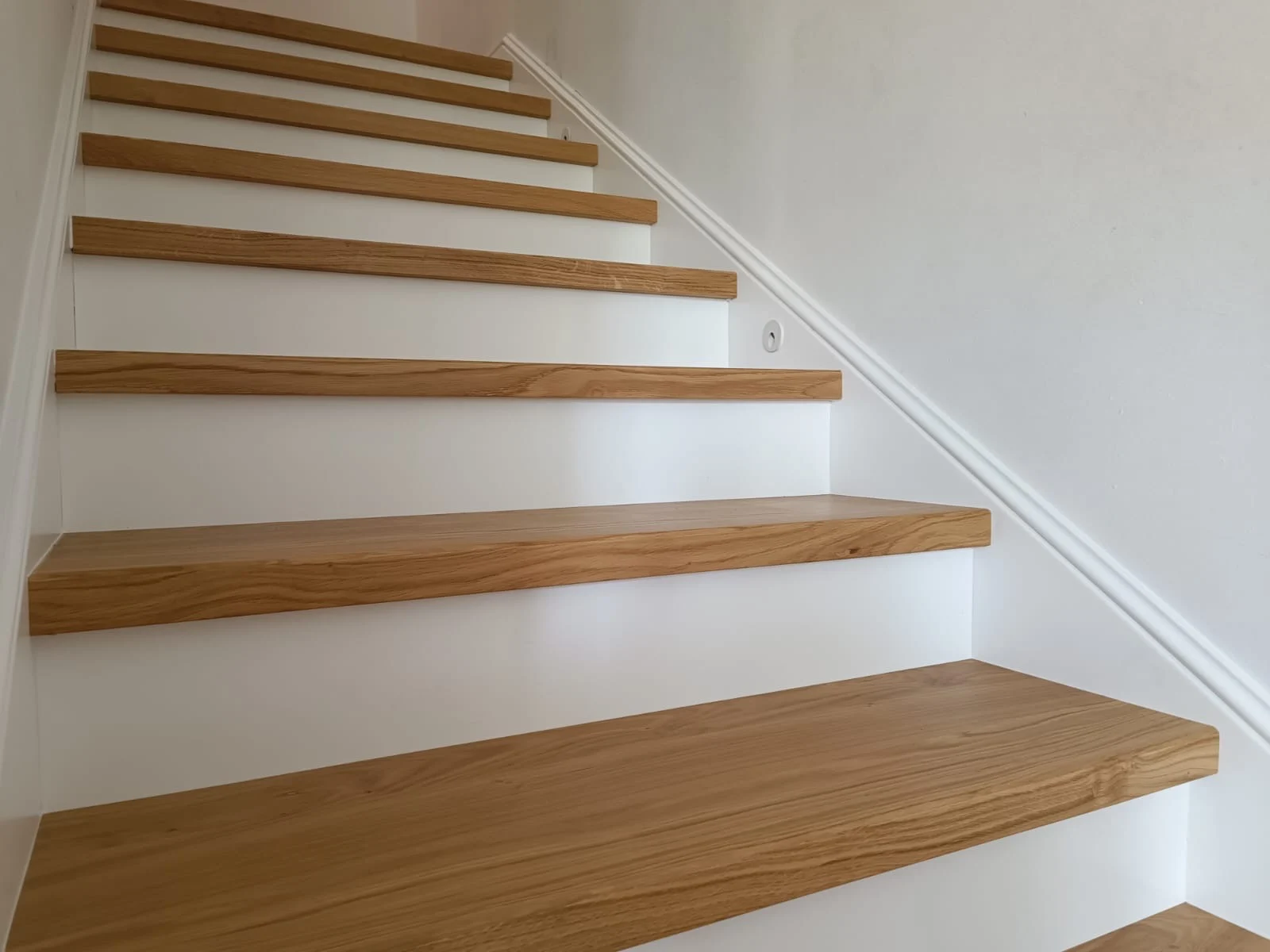
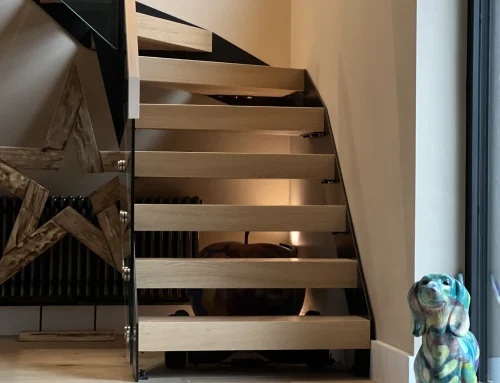
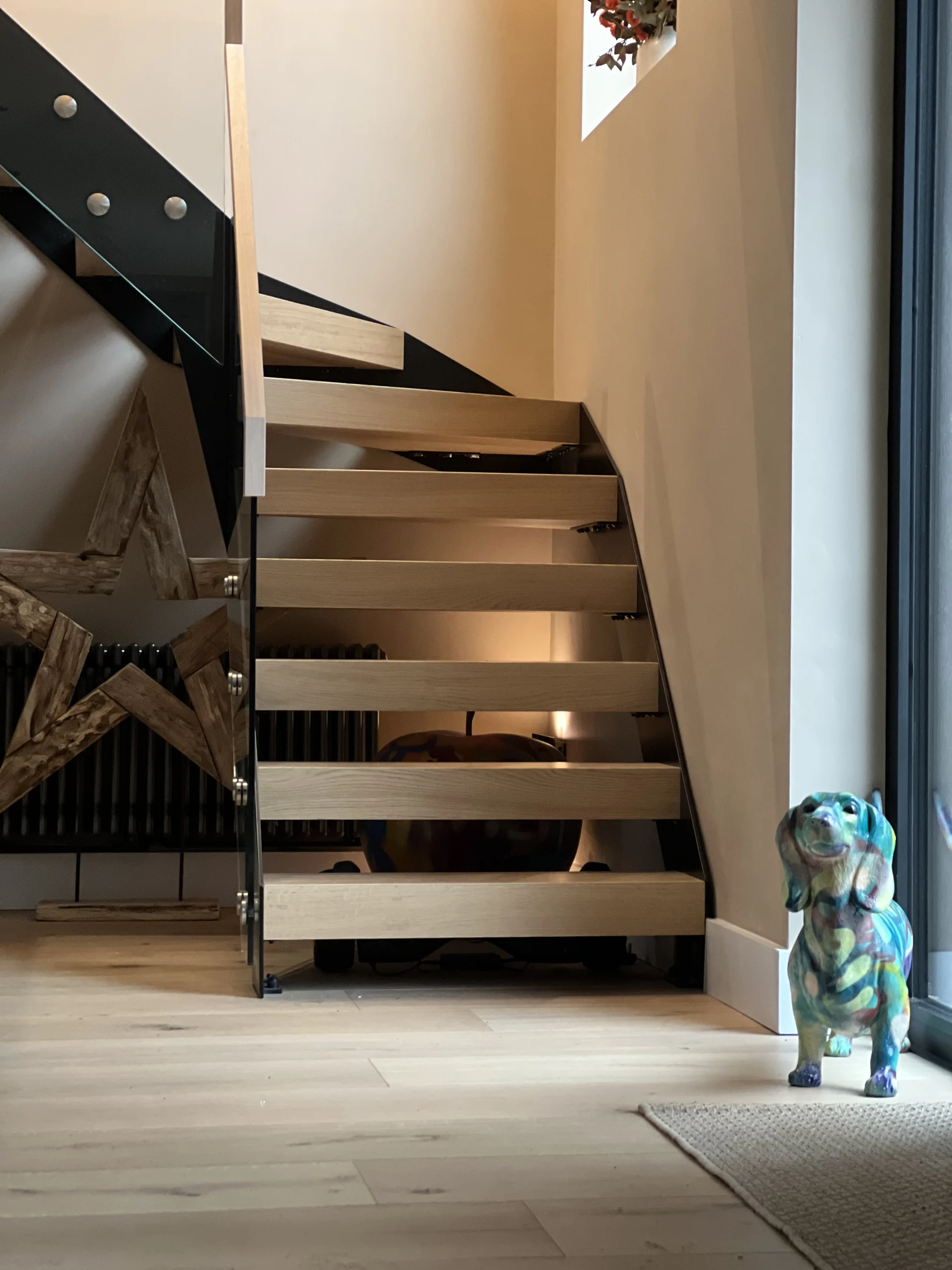
Open string with oak treads — the stair profile is fully exposed, creating a light, airy aesthetic
A closed string staircase has a solid side panel that conceals the stair treads and risers — you cannot see the steps from the side. An open (cut) string follows the zig-zag profile of the treads and risers, exposing the step edges. A mono-stringer uses a single central steel beam underneath the treads, eliminating side panels entirely. Closed strings are cheaper (standard timber staircase from £1,500), simpler to build, and suit traditional and enclosed settings. Open/cut strings are more visually striking, allow spindles to sit on top of the treads (not in a base rail), cost roughly double a closed string, and suit hallways where the staircase is a visible feature. Mono-stringers (from £9,500 bespoke) create the lightest, most contemporary aesthetic and are almost exclusively fabricated from structural steel.
What Is a Stringer — And Why Does It Matter?
The stringer (or string) is the structural board that runs along each side of a staircase, supporting the treads and risers. Every staircase has at least one stringer — in most cases, two: a wall string (fixed to the wall) and a face string (the open side visible from the room). The design of the face string is what determines whether the staircase looks traditional or contemporary, heavy or light, modest or dramatic.
In timber staircase construction, the stringer is typically a solid board (usually 32mm thick in softwood or 40mm in hardwood) running from the bottom to the top of the flight at the same angle as the pitch. How the treads and risers attach to this board — housed inside it or sitting on top of it — defines the string type.
In steel staircase construction, the equivalent structure is a steel plate stringer (typically 10–12mm S275 steel), a twin stringer (two parallel steel plates), or a mono-stringer (a single central beam). Steel stringers can be thinner than timber while carrying greater loads — which is why steel enables the floating, open designs that timber alone cannot achieve.
Closed String — The Traditional Standard
A closed string staircase has a solid side panel that runs the full length of the flight. The treads and risers are housed in routed slots (typically 12mm deep) inside the string, secured with wedges and glue blocks. From the side, you see a smooth, unbroken board — the step profile is completely hidden.
How it works structurally
The treads and risers slot into routed grooves in the inner face of the string. Timber wedges are driven into the grooves beneath each tread and behind each riser, compressing the joint and holding the components tight. Glue blocks (small triangular timber pieces) are bonded into the angle between each tread and riser to add rigidity and prevent squeaks. This construction method is fast, cost-effective, and produces a strong, quiet staircase.
Advantages
Cheapest to manufacture — standard construction with minimal joinery complexity. The solid side panel adds stiffness to the overall structure. The underside can be plastered for a clean ceiling below the staircase. Suits enclosed stairwells where the side of the staircase is against a wall or hidden behind a partition. The base rail for spindles sits on top of the string, creating a simple, clean junction.
Limitations
The solid panel creates visual bulk — the staircase looks heavier and more enclosed than an open string design. Spindles sit in a base rail on top of the string, not directly on the treads — which limits spindle design options. The underside must be covered (plastered or cladded) because the wedges and glue blocks are visible.
 Closed string — solid side panel conceals the step profile
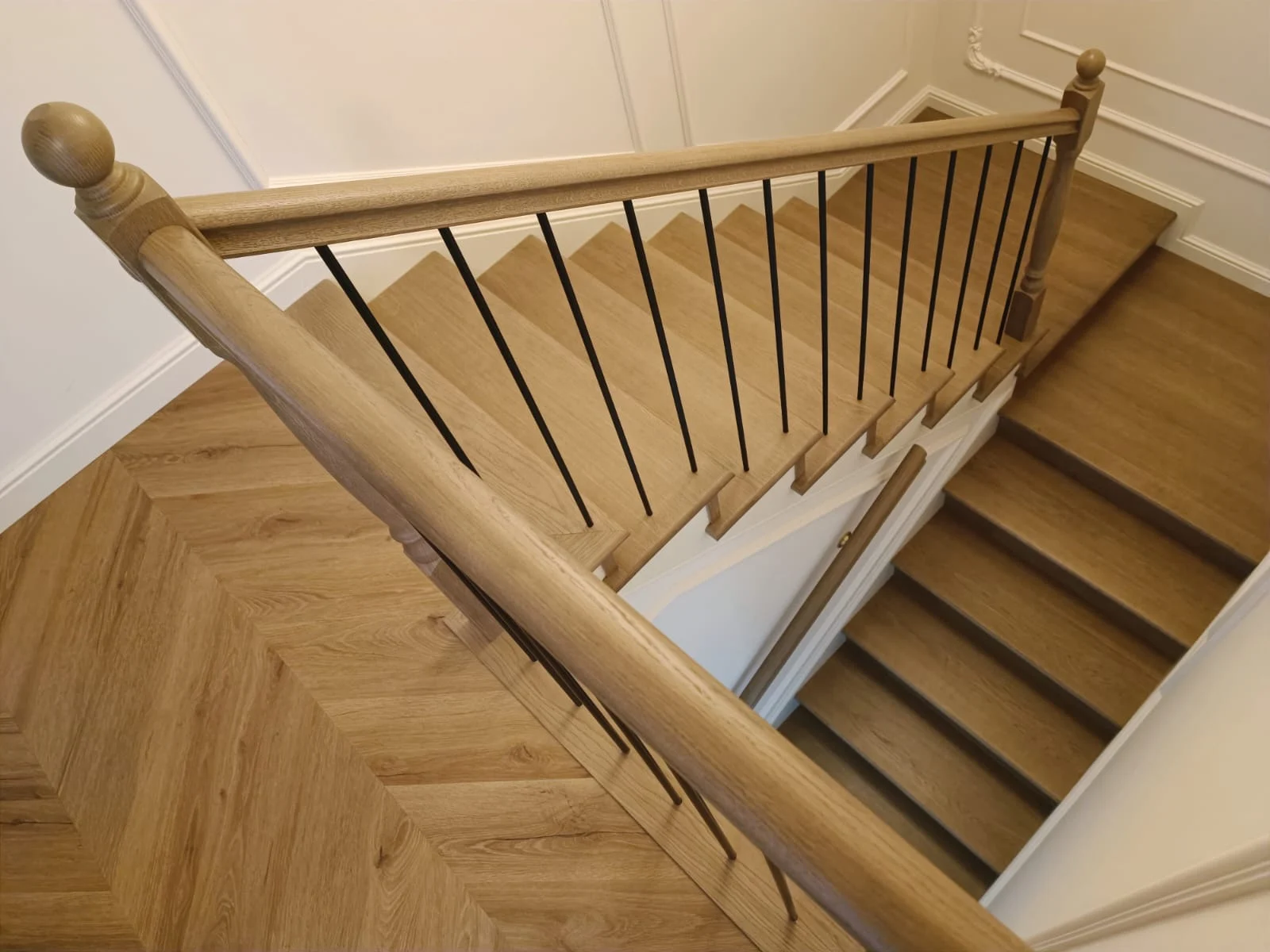 Traditional closed string — spindles sit in a base rail on top of the string
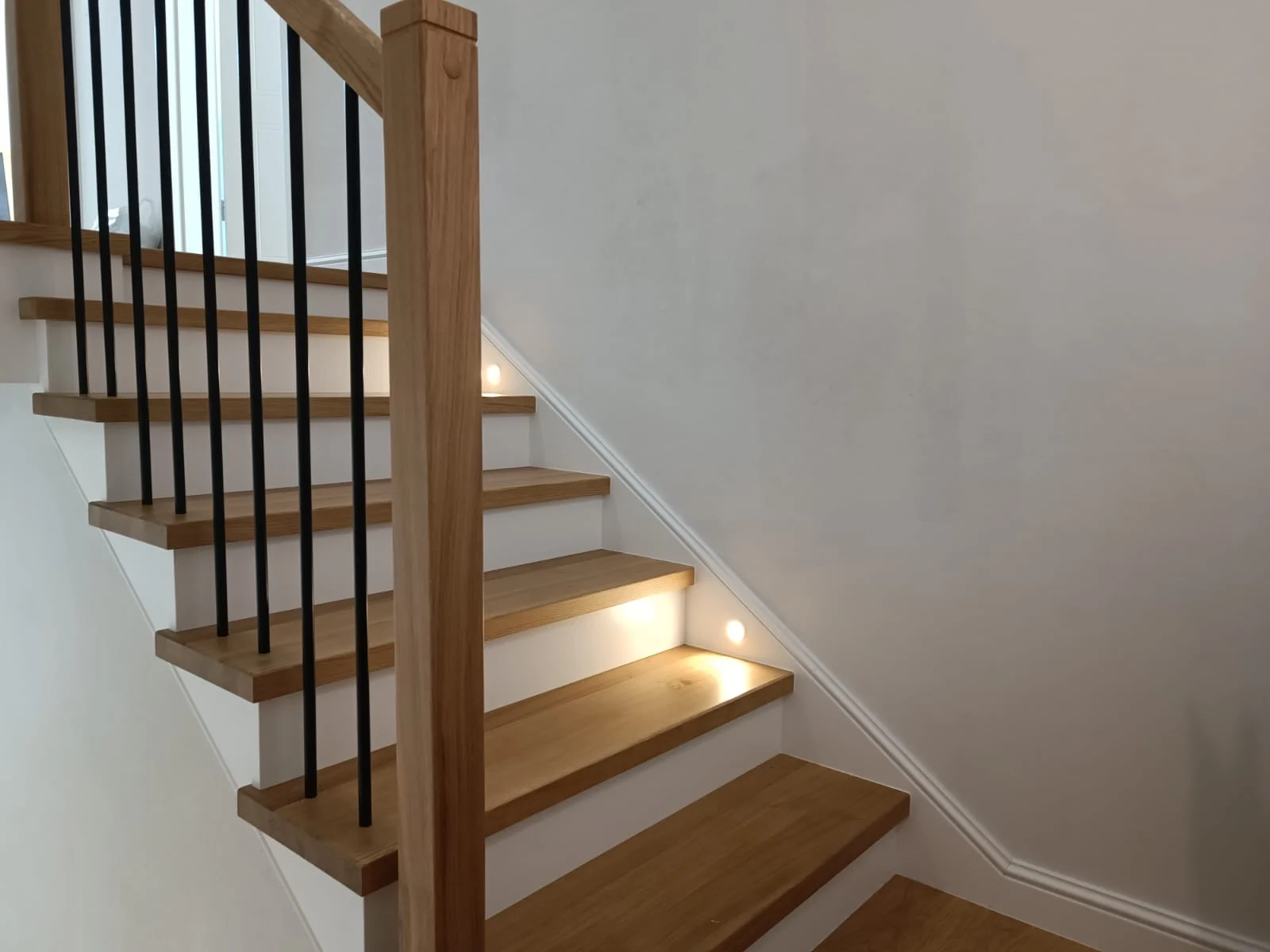 Closed string modernised — LED lighting and metal spindles update the look
 Closed string from above — clean lines, spindles set into base rail
Open (Cut) String — The Premium Upgrade
An open string — also called a cut string — has its upper edge cut in a zig-zag pattern that follows the profile of the treads and risers. The treads sit on top of the string rather than being housed inside it, and the step nosings are visible from the side. The result is a lighter, more detailed appearance that showcases the craftsmanship of the staircase.
How it works structurally
The string is cut with a jigsaw or router to follow the outline of each tread and riser. The treads extend beyond the string face, creating a visible nosing return. The risers either mitre into the string or terminate against a decorative riser bracket. Spindles fix directly into the top of each tread (rather than into a base rail), which allows for a wider variety of spindle designs and produces a more refined junction. The construction is more complex and time-consuming than a closed string — which is why it typically costs roughly twice as much.
Advantages
Visually lighter and more elegant — the zig-zag profile adds detail and visual interest. Spindles sit directly on the treads — creating a more refined, premium look. The exposed tread nosings showcase the timber grain (particularly effective with hardwood like oak or walnut). Decorative riser brackets can be added for additional detailing. The staircase looks finished from all angles — the underside can be left exposed if the construction is clean.
Limitations
Costs approximately twice as much as a closed string of the same timber specification. More complex to manufacture — requires precise cutting and additional joinery (mitre joints, return nosings, brackets). The exposed tread ends need return nosings to hide the end grain — an additional component and cost. The exposed profile means any imperfection in the cutting or fitting is visible — requiring higher craftsmanship. Less suitable for young children in some configurations — the exposed step edges can create climbing opportunities (though this is a consideration, not a regulation).
Cut string terminology: "Open string" and "cut string" are used interchangeably in the UK staircase industry. Some manufacturers also use "sawtooth string." The opposite — where the steps are concealed — is always "closed string." If your manufacturer quotes for a "standard string," they mean closed.
Mono-Stringer — The Contemporary Option
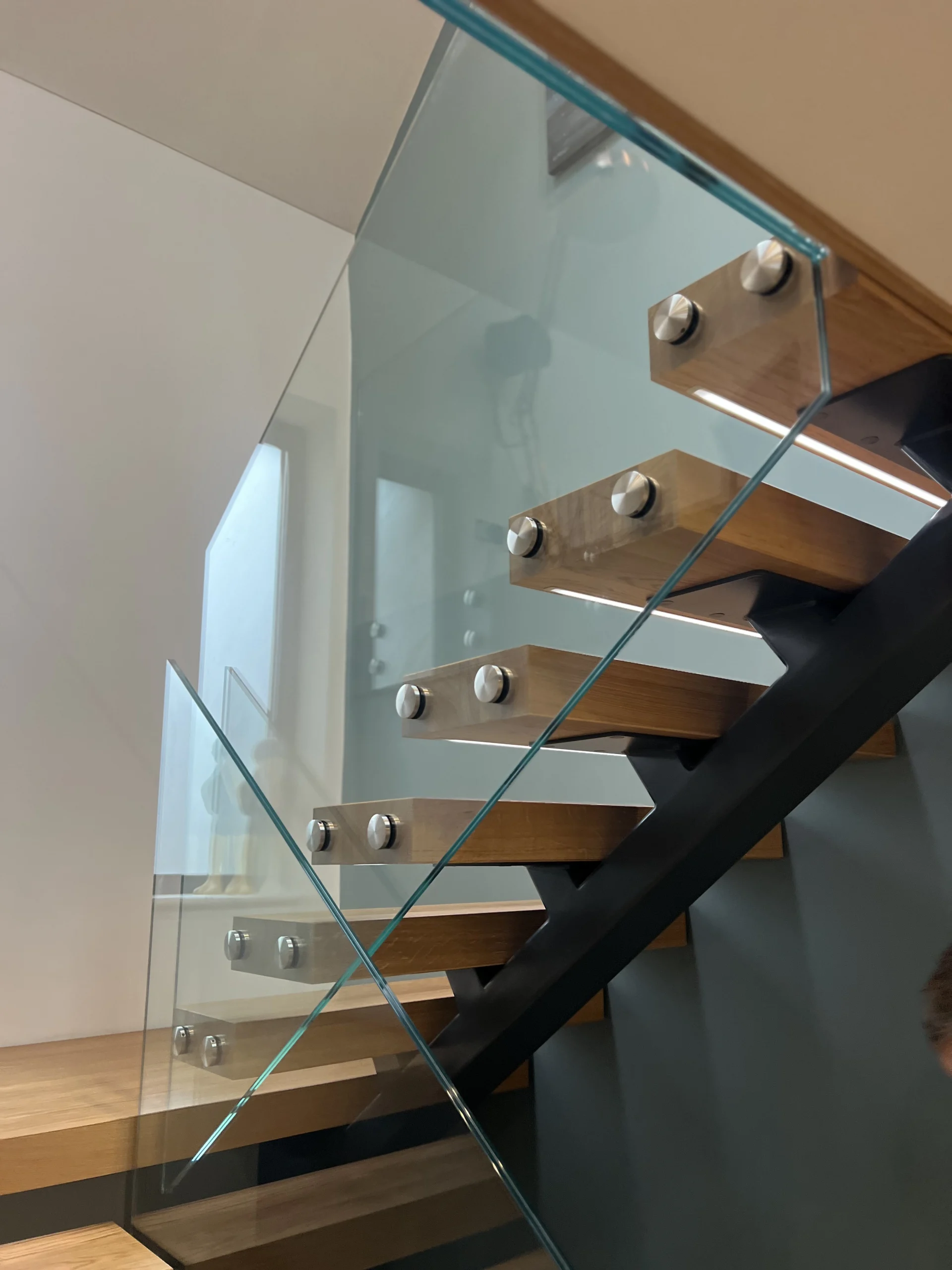
A mono-stringer uses a single structural beam running beneath the centre of the treads — eliminating side strings entirely. The treads appear to float from both sides, with no visible support structure along the edges. This is the design that defines contemporary residential staircases — and it is almost exclusively fabricated from structural steel because the engineering demands exceed what timber can achieve in this configuration.
At Continox, our central spine staircases use a single steel mono-stringer (typically 10mm S275 steel plate, powder coated) with solid oak treads welded or bolted to cross-brackets. The result is a staircase where the treads appear to float on either side of a clean, sculptural steel beam.
Advantages
The lightest, most visually open staircase type — no side panels, maximum sightlines and light flow. Works with open risers, glass balustrade, or no balustrade (where regulations allow). The ultimate design statement for open-plan homes. Steel mono-stringers inherently exceed 30-minute fire resistance — an advantage for loft conversions and multi-storey properties.
Limitations
Requires structural steel fabrication — not achievable with timber alone. Higher cost than timber string designs: central spine staircases from £9,500 at Continox. Requires precise engineering — the mono-stringer must be designed to resist both vertical loads and lateral forces (torsion) without side strings to provide bracing. Installation requires lifting equipment (the assembled steel frame is heavy). For further details on steel vs wood construction, see our wood vs steel staircase comparison.
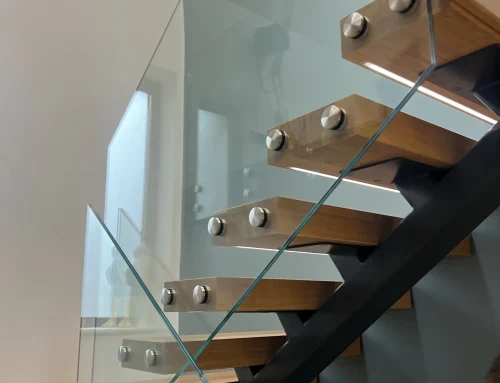
 Mono-stringer (central spine) — single steel beam, oak treads float on both sides
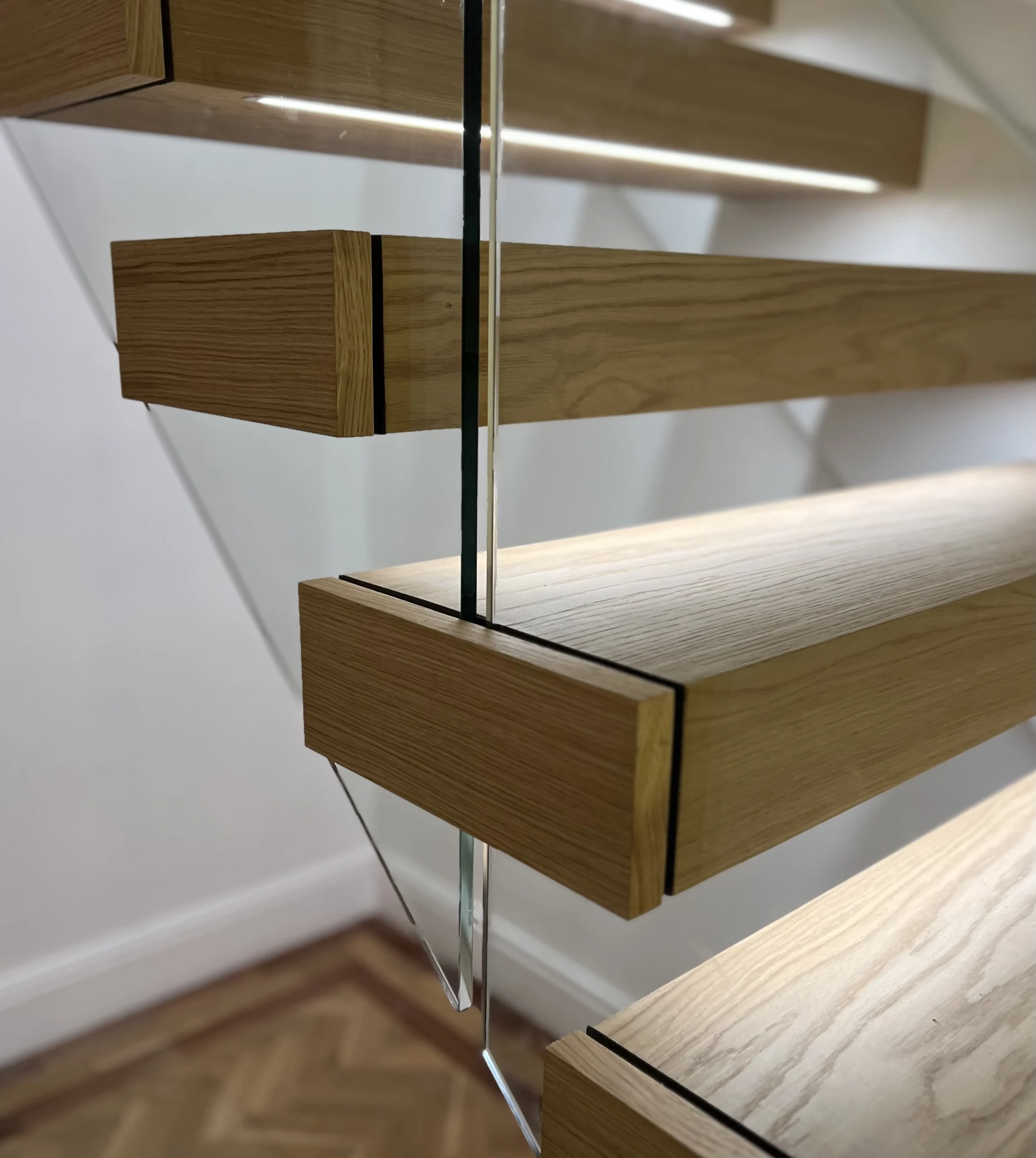 Floating design — the mono-stringer is concealed within the wall
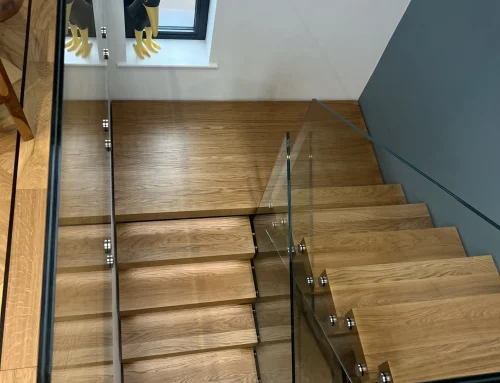
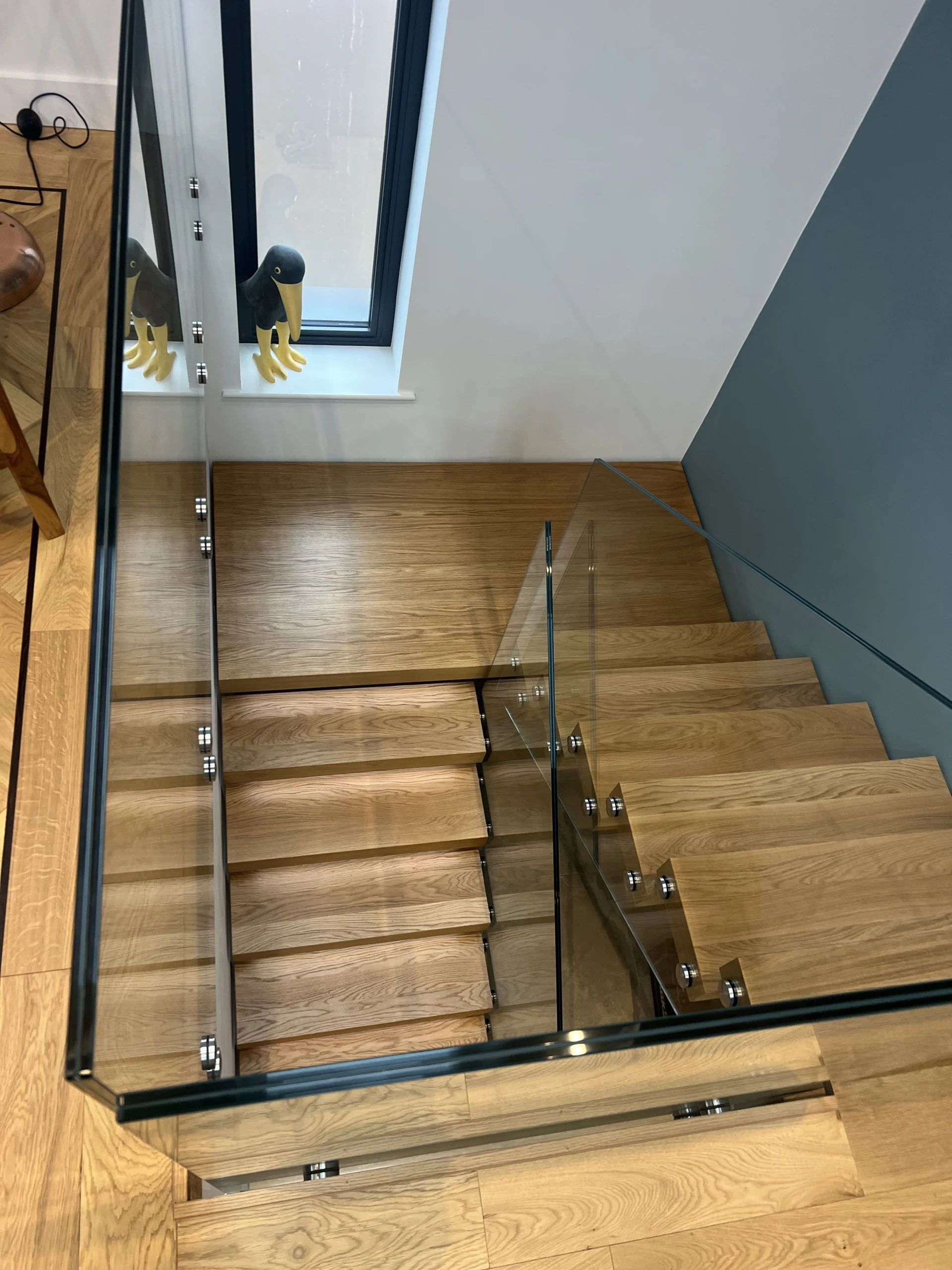
 Open string + glass balustrade — maximum light, minimum visual bulk
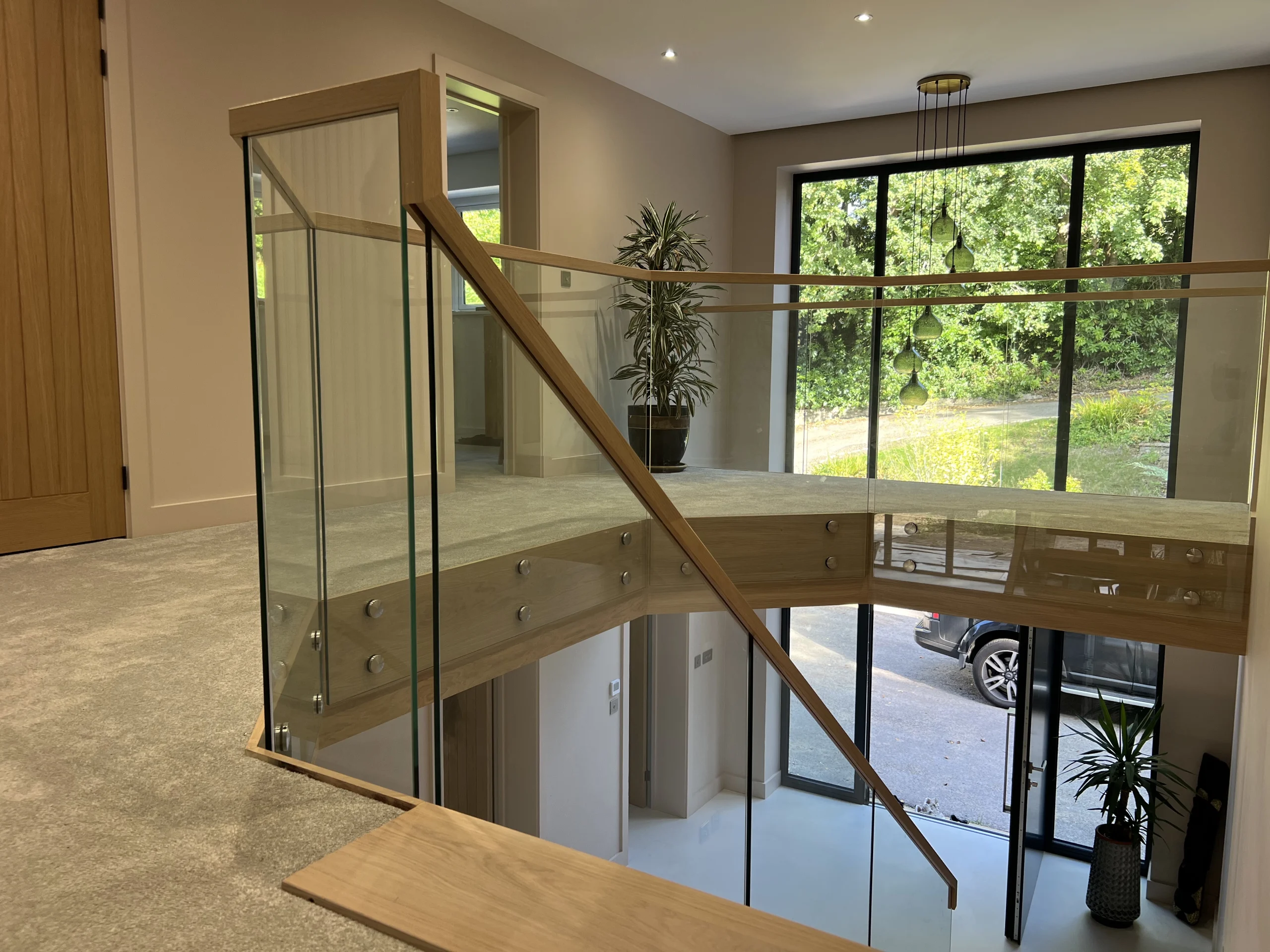 Twin steel stringers + glass — the contemporary open-plan standard
Cost Comparison — What Each Type Costs
| String Type | Typical Cost (Supplied & Fitted) | Material |
|---|---|---|
| Closed string (softwood, standard) | £1,500–£3,000 | Pine / spruce |
| Closed string (oak, bespoke) | £3,000–£5,000 | Solid European oak |
| Cut string (softwood) | £2,500–£4,500 | Pine with brackets |
| Cut string (oak, bespoke) | £4,500–£8,000 | Solid oak, return nosings, brackets |
| Steel twin stringer + oak treads | From £7,900 | S275 steel + solid oak |
| Steel mono-stringer (central spine) + oak + glass | From £9,500 | S275 steel + oak + frameless glass |
The approximately 2× cost multiplier for a cut string over a closed string is consistent across both softwood and hardwood — it reflects the additional joinery complexity (cutting the zig-zag profile, mitreing risers, adding return nosings and brackets) rather than a material cost difference. For full pricing across all staircase types, see our bespoke staircase cost guide.
Which String Type Suits Your Home?
| Your Situation | Best String Type | Why |
|---|---|---|
| Enclosed stairwell between walls | Closed string | Side panels are hidden — no visual benefit from a cut string |
| Budget under £3,000 | Closed string | No cut or mono-stringer options exist at this price |
| Period home, traditional style | Cut string (oak) | Exposed treads with riser brackets suit Georgian/Victorian aesthetics |
| Hallway staircase visible from front door | Cut string (oak or walnut) | The visual detail justifies the investment where the staircase is the first impression |
| Open-plan contemporary home | Mono-stringer (steel) | Maximum visual lightness, floating aesthetic, glass balustrade compatible |
| Loft conversion — fire safety priority | Steel stringer (any type) | Inherent 30-minute fire resistance without treatment |
| Matching existing staircase | Match existing type | Consistency between flights — mismatched strings look wrong |
For staircase design inspiration across all string types, see our modern staircase gallery and our staircase ideas page.
Balustrade Compatibility — What Works with Each String
Closed string + spindles
The classic combination. Spindles sit in a base rail on top of the closed string. Works with timber spindles (square, turned, or fluted), metal spindles (round bar or flat bar), or a combination. The base rail creates a visible horizontal line along the top of the string — this is part of the traditional aesthetic but can look heavy in contemporary settings.
Cut string + spindles
Spindles fix directly into the top of each tread — no base rail. This produces a cleaner, more detailed junction where each spindle rises from the tread surface. Works with timber, metal, or glass infill panels. The absence of the base rail makes the balustrade appear lighter.
Any string + glass balustrade
Glass balustrade works with all string types. On a closed string, the glass is typically housed between the string and a top handrail. On a cut string, the glass can be cut to follow the step profile (more expensive) or set between straight rails above the steps. On a mono-stringer, frameless glass panels are typically clamped or channel-fixed to the tread edges — the cleanest, most contemporary option.
Mono-stringer + frameless glass
The ultimate contemporary pairing. The steel mono-stringer provides the structural support, and frameless glass panels (from £450 per linear metre) provide the guarding. No base rail, no spindles, no visual clutter — just steel, oak, and glass. This is the specification that Continox most commonly delivers for bespoke residential projects.
 Cut string + decorative steel balustrade — spindles sit on treads, not base rail
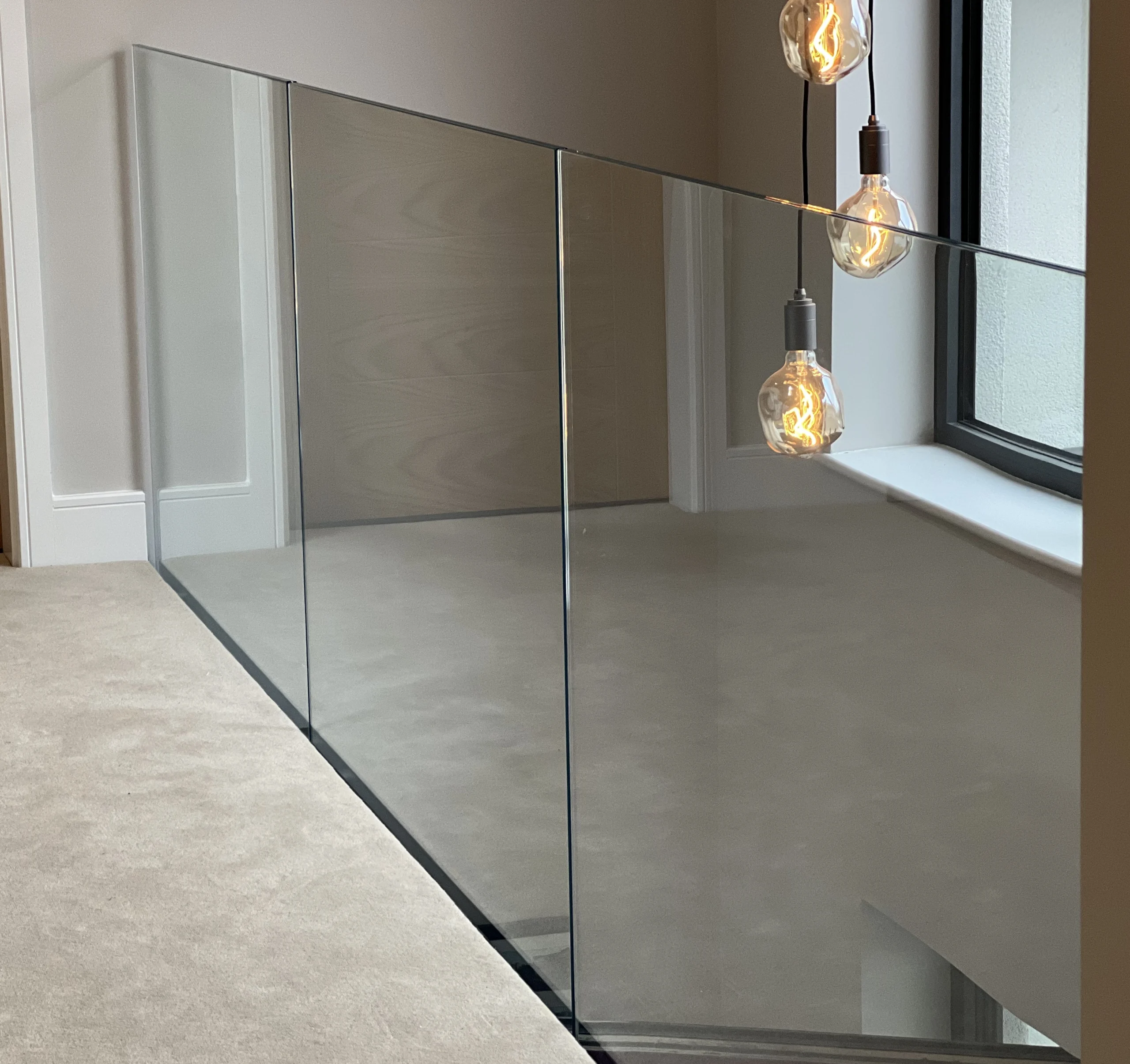 Mono-stringer + frameless glass — the ultimate contemporary combination
 Glass works with any string type — framed or frameless
 Steel stringers + LED — impossible with a closed timber string
Frequently Asked Questions — Open vs Closed String
A closed string has a solid side panel that conceals the treads and risers — you cannot see the step profile from the side. An open (cut) string has its upper edge cut in a zig-zag pattern that follows the treads and risers, exposing the step edges. The open string is more visually detailed and approximately twice the cost of a closed string.
Yes — if the staircase is visible from the hallway or living area. The exposed tread nosings, direct-to-tread spindle fixing, and decorative brackets create a noticeably more premium appearance. If the staircase is enclosed between walls and the side panel is never seen, a cut string offers no visual benefit and a closed string is the rational choice.
Approximately twice as much. A standard softwood closed string costs £1,500–£3,000. The same staircase with a cut string costs £2,500–£4,500. In oak, the difference is £3,000–£5,000 (closed) versus £4,500–£8,000 (cut). The premium reflects additional joinery complexity — cutting the zig-zag profile, mitreing risers, adding return nosings and decorative brackets.
A mono-stringer uses a single structural beam (almost always steel) running beneath the centre of the treads, eliminating side strings entirely. The treads appear to float from both sides. This is the foundation of central spine and floating staircase designs. At Continox, central spine staircases start from £9,500 with oak treads and glass balustrade.
In theory, yes — a joiner can cut away the upper edge of an existing closed string to create the zig-zag profile. In practice, this is rarely cost-effective. The existing string may not be thick enough to cut without compromising structural integrity, the joints between treads and string must be rebuilt, and return nosings and brackets must be added. A new cut string staircase typically costs less than converting an existing closed string and produces a better result.
Glass works with all string types, but the cleanest result is with a steel mono-stringer — frameless glass panels clamped to the tread edges with no base rail or spindles. On a closed string, glass is typically housed between the string and a handrail, which is effective but adds visual elements. On a cut string, glass can follow the step profile for maximum impact but at additional cost.
A double cut string has the zig-zag profile cut on both the upper and lower edges of the string — creating a mirrored pattern on the underside. This is a rare, premium detail that produces a visually striking result when the underside of the staircase is visible (for example, in a double-height hallway). It is significantly more expensive than a standard single cut string.
No — Part K dimensional requirements (rise, going, pitch, headroom, handrail heights) are identical regardless of string type. The string type is a design and construction choice, not a regulatory one. The one area where string type can be indirectly relevant is fire resistance: a steel stringer inherently exceeds the 30-minute fire resistance requirement, while a timber stringer (open or closed) is combustible. For full regulations, see our staircase regulations guide.
Which String Type Is Right for Your Staircase?
Continox designs bespoke staircases across all string types — from steel mono-stringers and central spines to twin stringers with oak treads and glass balustrade. Free site surveys across Southern England.