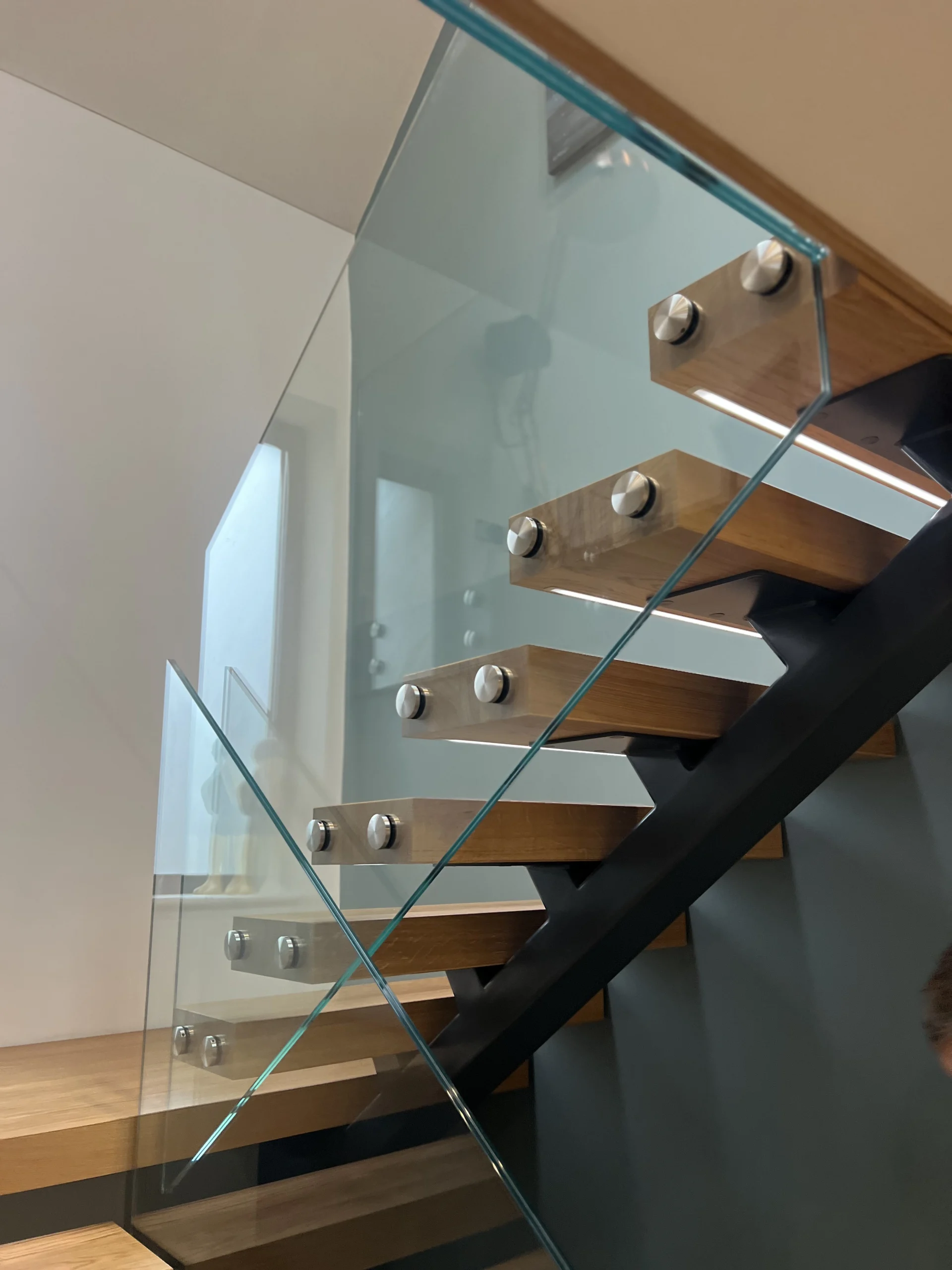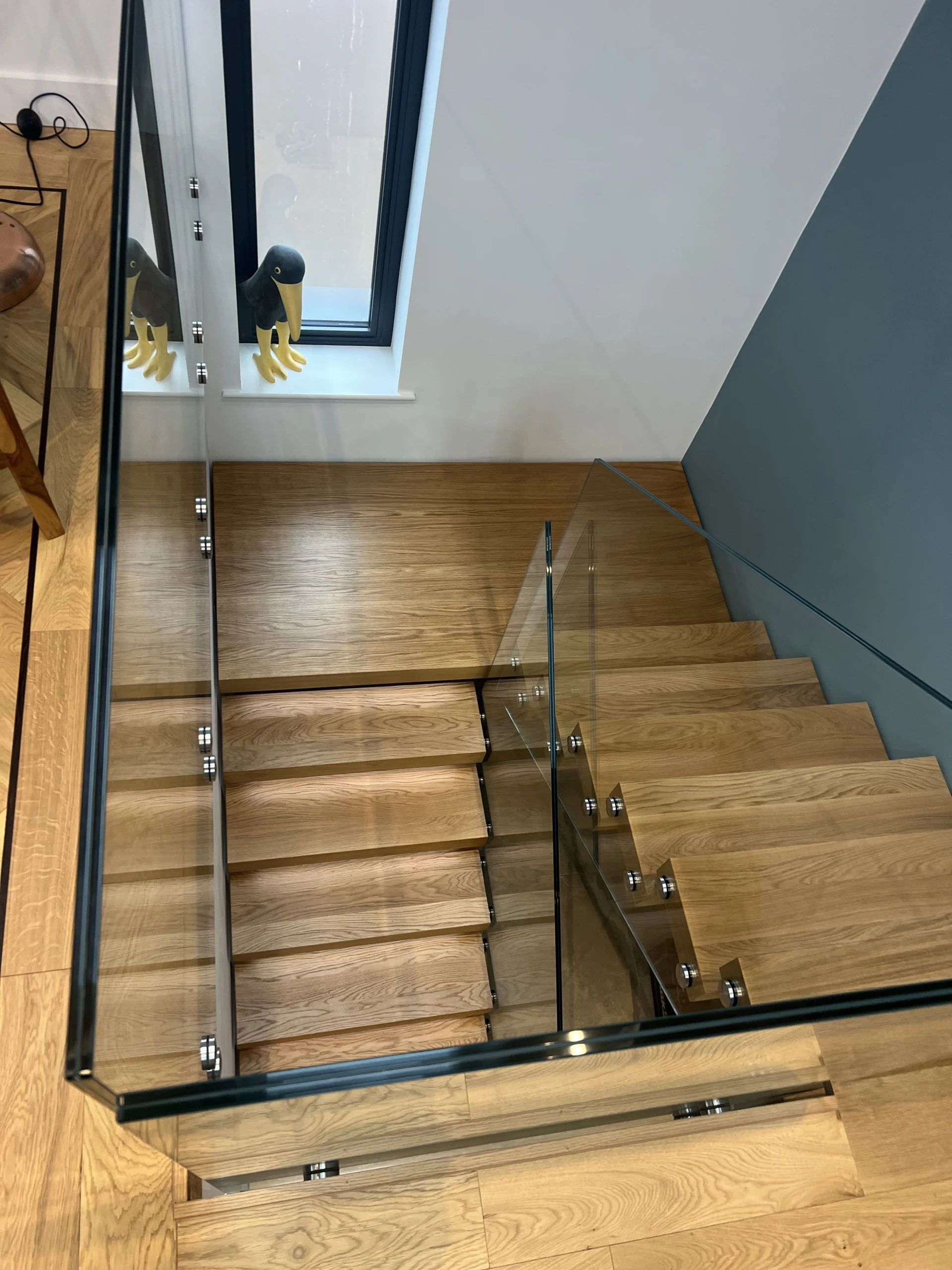

A Juliet balcony is one of the most searched — and most misunderstood — architectural features in UK residential design. It is not a balcony you can stand on. It has no platform, no floor, and no projecting structure. It is a protective barrier fixed across a full-height opening — typically French doors or floor-to-ceiling windows — that allows the doors to open fully while preventing anyone from falling out. Named after Shakespeare's Romeo and Juliet, where Juliet appears at an upper-storey opening, a Juliet balcony creates the feeling of an open balcony without the structural complexity, planning permission headaches, or cost of building one.
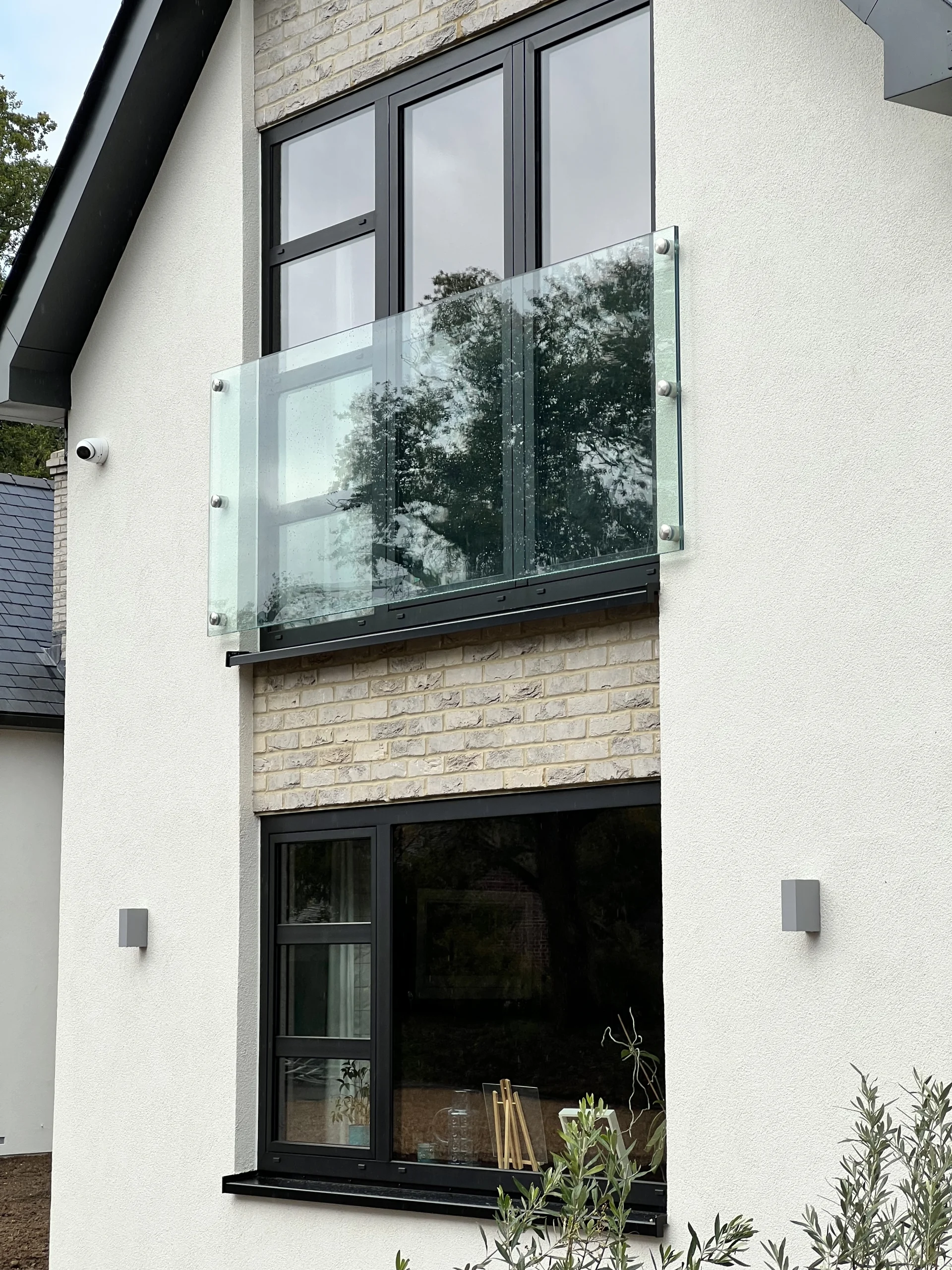
A frameless glass Juliet balcony — no platform, no protrusion, maximum light and ventilation
A Juliet balcony is a protective barrier — usually frameless glass, steel railings, or wrought iron — fixed to the outside (or inside) of a full-height opening on an upper floor. It has no external platform or floor to stand on. Under UK Building Regulations, a Juliet balcony is classified as guarding (Part K), not a balcony. It must be at least 1,100mm high from finished floor level, have no gaps exceeding 100mm (sphere rule), withstand a 0.74 kN/m horizontal line load for residential use, and use safety glass (toughened or laminated) if glazed. Planning permission is generally not required because there is no external platform — but Building Regulations approval is required whenever the installation forms part of wider building work. Cost: £300–£1,500+ depending on material, width, and specification.
Juliet Balcony vs Real Balcony — The Critical Difference
The confusion starts with the name. A Juliet balcony is not a balcony in any structural sense. A real balcony — sometimes called a walkout balcony or cantilever balcony — has a platform that projects from the building, creating an external floor area you can step out onto. It requires substantial structural engineering, planning permission in almost all cases, and Building Regulations approval covering both the platform structure and the edge protection.
A Juliet balcony has none of this. There is no external platform. There is no projecting structure. The barrier is fixed directly to the building facade or within the door reveals. You open the doors and stand inside the room, looking out through the barrier — you cannot step outside because there is nothing to step onto.
This distinction has massive practical implications. A walkout balcony typically costs £5,000–£20,000+, requires structural engineering calculations, almost always needs planning permission, and must be designed by a qualified structural engineer. A Juliet balcony typically costs £300–£1,500, rarely needs planning permission, and can be installed in a day.
| Feature | Juliet Balcony | Walkout Balcony |
|---|---|---|
| External platform | None | Yes — projecting floor |
| Can you stand outside? | No | Yes |
| Planning permission | Usually not required | Almost always required |
| Structural engineering | Minimal — fixings into masonry | Full structural design required |
| Cost range | £300–£1,500+ | £5,000–£20,000+ |
| Installation time | Half day to one day | 1–4 weeks |
| Building Regulations | Part K guarding | Part A structure + Part K guarding |
Types of Juliet Balcony — Which Design Suits Your Property?
1 Frameless glass
The most popular option in contemporary UK housing. A single sheet (or two sheets) of clear toughened or laminated safety glass, held in place by minimalist stainless steel point fixings or a U-channel base shoe. The glass provides an unobstructed view, allows maximum light into the room, and creates a clean, modern aesthetic that suits new builds and renovated period properties alike. Frameless glass Juliet balconies start from around £400 for a standard 1,200mm-wide opening and upward of £800 for wider spans or bespoke sizes.
2 Steel railing (contemporary)
Horizontal or vertical steel bars in a powder-coated frame — typically matte black (RAL 9005) or anthracite grey (RAL 7016). This is the classic modern Juliet balcony for mid-century and contemporary properties. Vertical bars automatically meet the 100mm sphere rule; horizontal bars must be spaced so that the gaps do not exceed 100mm and must not create climbing footholds (particularly important for properties with young children). Cost: £200–£600.
3 Wrought iron (traditional)
Decorative wrought iron or cast iron Juliet balconies with scrollwork, curves, and ornamental details. The traditional choice for Georgian, Victorian, and Edwardian properties where a contemporary glass or steel design would look out of place. Period-appropriate wrought iron Juliet balconies are available from specialist ironwork suppliers — expect to pay £300–£800 for a standard width, or significantly more for bespoke period-accurate reproductions.
4 Glass with steel handrail
A hybrid design combining frameless or framed glass panels with a steel or stainless steel handrail across the top. This provides the visual transparency of glass with a tactile gripping surface — useful for properties where a handrail adds a sense of security. This is the specification Continox most commonly supplies for bespoke Juliet balconies, using toughened glass with a powder-coated steel flat bar handrail at 1,100mm.
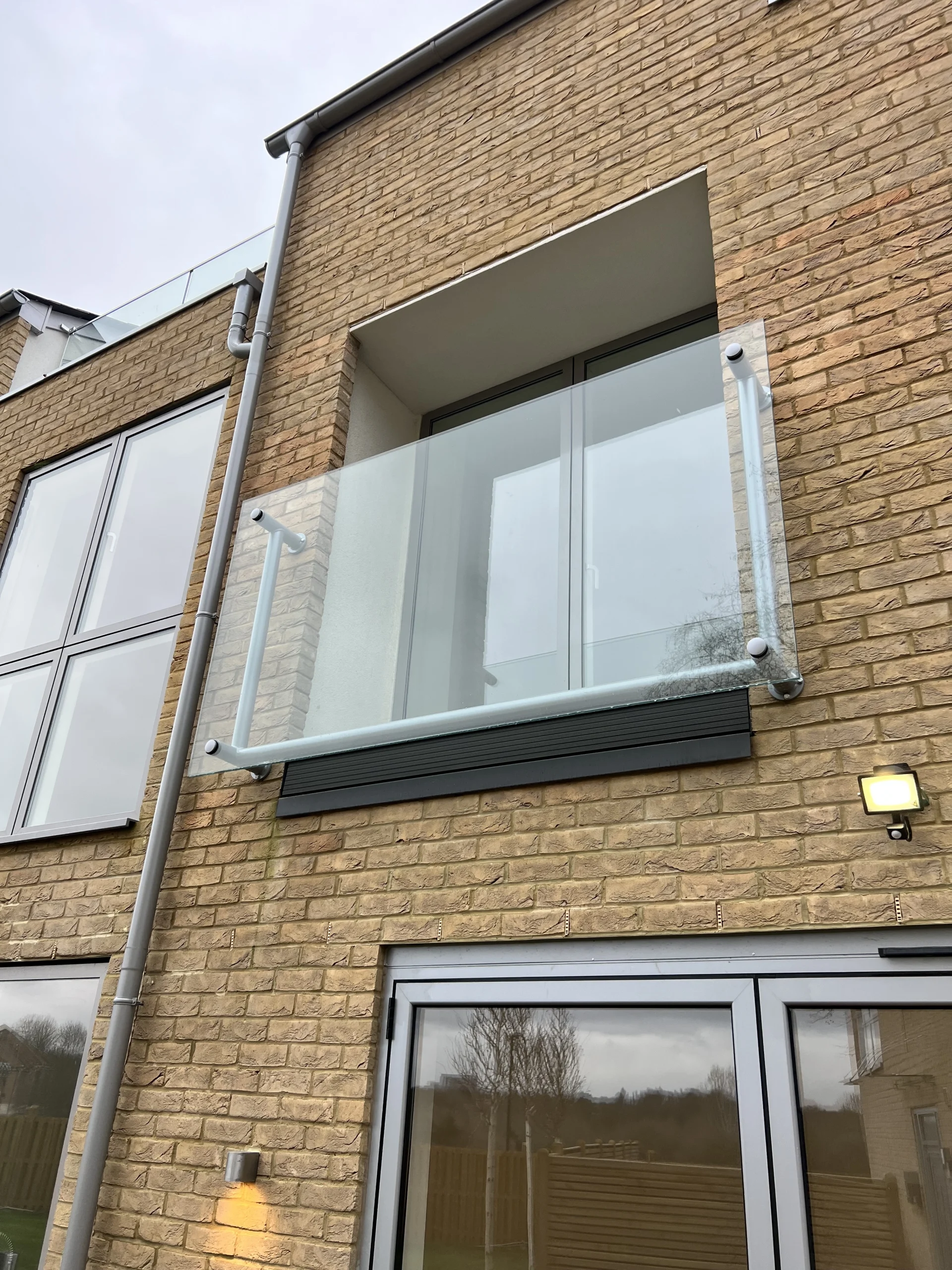 Bespoke glass Juliet balcony with steel handrail — designed and installed by Continox
 Frameless glass — unobstructed view, maximum light, contemporary aesthetic
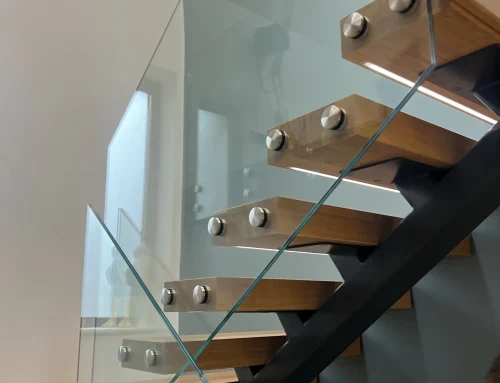
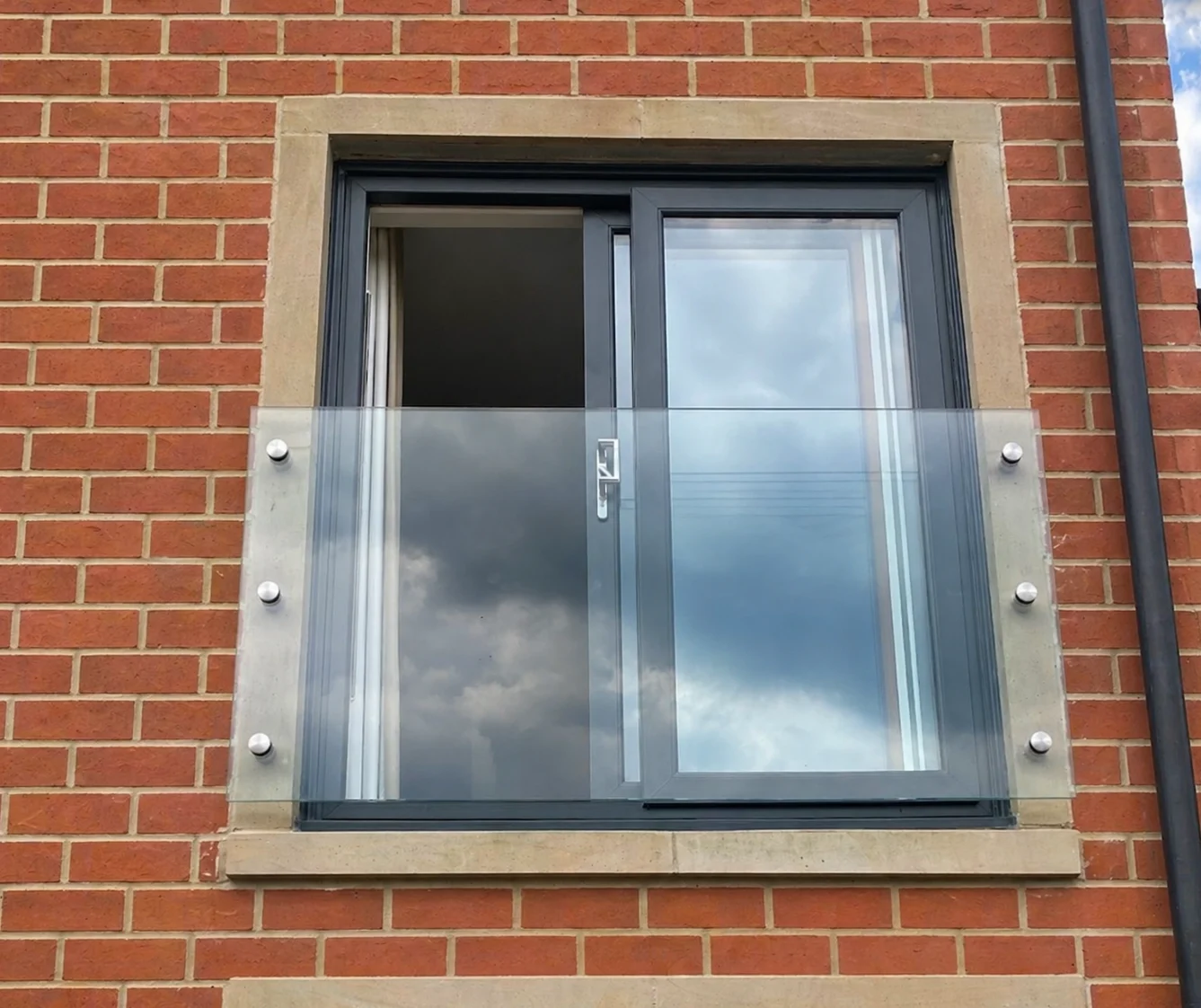 Point-fixed glass system — minimalist fixings into masonry
Continox Juliet balcony — bespoke sizing for any opening width
Point-fixed glass system — minimalist fixings into masonry
Continox Juliet balcony — bespoke sizing for any opening width
Building Regulations — What Part K Requires
A Juliet balcony is classified as guarding under Approved Document K (Protection from Falling), not as a balcony structure. This is a critical distinction — it means the regulations governing Juliet balconies are about fall prevention, not structural load-bearing for occupancy. The requirements are straightforward but non-negotiable.
| Requirement | Value | Notes |
|---|---|---|
| Minimum height | 1,100mm | Measured from finished floor level — not structural slab |
| 100mm sphere rule | No gap >100mm | Prevents child entrapment |
| Horizontal line load | 0.74 kN/m | Residential — applied at top of barrier |
| Glass specification | Toughened or laminated safety glass | BS EN 12150 / BS EN 14449 |
| Glass thickness (typical) | 10–15mm toughened or 17.5mm laminated | Depends on span and fixing method |
| Anti-climb design | No horizontal footholds | Especially important with children present |
| Fixings | Into structural masonry or steel — not insulation | Chemical anchor or expansion bolt |
The 1,100mm measurement trap: The most common reason Juliet balcony installations fail Building Control is incorrect height measurement. The 1,100mm minimum is measured from the finished floor level inside the room — not from the structural slab, not from the door threshold, and not from the external brickwork. If your floor has a 20–30mm screed or floor covering above the slab, the barrier must account for that additional height. A 20mm error is enough for Building Control to reject the installation.
For the complete UK guarding regulations covering staircases, landings, and balconies, see our staircase regulations pillar page. For glass balustrade specifications — including frameless systems suitable for Juliet balconies — see our product page.
Planning Permission — Do You Need It?
In most cases, a Juliet balcony does not require planning permission. Because there is no external platform, no projecting structure, and no increase in the building's footprint, a Juliet balcony is generally treated as a window alteration or like-for-like replacement — which falls within permitted development rights for most residential properties.
However, planning permission may be required in the following situations. The property is in a conservation area, Area of Outstanding Natural Beauty, or National Park, and the Juliet balcony would alter the external appearance of the building. The property is a listed building — any external alteration to a listed building requires listed building consent, regardless of size. The Juliet balcony is on a front elevation or side elevation that is visible from a public highway, and the local planning authority has specific policies about external alterations. The opening itself is new (you are creating a new doorway or window where there was not one before) — the new opening may require planning permission even if the Juliet balcony itself does not.
Practical advice: If you are in any doubt, contact your local planning authority before ordering. You can apply for a Lawful Development Certificate to confirm that your installation is permitted development — this costs approximately £100 and gives you written proof that planning permission is not required. For straightforward rear-elevation installations on non-listed, non-conservation-area properties, this is usually unnecessary.
Building Regulations Approval — When You Need It
Building Regulations approval is a separate question from planning permission — and the rules are different. A Juliet balcony installation will normally require Building Regulations approval if it forms part of wider building work that is subject to Building Regulations (for example, a loft conversion with new French doors, an extension with an upper-floor opening, or a material alteration to the building fabric).
If you are simply replacing an existing Juliet balcony with a new one on an otherwise unchanged opening — and no structural alterations are involved — Building Regulations approval may not be required. However, the replacement must still comply with the Part K requirements (1,100mm height, 100mm sphere rule, safety glass, adequate fixings). Always check with your local Building Control office before assuming approval is not needed.
Building Control will typically want to see that the barrier height meets the 1,100mm minimum, the glass specification meets safety standards, the fixings are into structural masonry or steel (not insulation or render), and the overall installation can resist the required horizontal loads.
How a Juliet Balcony Transforms a Room
The practical benefit of a Juliet balcony is not about standing outside — it is about transforming the room inside. Replacing a standard window with French doors and a Juliet balcony changes the character of a room in three ways.
Light
Full-height French doors admit dramatically more natural light than a standard window. A frameless glass Juliet balcony preserves this light without obstruction — there are no rails, bars, or frames casting shadows. In north-facing rooms or rooms with limited window area, this can be the single most effective improvement to natural light levels.
Ventilation
Opening both French doors creates a full-width opening to the outside — providing substantially more ventilation than a window that opens by 100–200mm. With the Juliet balcony in place, you can open the doors fully while maintaining fall protection. This is particularly valuable in bedrooms, where nighttime ventilation improves sleep quality.
Connection to the outside
A Juliet balcony creates a visual and sensory connection between the room and the view beyond — whether that view is a garden, a street, a coastline, or a cityscape. Standing at the open doors with fresh air on your face and an unobstructed view through frameless glass creates an experience that is fundamentally different from looking through a window.
Where Juliet Balconies Work Best — Room by Room
Master bedroom
The most popular location for a Juliet balcony. French doors with a frameless glass barrier create a sense of luxury and connection to the outside that transforms the room from a sleeping space into a retreat. Morning light, nighttime ventilation, and a view from the bed are the three benefits homeowners mention most.
Loft conversion
A Juliet balcony on a loft conversion dormer is one of the most effective ways to make the loft feel like a genuine part of the house rather than a converted roof space. The full-height opening and glass barrier bring the loft room into visual connection with the garden or surroundings. For more on loft conversion design, see our loft conversion staircase ideas guide.
Kitchen / dining room
An upper-floor kitchen or dining room benefits from the ventilation a Juliet balcony provides — cooking odours and steam clear quickly through a full-width opening. The visual connection to the outside also makes the room feel larger and more open.
Home office
Natural light and fresh air are the two environmental factors most strongly correlated with productivity and wellbeing in a work-from-home setting. A Juliet balcony on a home office provides both — without the distraction of an actual balcony that tempts you to sit outside.
Juliet Balcony Costs — 2026 UK Pricing
| Type | Supply Cost | Installed Cost |
|---|---|---|
| Steel railing (powder coated, standard width) | £150–£350 | £200–£500 |
| Wrought iron (traditional design) | £250–£600 | £350–£800 |
| Frameless glass (standard 1,200mm) | £300–£600 | £400–£800 |
| Frameless glass (wide span 1,800mm+) | £500–£900 | £700–£1,200 |
| Glass with steel handrail (bespoke) | £600–£1,000 | £800–£1,500 |
| Bespoke stainless steel + glass (architectural) | £800–£1,500 | £1,000–£2,000+ |
Prices do not include the French doors or the opening itself — only the Juliet balcony barrier. If you are creating a new opening (converting a window to French doors), budget an additional £1,500–£4,000 for the doors, lintel, structural alterations, and making good. For glass balustrade pricing across all applications — staircases, landings, balconies — see our glass balustrade product page.
Installation — What the Process Involves
1 Site survey and measurement
The opening width and height are measured precisely, and the wall construction is assessed (solid masonry, cavity wall, timber frame, steel frame). The fixing positions are determined based on where the structural masonry or steel is located — fixings must never be into insulation, render, or brick slips.
2 Manufacture
For bespoke Juliet balconies, the glass is cut to size, toughened (or laminated), and the steel fixings or frame are fabricated to match the exact opening dimensions. Standard Juliet balconies are available in common widths (900mm, 1,200mm, 1,500mm, 1,800mm) for faster delivery.
3 Installation
The barrier is fixed to the external wall face (most common), within the door reveals, or to the internal wall face (less common, used when the doors open outward). Fixings are typically M12 or M16 stainless steel chemical anchor bolts into masonry. The entire installation takes 2–4 hours for a standard Juliet balcony.
4 Sealant and drainage
Where the fixings penetrate the external wall, a weather-resistant sealant (typically silicone or polyurethane) is applied to prevent water ingress. If the Juliet balcony has a base shoe or U-channel, drainage slots must be provided to prevent rainwater pooling against the glass.
Maintenance — Keeping Your Juliet Balcony Looking Good
Juliet balconies are low-maintenance, but not zero-maintenance. Glass panels should be cleaned every 3–6 months with warm water and a non-abrasive glass cleaner — hard water deposits and environmental grime can build up and reduce transparency. Stainless steel fixings should be wiped down with a stainless steel cleaner once or twice a year, particularly in coastal areas where salt exposure accelerates surface corrosion on lower-grade stainless steel (use Grade 316 in coastal locations). Powder-coated steel frames should be checked annually for chips or scratches that could expose the steel to corrosion — touch up with a matching paint if needed. Check fixings annually by applying gentle pressure to the barrier — any movement indicates the fixings may need tightening or replacing.
Does a Juliet Balcony Add Property Value?
A Juliet balcony does not add measurable value in the way a loft conversion or kitchen extension does — no estate agent will quote a percentage uplift specifically for a Juliet balcony. What it does is enhance the desirability and appeal of the rooms it serves, which contributes to the overall impression buyers form during viewings.
A bedroom with French doors, a frameless glass Juliet balcony, and a garden view photographs significantly better than the same room with a standard window — and in a market where buyers make initial judgments from online listing photos, this matters. The cost of installation (£400–£1,500) is trivial relative to the improvement in the room's presentation.
For maximum impact on property value, combine a Juliet balcony with a premium internal staircase — the two elements together signal a level of design quality that buyers remember. For staircase options, see our modern staircase range or our guide to bespoke staircase costs.
Frequently Asked Questions — Juliet Balconies
A Juliet balcony is a protective barrier fixed across a full-height opening (typically French doors) on an upper floor. It has no external platform — you cannot stand outside on it. It provides fall protection while allowing the doors to open fully for light and ventilation. Under UK Building Regulations, it is classified as guarding (Part K), not a balcony.
Generally no — because there is no external platform, a Juliet balcony usually falls within permitted development. However, planning permission may be needed if the property is listed, in a conservation area, or if you are creating a new opening in the wall. Always check with your local planning authority if in doubt.
A minimum of 1,100mm from the finished floor level inside the room. This is measured from the final floor surface (including carpet, tiles, or laminate) — not from the structural slab. A 20–30mm discrepancy caused by measuring from the slab instead of the finished floor is enough for Building Control to reject the installation.
A standard steel railing Juliet balcony costs £200–£500 installed. Frameless glass starts from £400–£800 for a standard width. Bespoke glass with steel handrail runs £800–£1,500+. These prices are for the barrier only — creating a new opening (converting a window to French doors) adds £1,500–£4,000.
No — a Juliet balcony has no external platform or floor. You stand inside the room, looking out through the barrier. If you want to step outside, you need a walkout balcony (which is a completely different structure requiring planning permission, structural engineering, and significantly higher cost).
Toughened safety glass (BS EN 12150) or laminated safety glass (BS EN 14449). Thickness is typically 10–15mm for toughened glass or 17.5–21.5mm for laminated glass, depending on the span and fixing method. Laminated glass is recommended for higher installations because it remains in place if broken, maintaining the barrier function.
Building Regulations approval is required if the Juliet balcony forms part of wider building work (loft conversion, extension, new opening). If you are replacing an existing Juliet balcony like-for-like with no structural alterations, Building Regulations approval may not be required — but the installation must still comply with Part K. Check with your local Building Control office.
Master bedrooms are the most popular location, followed by loft conversions, upper-floor living rooms, and home offices. Rear elevations are ideal because they rarely require planning permission and provide views over the garden. Front and side elevations may be more sensitive due to overlooking neighbours and conservation area restrictions.
Need a Juliet Balcony for Your Property?
Continox designs and manufactures bespoke glass Juliet balconies — frameless, with steel handrail, or fully custom to your specification. Part K compliant, precision-engineered, installed by our own team. Based in Gosport, Hampshire, serving Southern England.