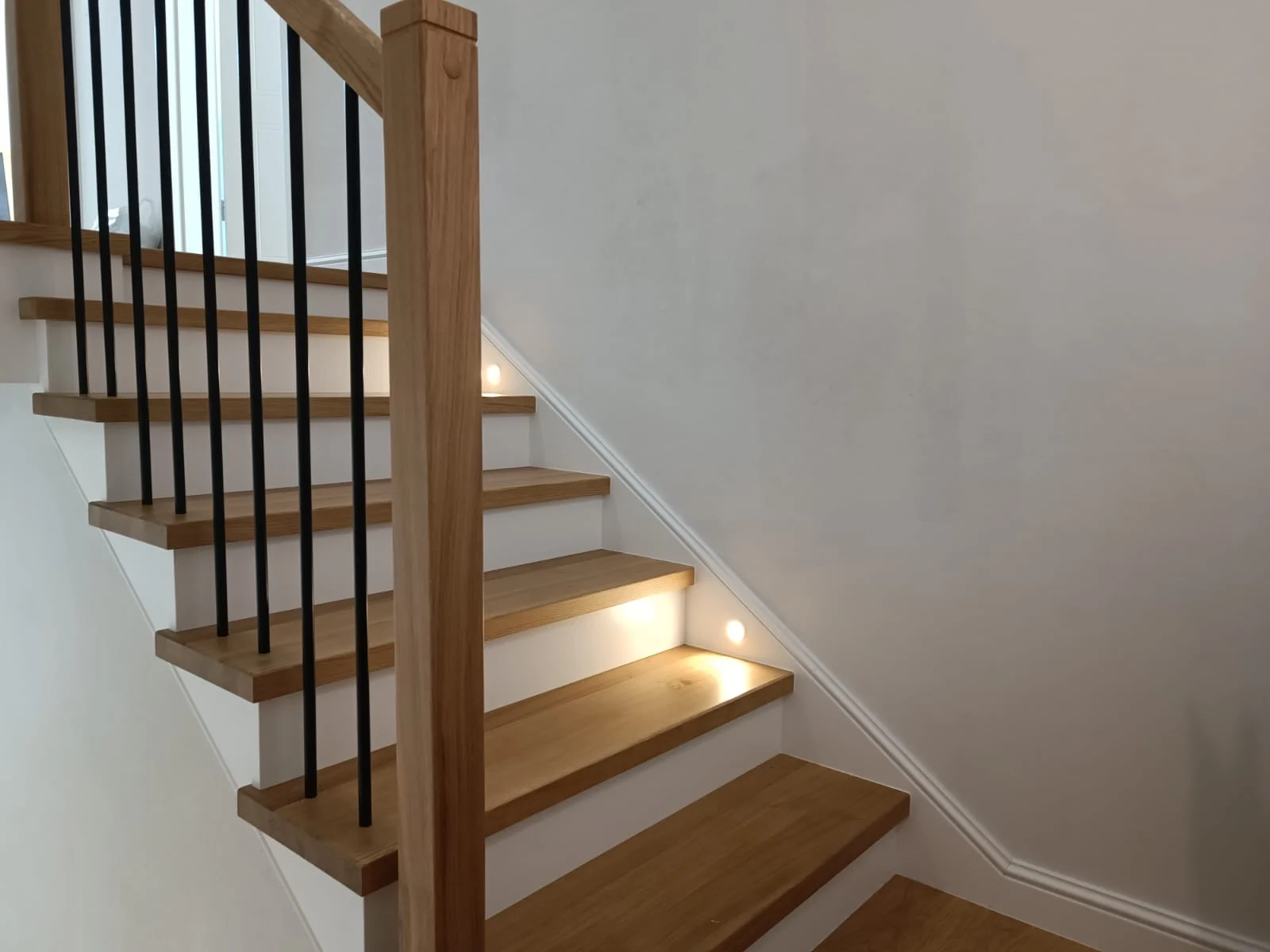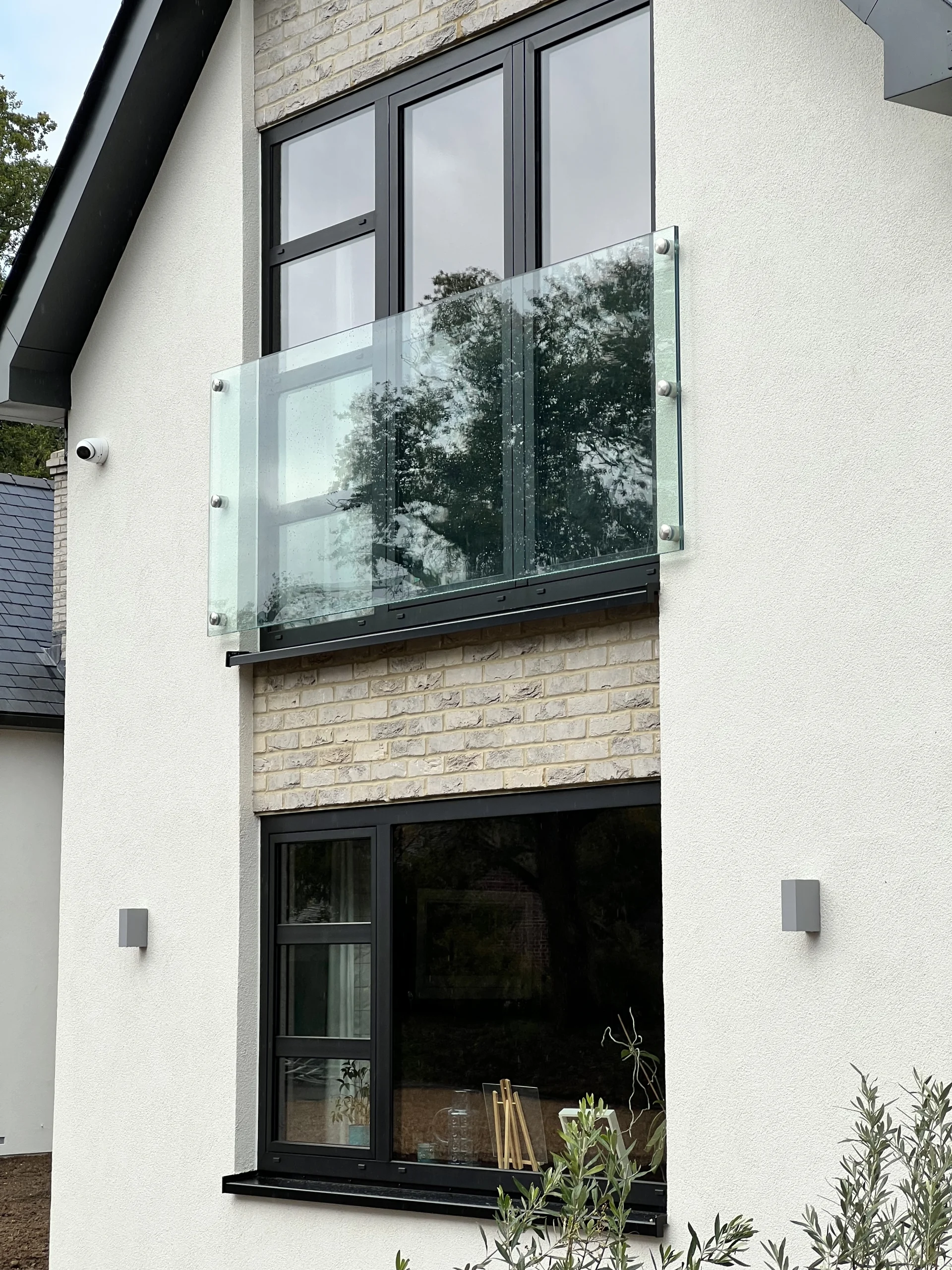

Your loft conversion staircase is the single element Building Control scrutinises most closely — and the one most likely to cause delays if it does not meet regulations. This guide covers every rule that applies to loft conversion staircases under Approved Document K, Approved Document B (fire safety), and the Building Control inspection process. Written for UK homeowners planning a loft conversion in England and Wales, with the specific concessions, exceptions, and practical thresholds that apply only to loft stairs.
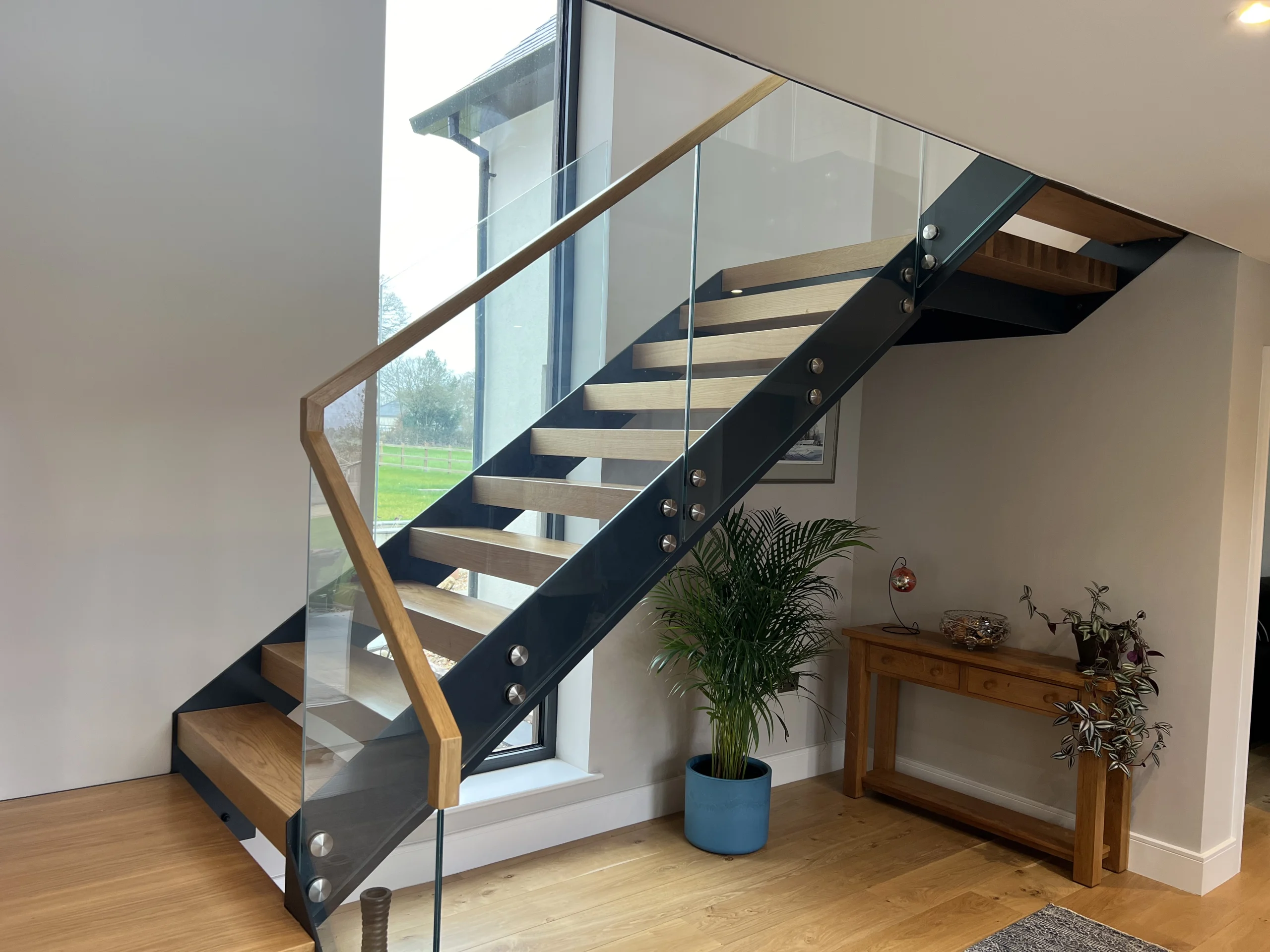
A Part K compliant bespoke loft staircase — oak treads, steel frame, glass balustrade — designed and manufactured by Continox
Every loft conversion staircase in England and Wales must comply with Approved Document K (Part K) of the Building Regulations. The core requirements are: maximum pitch 42°, rise per step 150–220mm, going (tread depth) minimum 220mm, headroom minimum 2,000mm (reduced to 1,800mm at the low side and 1,900mm at centre line under a sloping ceiling — loft concession only), handrails at 900–1,000mm, and the 100mm sphere rule for balustrading. Approved Document B adds 30-minute fire resistance for the staircase structure and stairwell enclosure, fire doors (FD20 or FD30), and mains-powered interlinked smoke alarms on every floor. Building Control will inspect at structural stage, mid-build, and final sign-off before issuing a completion certificate.
Which Regulations Apply to Loft Conversion Staircases?
A loft conversion staircase sits at the intersection of three separate Approved Documents. Understanding which regulations come from which document helps you — and your builder — anticipate exactly what Building Control will check at each inspection stage.
Approved Document K — Protection from falling, collision and impact
This is the primary staircase regulation. Part K covers every dimensional requirement: pitch, rise, going, headroom, handrail heights, balustrade gaps, landing sizes, and the specific rules for winder treads, alternating tread stairs, spiral staircases, and fixed ladders. It is the document your staircase designer will reference most frequently, and the one that determines whether a proposed design is physically compliant.
Approved Document B — Fire safety
Part B governs the staircase as part of the means of escape. It requires 30-minute fire resistance for the staircase structure, the stairwell enclosure walls, and any glazing within the stairwell. It mandates fire doors on all openings into the stairwell, mains-powered interlinked smoke alarms, and — in properties that become three storeys after loft conversion — a protected stairwell that discharges directly to a door leading outside.
Approved Document A — Structure
Part A is relevant because the staircase opening requires cutting existing ceiling joists. These joists support the ceiling below and restrain the roof structure from spreading. The opening must be formed with timber trimmers — usually double trimmers (two timbers bolted together) — sized by a structural engineer to transfer the load to the remaining joists. Your structural engineer's calculations must be approved by Building Control before work begins.
Key point: Building Regulations approval is mandatory for every loft conversion staircase — regardless of whether the wider loft conversion requires planning permission. Most loft conversions fall under permitted development and do not need planning permission, but Building Regulations always apply. Without a completion certificate from Building Control, the conversion is classed as non-compliant.
Part K Dimensional Requirements — The Complete Table
The table below covers every measurable requirement that Building Control will check on a standard loft conversion staircase. These dimensions apply to private domestic stairs under Part K — different values apply to common stairs, utility stairs, and stairs in buildings other than dwellings.
| Requirement | Value | Part K Reference |
|---|---|---|
| Maximum pitch | 42° | Table 1.1 |
| Rise (per step) | 150–220mm | Table 1.1 |
| Going (tread depth) | ≥220mm (max 300mm) | Table 1.1 |
| 2R + G comfort formula | 550–700mm | Table 1.1 note |
| Headroom — standard | ≥2,000mm | Diagram 1.3 |
| Headroom — loft concession (low side) | ≥1,800mm | Diagram 1.3 note |
| Headroom — loft concession (centre line) | ≥1,900mm | Diagram 1.3 note |
| Handrail height | 900–1,000mm | Diagram 1.9 |
| Balustrade height (stairs) | ≥900mm | Para 3.2 |
| Balustrade height (landing) | ≥900mm (domestic) | Para 3.2 |
| 100mm sphere rule | No sphere may pass through | Para 3.4 |
| Open riser overlap | ≥16mm | Para 1.10 |
| Open riser — sphere rule | 100mm sphere must not pass through | Para 1.10 |
| Consistent rise & going | Identical throughout flight | Para 1.3 |
| Landing length & width | ≥ width of staircase | Para 1.14 |
For a comprehensive guide to all UK staircase regulations — including commercial, fire escape, and external stairs — see our complete UK staircase regulations reference.
The Loft Conversion Headroom Concession Explained
Standard domestic staircases require a minimum of 2,000mm clear headroom above every tread, measured vertically from the nosing. For loft conversions, Part K provides a specific concession that recognises the practical constraints of working under a sloping roof.
Where the staircase passes under a sloping ceiling, headroom may reduce to 1,800mm at the lowest point (the side of the stair closest to the roof slope) and 1,900mm at the centre line of the stair width. This means the headroom is measured across the full width of the staircase, not just at the highest point.
Critical limitation: This concession applies only to loft conversion staircases. You cannot use it to justify reduced headroom on a ground-to-first-floor staircase, even if it passes under a sloping ceiling. Building Control will reject any design that applies the loft concession to a non-loft staircase. Always confirm with your local Building Control officer before relying on the concession.
If your loft cannot achieve even the reduced headroom thresholds, you have limited options. A dormer extension above the stairwell is the most common solution — it replaces the sloping roof section with a flat or raised roof, creating full-height headroom. Alternatively, repositioning the staircase to terminate at the highest point of the roof (typically the ridge line) can resolve marginal cases.
Measuring correctly: Headroom is measured vertically from the nosing of each tread to the underside of the ceiling directly above — not to the underside of the roof covering. If the ceiling is lined with plasterboard and insulation, allow for the combined thickness (typically 150–200mm) when calculating available headroom. Many homeowners measure to the rafters and are surprised to find they lose 150mm or more once the ceiling is lined.
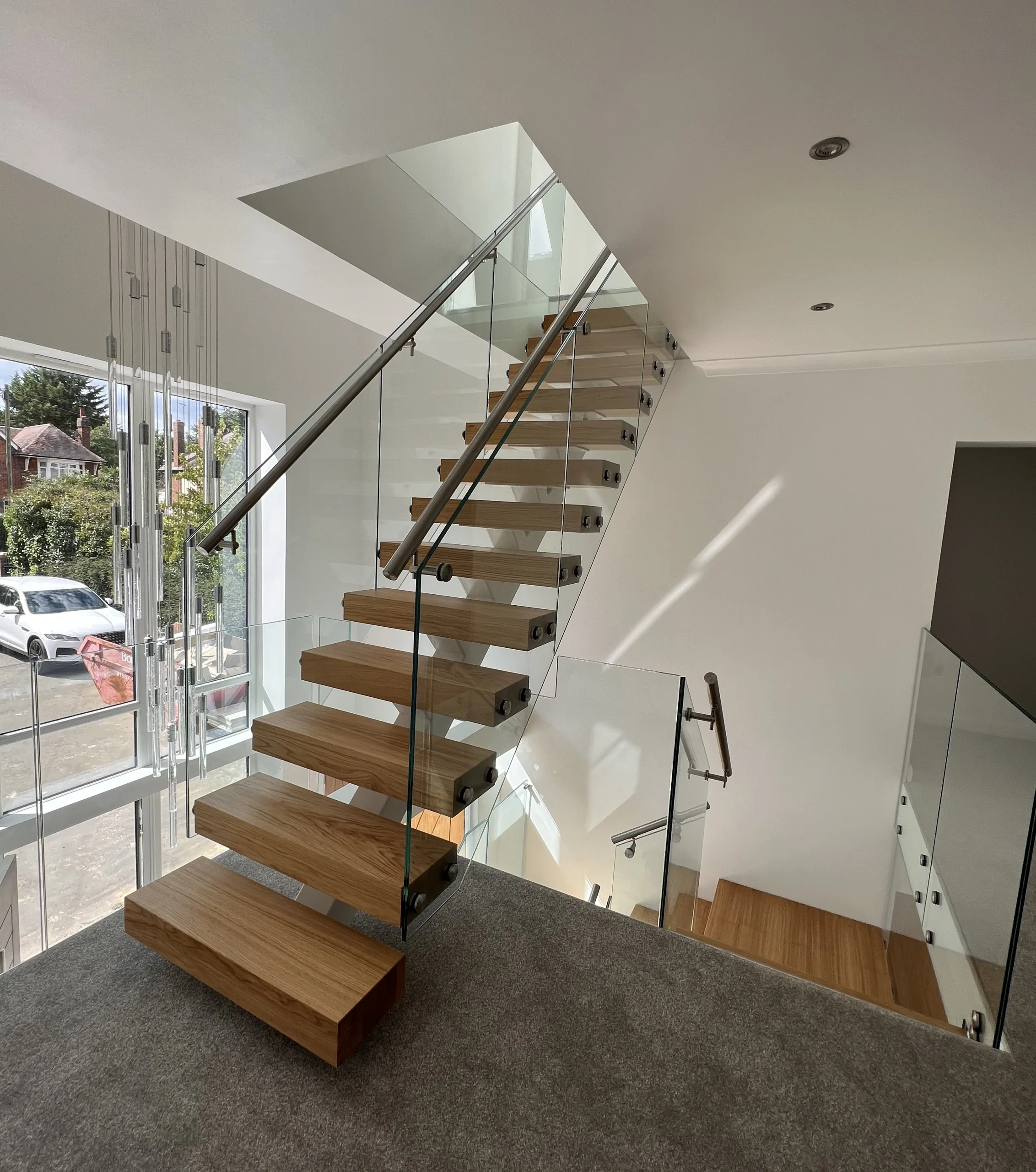 Loft staircase positioned at the ridge — maximum headroom achieved
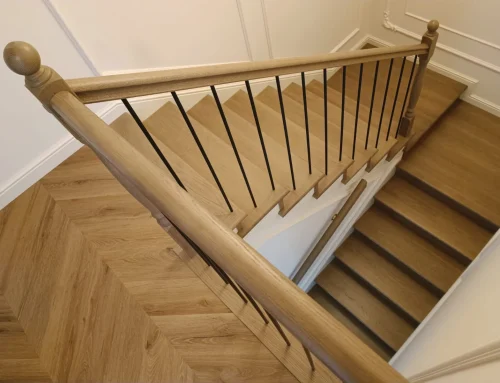
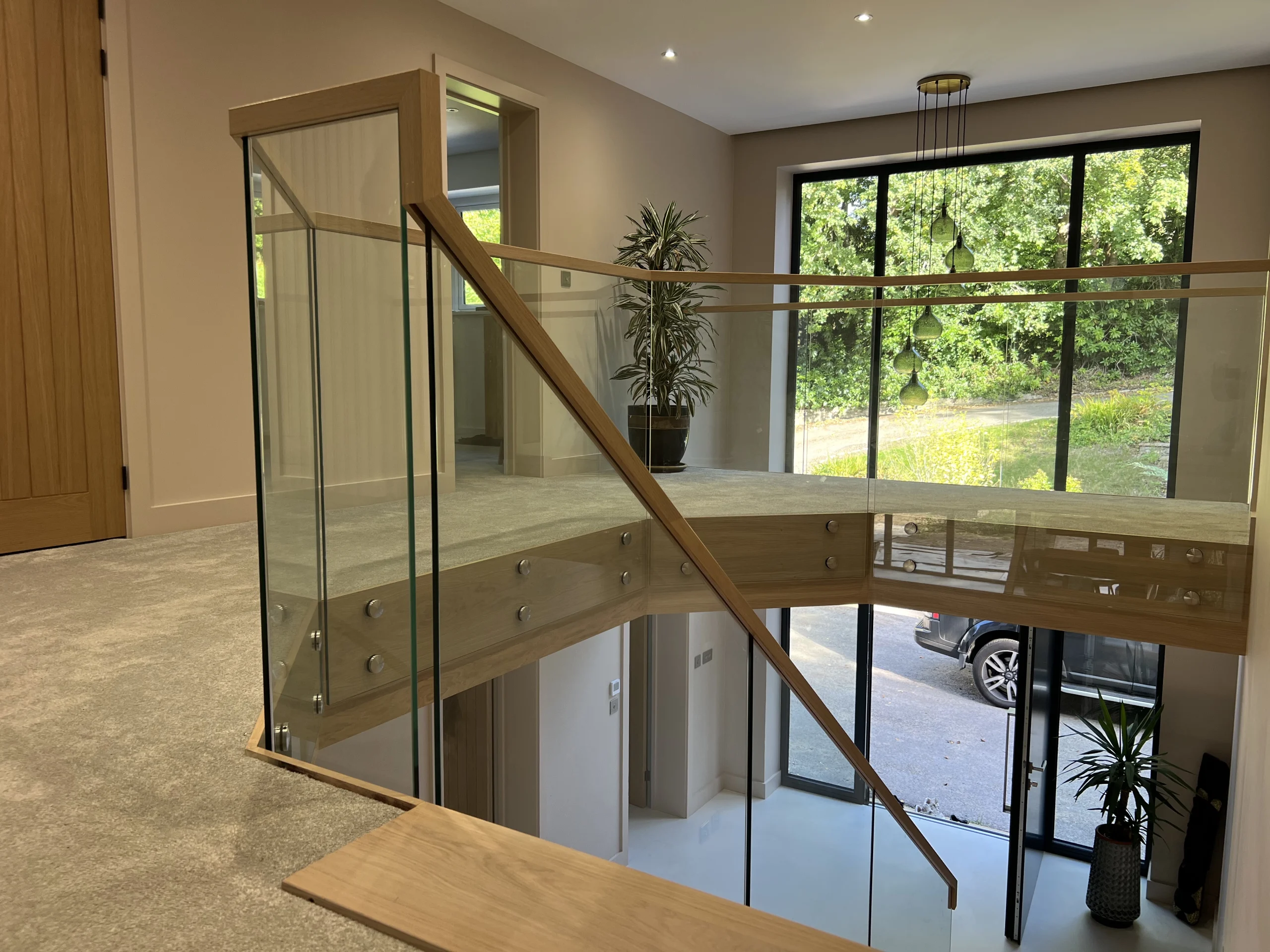 Part K compliant open risers — 16mm minimum overlap, 100mm sphere rule met
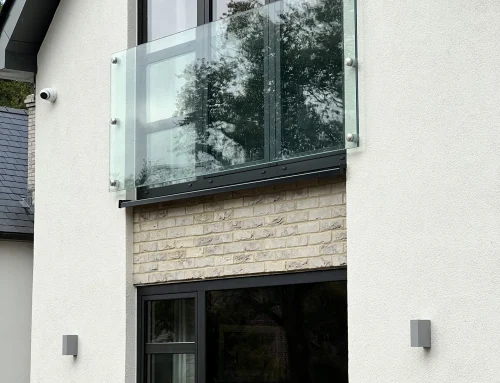
 Glass balustrade at 900mm+ height — compliant guarding for loft stairs
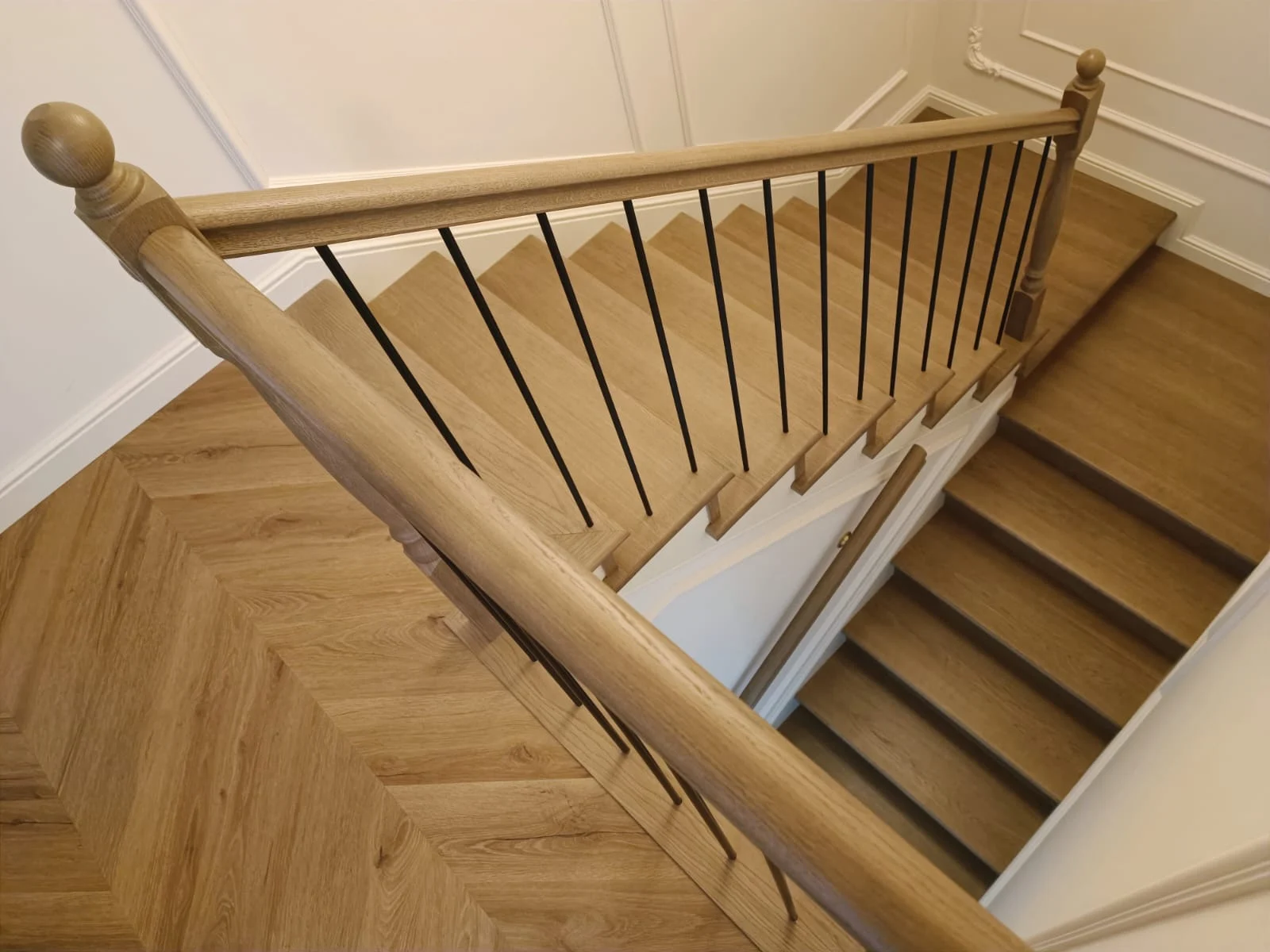
 Handrail at 900–1,000mm from pitch line — Part K compliant
Rise, Going and Pitch — Getting the Numbers Right
The relationship between rise (the vertical height of each step), going (the horizontal depth of each tread), and pitch (the angle of the staircase) is the foundation of Part K compliance. Get these wrong and Building Control will reject the staircase — there is no discretion here.
Rise: 150–220mm
Every step in a private domestic staircase must have a rise between 150mm and 220mm. The critical constraint is consistency: every step within a single flight must have an identical rise. If your floor-to-floor height does not divide evenly by your chosen rise, you must adjust either the rise or the number of treads — you cannot have one step that is slightly different from the others.
Going: minimum 220mm
Going is measured horizontally from the nosing of one tread to the nosing of the next. For a private domestic staircase (including loft conversions), the going must be at least 220mm and no more than 300mm. As with rise, every step in the flight must have an identical going.
The 2R + G comfort formula
Part K requires that twice the rise plus the going falls between 550mm and 700mm. This formula — 2R + G — is a comfort check that ensures the staircase feels natural to climb. For example, a staircase with 175mm rise and 250mm going gives: (2 × 175) + 250 = 600mm, which sits comfortably within the range.
Pitch: maximum 42°
The pitch is the angle of the staircase measured from horizontal. For a private domestic staircase, the maximum pitch is 42°. In practice, if your rise and going comply with the dimensional requirements and the 2R + G formula, the pitch will automatically fall within the limit. A staircase that pushes to 42° (rise 220mm, going 220mm) feels steep but is compliant.
| Rise (mm) | Going (mm) | 2R + G | Pitch | Verdict |
|---|---|---|---|---|
| 175 | 250 | 600mm | 35° | Comfortable — ideal for daily use |
| 190 | 240 | 620mm | 38° | Good — practical compromise |
| 200 | 230 | 630mm | 41° | Steep but compliant |
| 220 | 220 | 660mm | 42° | Maximum allowed — feels steep |
| 220 | 200 | 640mm | 47.7° | NON-COMPLIANT — going below 220mm |
Practical guidance: A rise of 175–190mm with a going of 240–250mm represents the sweet spot for loft conversion staircases — steep enough to minimise the horizontal footprint (saving floor space below) while comfortable enough for daily use. At Continox, we typically specify 185mm rise and 245mm going as the default starting point for bespoke loft stairs.
Winder Treads — Regulations for Turns
Most loft conversion staircases include at least one turn — typically a 90° quarter turn using winder treads (tapered treads that fan out around the turn). Winders are regulated more strictly than straight treads because the narrow end creates a potential trip hazard.
Part K requires that the going on winder treads is measured at the centre of the tread width. At the narrow end, the tread must not be less than 50mm wide. The going at the walking line (measured 270mm from the inner edge for stairs less than 1,000mm wide) must comply with the same minimum going as straight treads — 220mm for private stairs.
In practice, this means winder treads must be designed so that even at their narrowest point, someone placing their foot at the centre of the tread has a full 220mm+ of going. This is where many budget staircase designs fail — the winders look acceptable but the going at the walking line falls short.
Common failure point: Building Control will measure the going of winder treads at the walking line — not at the widest part of the tread. If the going at the walking line is less than 220mm, the staircase fails. A bespoke staircase manufacturer will calculate these dimensions precisely during the design phase. Off-the-shelf staircases often need modification to achieve compliance in loft conversions with non-standard floor-to-floor heights.
Handrails and Balustrading — Height, Strength, Gaps
Part K sets three critical requirements for handrails and balustrading on loft conversion staircases.
Handrail height: 900–1,000mm
Handrails must be positioned between 900mm and 1,000mm above the pitch line (the imaginary line connecting the nosings of the treads). For stairs narrower than 1,000mm, a handrail is required on at least one side. For stairs wider than 1,000mm, handrails must be fitted on both sides. The handrail must provide a continuous gripping surface along the full length of the stair flight.
Balustrade height: minimum 900mm
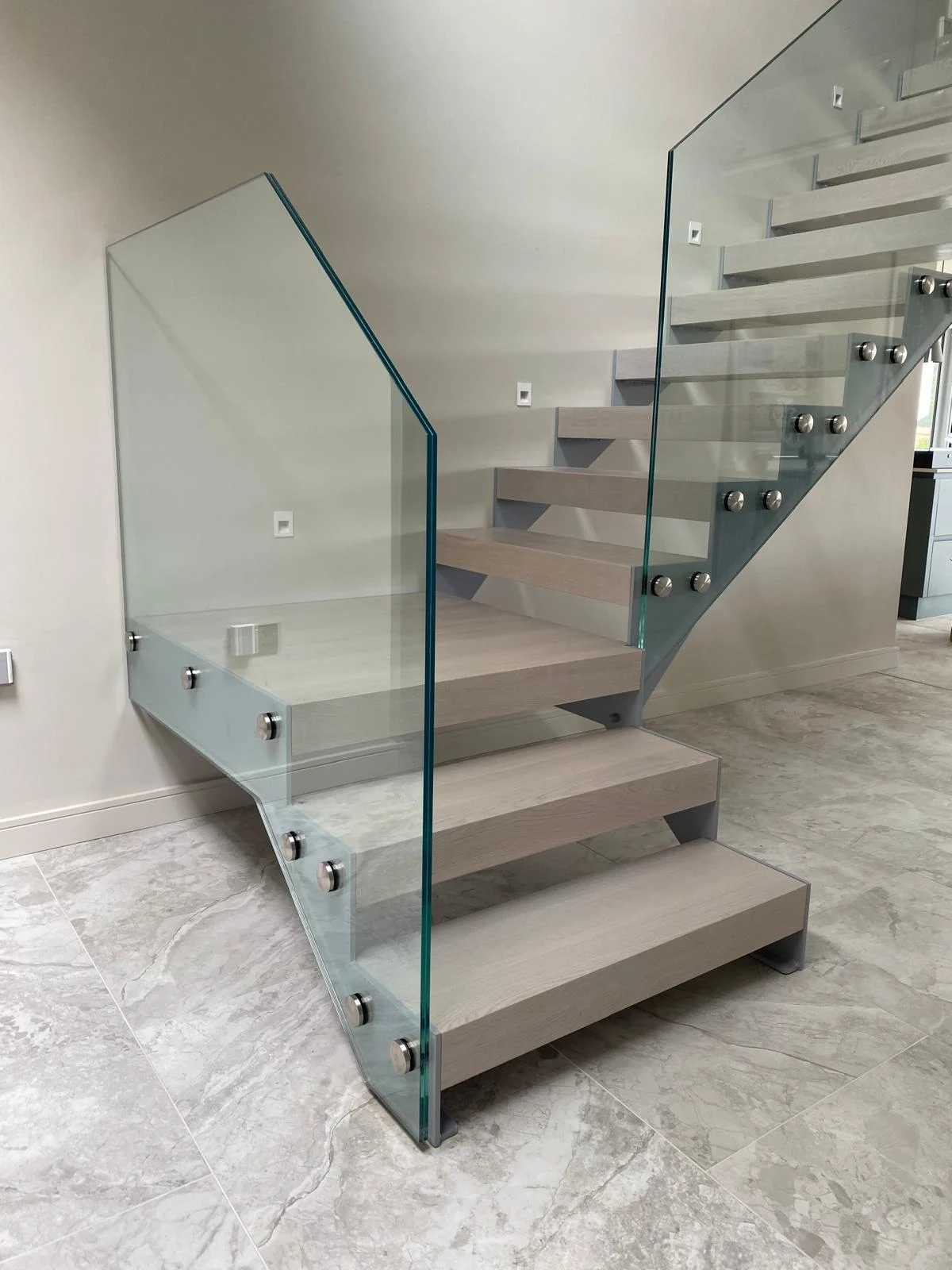
On open sides of stairs and landings where there is a drop of more than 600mm, guarding (a balustrade or barrier) must be at least 900mm high. This applies to the staircase itself and to the landing at the top — including the opening in the loft floor around the staircase. A frameless glass balustrade is one of the most effective solutions because it provides compliant guarding while allowing light to flow between floors.
The 100mm sphere rule
No gap in the balustrade construction — between spindles, between panels, or between the bottom rail and the stair tread — should allow a 100mm sphere to pass through. This rule exists to prevent children from getting their heads caught between balusters. It applies equally to traditional spindle balustrading and to modern glass or metal infill systems.
For open-riser staircases, the same 100mm sphere rule applies to the gap between consecutive treads. Additionally, each tread must overlap the one below by at least 16mm.
Fire Safety — Approved Document B Requirements
Fire safety regulations for loft conversion staircases are governed by Approved Document B, and they become significantly more demanding when a loft conversion creates a third storey. This is the area where most homeowners are caught off guard — the staircase regulations (Part K) are relatively straightforward, but the fire safety requirements add substantial cost and complexity.
Two-storey houses becoming three-storey
When you convert the loft of a standard two-storey house, the property becomes three storeys. At this height, Building Regulations consider that escape through windows is no longer a safe option for all occupants. The staircase becomes the primary means of escape, and the following requirements apply.
The staircase must be enclosed within a protected stairwell. All walls, floors, and ceilings forming the stairwell enclosure must achieve 30-minute fire resistance. Every door opening onto the stairwell — on every floor, from ground to loft — must be a self-closing fire door rated to at least FD20 (20-minute fire resistance), although FD30 is generally preferred and increasingly specified by Building Control officers.
The protected stairwell must discharge directly to an external door at ground level. This is a critical requirement: the staircase must lead to a hallway or corridor that has a door directly to the outside. If your existing ground-floor layout has the front door opening through a living room rather than a hallway, structural alterations may be required to create a compliant escape route.
The alternative: Where a protected stairway direct to an external door is not achievable without major structural work, Building Control may accept an escape window from the loft room as an alternative. The window must provide a minimum opening area of 0.33m², with a minimum height and width of 450mm. The window sill must be between 600mm and 1,100mm above the loft floor. This is a concession, not a right — always agree the approach with Building Control before committing to a design.
Smoke detection
Mains-powered smoke alarms with battery backup must be installed on every floor of the dwelling, interlinked so that when one activates, all alarms sound simultaneously. This is non-negotiable and applies regardless of what fire protection strategy you adopt for the stairwell.
Staircase materials and fire resistance
The staircase structure itself must achieve 30-minute fire resistance. Steel-framed staircases inherently exceed this requirement — structural steel does not contribute to fire spread and maintains structural integrity for well over 30 minutes under standard fire conditions. Timber staircases may need additional fire protection, depending on their construction.
Any glazing within the stairwell enclosure — including glass balustrade panels and glass partitions — must also achieve 30-minute fire resistance. Georgian wired glass, borosilicate glass, or specifically rated fire-resistant glass are the compliant options. Standard toughened glass is not fire-rated and cannot be used within the stairwell enclosure without additional protection.
Special Staircase Types — What Part K Allows
Part K recognises that loft conversions often face space constraints that make a standard staircase impractical. It provides specific provisions for three alternative staircase types — each with strict conditions on when they may be used.
1 Alternating tread stairs (paddle stairs)
Part K paragraph 1.29 permits alternating tread stairs only in a loft conversion and only when Building Control is satisfied there is not enough space for a staircase that meets the standard requirements (paragraphs 1.2–1.24). Paddle stairs may serve only one habitable room, plus optionally a bathroom and/or WC — provided it is not the only WC in the dwelling. They must be in one or more straight flights (no turns), and every alternating step must be uniform with parallel nosings. Fixed handrails are required on both sides, and treads must have a non-slip surface.
2 Fixed ladders
Part K paragraph 1.32 permits a fixed ladder — with fixed handrails on both sides — only for a loft conversion containing one habitable room and only when there is not enough space, without altering the existing space, for any type of staircase. This is the most restricted access option: it is essentially a last resort when even a paddle staircase cannot fit. Retractable ladders are explicitly prohibited as a means of escape under Approved Document B.
3 Spiral and helical staircases
Spiral and helical staircases are governed by BS 5395 Part II rather than the rise-and-going requirements of Part K. A spiral staircase serving as primary access in a private dwelling must meet Category B requirements: minimum width of 1,000mm measured from the centre pole to the outer edge. The tread going is measured at the walking line, 270mm from the inner edge. Spiral staircases are fully compliant as primary loft access — unlike paddle stairs and ladders, they are not restricted to single-room conversions.
Hierarchy of options: Building Control operates a clear hierarchy. A standard staircase (straight, quarter-turn, L-shape, U-shape) is always preferred. A spiral or helical staircase is the next best option. Alternating tread stairs are a last resort. A fixed ladder is accepted only when nothing else will fit. If your builder proposes paddle stairs or a fixed ladder as a first option, ask whether the staircase position has been properly optimised — in most properties, a standard or spiral staircase can be made to work with creative positioning.
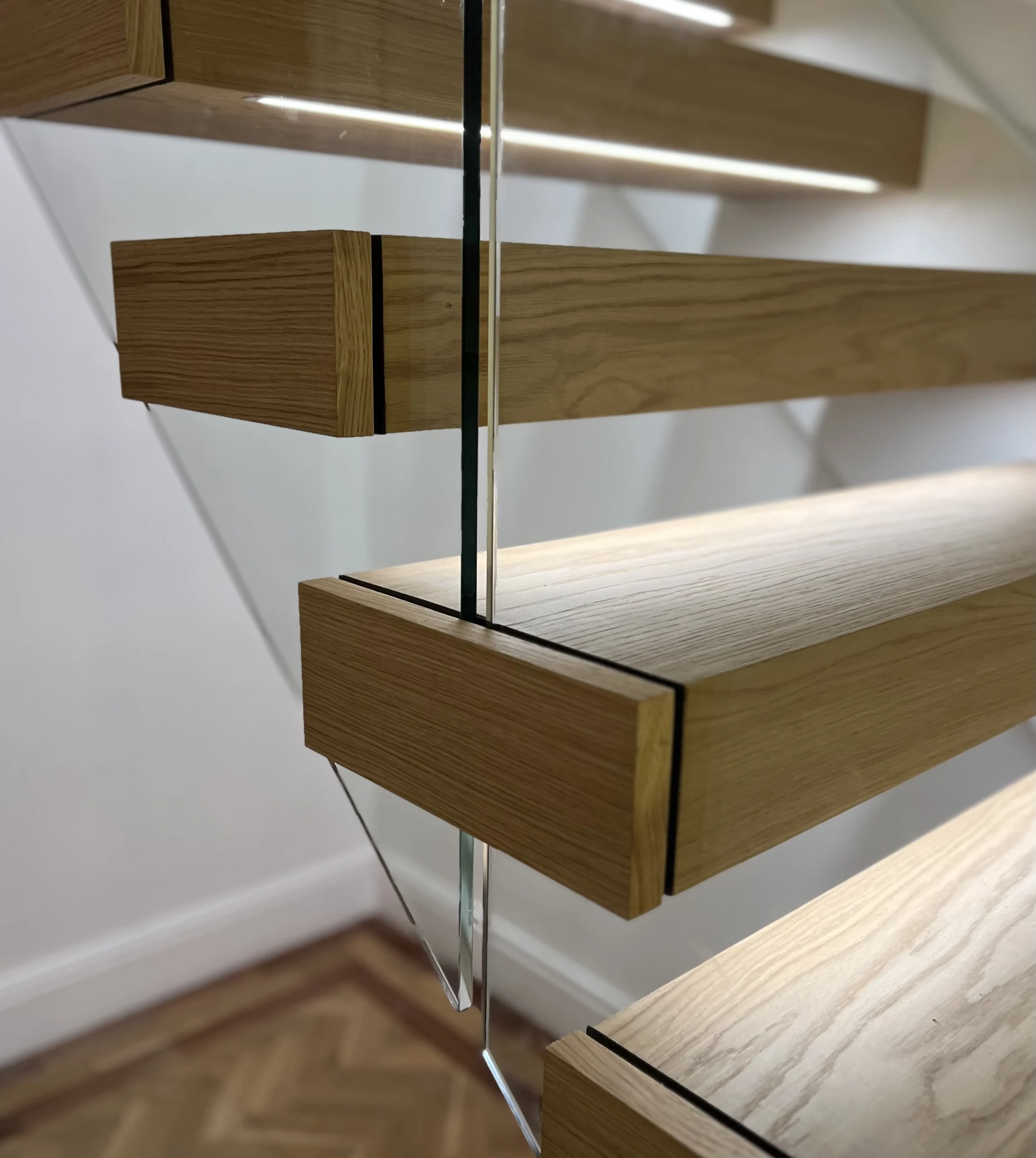 Floating staircase — open risers with 16mm+ overlap, fully Part K compliant
 U-shaped central spine — smallest horizontal footprint for standard compliance
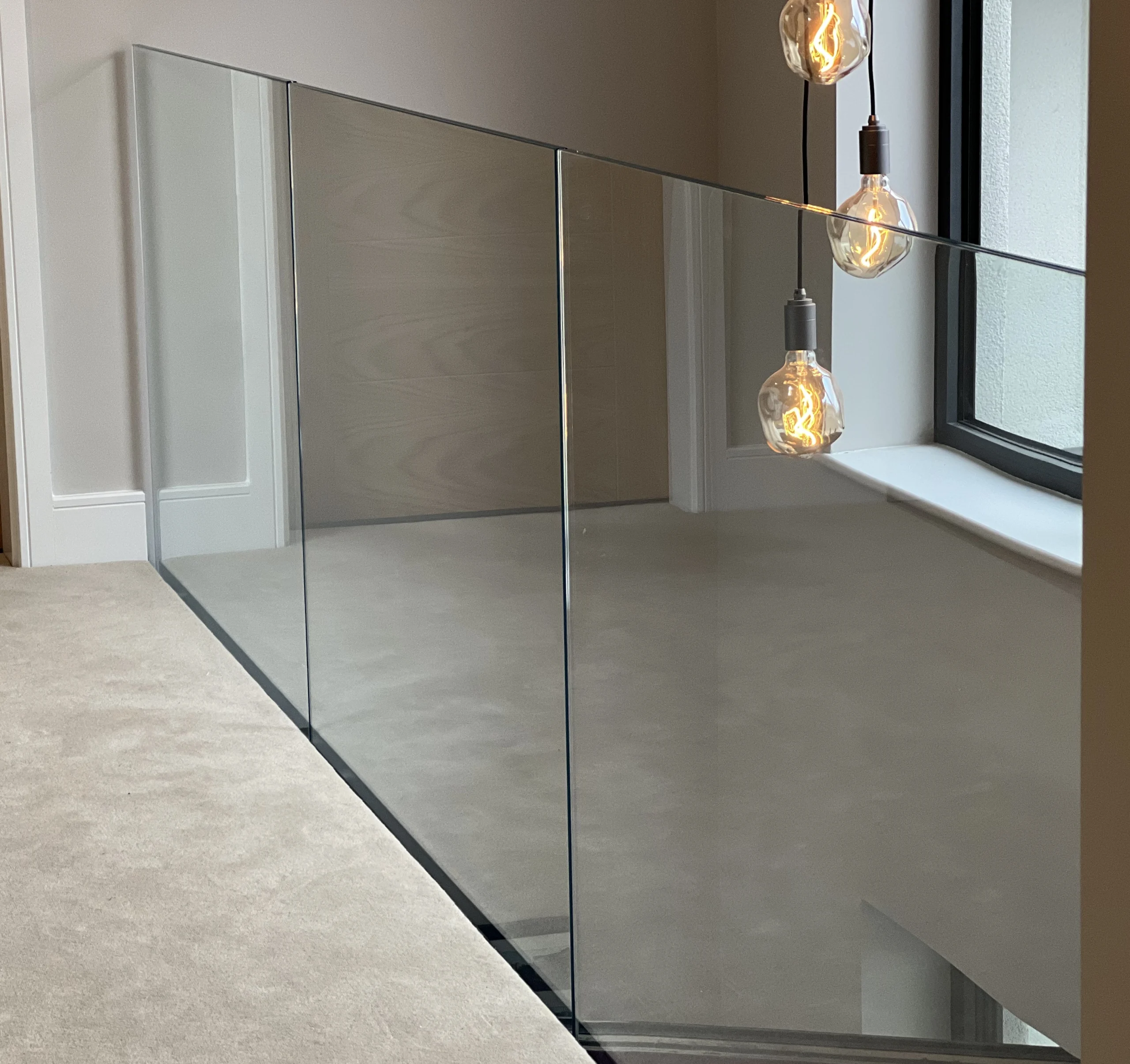 Frameless glass — no gaps, 100mm sphere rule automatically met
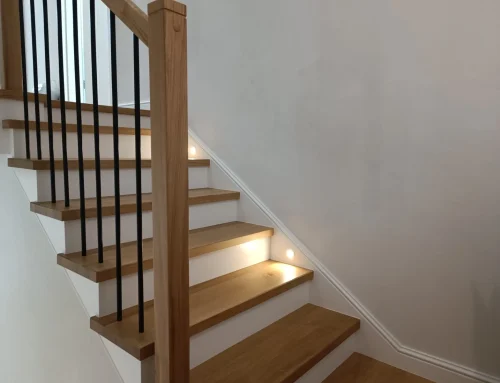
 LED-integrated treads — functional safety lighting for loft stairwells
Landing Requirements — Top, Bottom, and Intermediate
Part K requires landings at both the top and bottom of every flight. The landing must be at least as wide and as long as the smallest width of the staircase itself. A landing may be part of the existing floor — you do not need a separate platform if the corridor or room floor serves as the landing.
At the top of the loft staircase, the landing is formed by the loft floor around the staircase opening. This opening must be edged with compliant guarding (balustrade at minimum 900mm height with the 100mm sphere rule) on all open sides.
Doors may open onto a landing at the bottom of a flight, but Part K imposes restrictions. A door may swing across a landing at the bottom of a flight only if it leaves a clear landing area of at least 400mm beyond the swing of the door. At the top of a flight, cupboard doors are acceptable but subject to similar restrictions — see paragraph 1.21 of Approved Document K for the specific conditions.
For flights with more than 36 steps (unlikely in a domestic loft conversion, but possible in a tall property), the flight must be broken with a change of direction of at least 30° between sections.
The Staircase Opening — Structural Requirements
Creating the opening in the first-floor ceiling for the loft staircase is a structural intervention that requires engineering calculations under Approved Document A. The existing ceiling joists support the plasterboard ceiling below and also restrain the roof rafters from spreading outward. Cutting them creates a structural weakness that must be compensated.
The standard solution is to install timber trimmers around the opening — double trimmers (two timbers fixed together) are typical, sized to transfer the load from the cut joists to the remaining intact joists on either side. In properties with heavier loads or wider openings, steel trimmers or a steel beam may be required.
Your structural engineer will produce calculations specifying the trimmer sizes, connection details, and bearing lengths. These calculations must be submitted to Building Control before the opening is formed. Building Control will inspect the completed steelwork or timberwork before the ceiling is closed up — if you plasterboard over the trimmers before the inspection, you may be required to remove the plasterboard so the structure can be checked.
The Building Control Inspection Process
Building Control — whether your local council team or an independent approved inspector — will inspect the loft conversion staircase at three key stages. Understanding what they check at each stage helps you avoid delays and costly rework.
Stage 1: Plan check
Before work begins, Building Control reviews the submitted drawings and structural calculations. For the staircase, they will check the proposed dimensions (rise, going, headroom, handrail heights), the structural calculations for the floor opening, and the fire safety strategy. If anything is non-compliant, they will raise queries before granting approval to start.
Stage 2: Structural inspection
Once the floor opening has been formed and the trimmers or steelwork installed, Building Control will inspect the structural work before it is covered up. They will check that the trimmers match the approved calculations, that connections and bearing details are correct, and that the opening size matches the approved drawings.
Stage 3: Final inspection
After the staircase is installed and the loft conversion is complete, Building Control will carry out a final inspection. They will physically check the staircase dimensions (rise, going, headroom), the handrail and balustrade heights and gaps, the fire doors and their self-closing mechanisms, the smoke alarm installation and interlinking, and the overall fire protection of the stairwell enclosure. If everything passes, they will issue a completion certificate.
No certificate = non-compliant: Without a Building Regulations completion certificate, your loft conversion is technically unauthorised. This will surface when you try to sell the property — conveyancing solicitors routinely check for completion certificates, and the absence of one can delay or even collapse a sale. If your conversion was completed without a certificate, you can apply for a regularisation certificate from your local authority, but this involves retrospective inspections and potential remedial work.
7 Most Common Building Control Failures for Loft Stairs
Based on our experience manufacturing and installing loft conversion staircases, these are the issues that most frequently cause Building Control rejections or required modifications.
1 Insufficient headroom
The most common failure. Homeowners measure to the underside of the rafters but forget to allow for the plasterboard, insulation, and ceiling lining — which typically reduces the available headroom by 150–200mm. Always measure to the finished ceiling level, not the raw structure.
2 Inconsistent rise
The floor-to-floor height divided by the chosen rise does not give a whole number, so the installer adjusts one step to make up the difference. This fails — every step must be identical. The solution is to adjust the rise value until it divides evenly, or adjust the number of treads.
3 Going too short on winder treads
The going of winder treads measured at the walking line (not the widest point) falls below 220mm. This is a design error that must be corrected before installation — it cannot be remedied on site.
4 Balustrade gaps exceeding 100mm
Spindle spacing or the gap between glass panels and the stair tread allows a 100mm sphere to pass through. This is a straightforward fix but one that Building Control will always check.
5 Missing or non-compliant fire doors
The fire door requirement catches many homeowners by surprise. Every door opening onto the stairwell enclosure — on every floor — must be a rated fire door with a self-closing device. Existing internal doors are almost never fire-rated and must be replaced.
6 Smoke alarms not interlinked
Individual battery-powered smoke alarms do not meet the regulations. The alarms must be mains-powered, have battery backup, and be interlinked so that all alarms sound simultaneously when any one is triggered.
7 No protected stairwell to external door
In a three-storey property (post-conversion), the stairwell must be a protected enclosure leading directly to an external door. If the ground-floor layout does not provide this, structural alterations or an alternative escape strategy (loft escape window) must be agreed with Building Control.
For more on staircase design that avoids these pitfalls, see our guide to modern staircase design and specification.
Frequently Asked Questions — Loft Staircase Regulations
Yes — Building Regulations approval is mandatory for every loft conversion staircase in England and Wales, regardless of whether the wider conversion requires planning permission. Building Control will inspect the structural opening, the staircase installation, and the fire safety provisions before issuing a completion certificate. Without this certificate, the conversion is classed as non-compliant.
Standard requirement is 2,000mm clear headroom above every tread. Loft conversions get a concession under Part K: headroom can reduce to 1,800mm at the low side and 1,900mm at the centre line of the stair width where the staircase passes under a sloping ceiling. This concession applies only to loft stairs and must be confirmed with your local Building Control officer.
No — Approved Document B explicitly prohibits retractable ladders as a means of escape in a loft conversion. A fixed staircase is mandatory for any habitable loft room. The only alternative fixed access options are: a standard staircase (preferred), a spiral staircase (compliant under BS 5395), alternating tread stairs (last resort, single room only), or a fixed ladder with handrails on both sides (most restricted — single room only, where no staircase will fit).
The maximum pitch for a private domestic staircase — including loft conversion stairs — is 42° under Part K. This corresponds to a rise of 220mm and a going of 220mm (the steepest compliant combination). A steeper pitch is only permitted for alternating tread stairs and fixed ladders in loft conversions where Building Control agrees there is no space for a standard staircase.
Yes — when a loft conversion creates a three-storey property, Approved Document B requires all doors opening onto the stairwell enclosure to be self-closing fire doors rated to at least FD20 (FD30 preferred). This applies on every floor, from ground to loft. The stairwell must be a protected enclosure with 30-minute fire-resistant walls, floors, and ceilings, leading directly to an external door at ground level.
Part K does not specify a minimum width for private domestic stairs. In practice, 850mm is widely regarded as the minimum comfortable width for a domestic staircase. For loft conversions with very tight space, widths down to 600mm have been accepted by some Building Control officers — but narrower stairs are harder to use, restrict furniture movement, and may reduce the property's resale appeal. Always confirm acceptable width with your Building Control officer at the design stage.
Without a completion certificate, the conversion is technically unauthorised. This surfaces when you sell the property — conveyancing solicitors check for certificates, and their absence can delay or collapse a sale. Your local authority can also take enforcement action within two years of the work being completed. If the conversion is already done, you can apply for a regularisation certificate, which involves retrospective inspections and potentially remedial work to bring the conversion up to current standards.
Yes — glass balustrade is fully compliant with Part K provided it meets the minimum height requirements (900mm on stairs, 900mm on domestic landings), has no gaps that allow a 100mm sphere to pass through, and meets the structural load requirements (0.74 kN/m horizontal for residential). Frameless glass automatically satisfies the 100mm sphere rule because there are no gaps between panels. However, any glass within the protected stairwell enclosure must also achieve 30-minute fire resistance under Part B — standard toughened glass does not meet this requirement.
Need a Loft Staircase That Passes Building Control?
Continox designs and manufactures bespoke loft conversion staircases that meet every requirement of Part K and Part B. Steel-framed, precision-engineered, and installed by our own team — with full dimensional compliance guaranteed. Based in Gosport, Hampshire, serving Southern England.