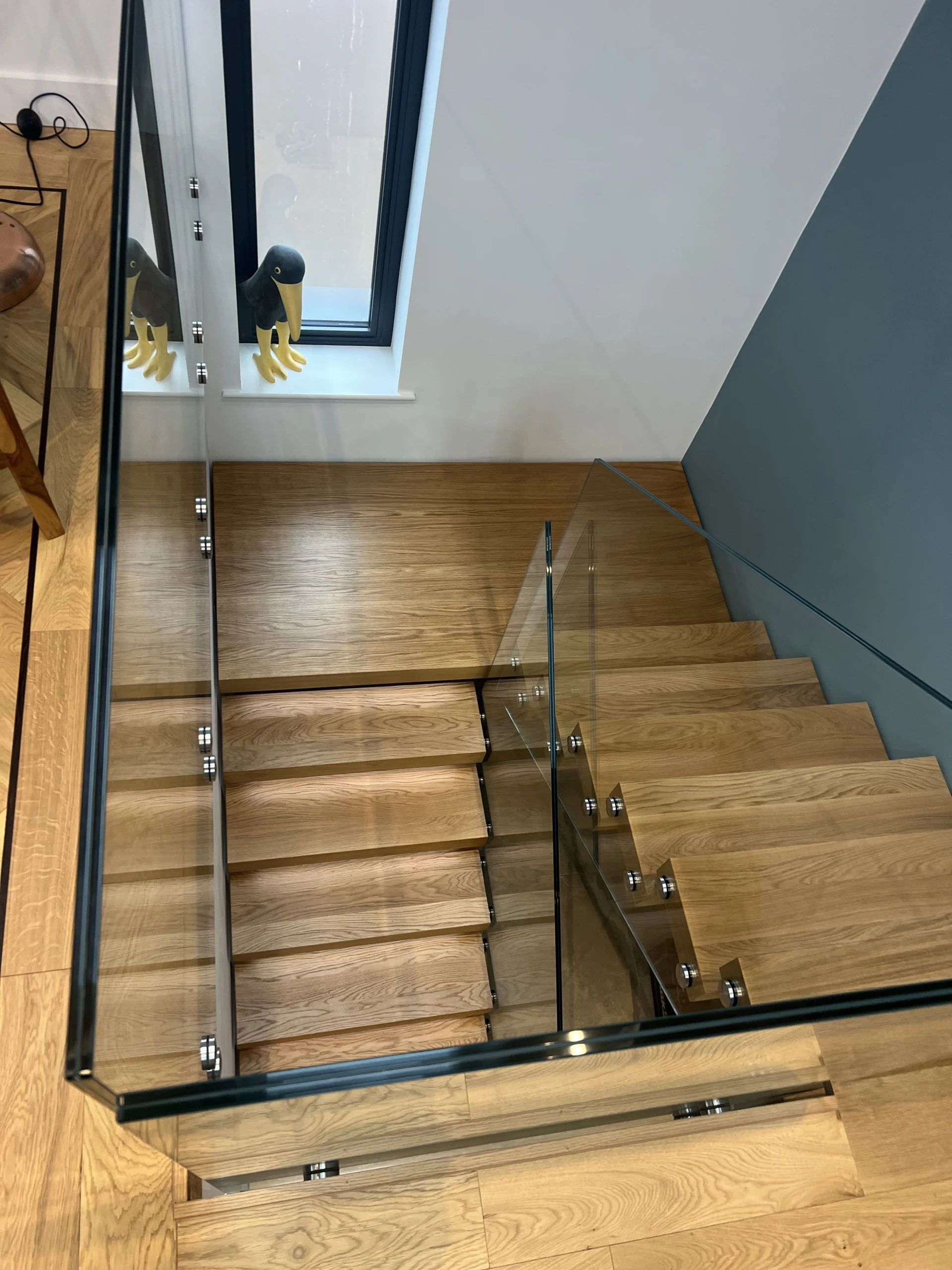

Every year in the UK, stair falls cause approximately 350,000 injuries and up to 575 deaths among older adults — and a recent study found that over 40% of staircases in homes occupied by people aged 60+ do not meet current government guidelines for safe dimensions. This guide covers every practical step you can take — from quick fixes like LED lighting and anti-slip nosings through to full bespoke staircase replacements designed specifically for elderly users. We explain the UK regulations that matter, the design features that genuinely reduce fall risk, and when it makes sense to invest in a purpose-built staircase rather than patch an unsafe one.
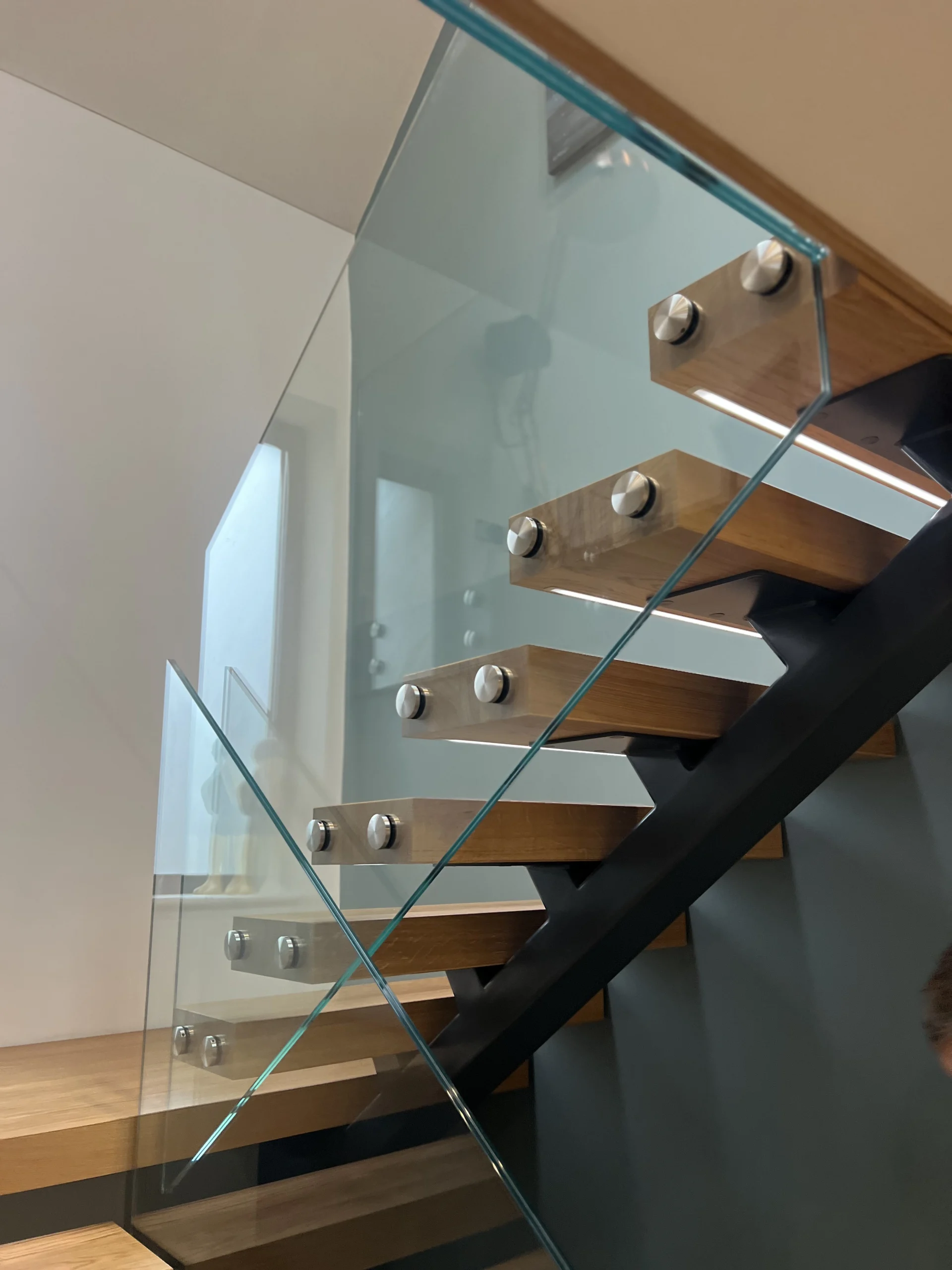
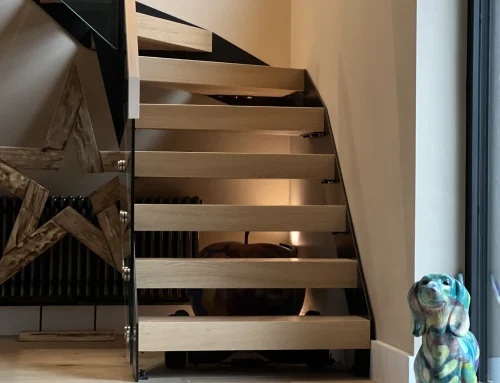
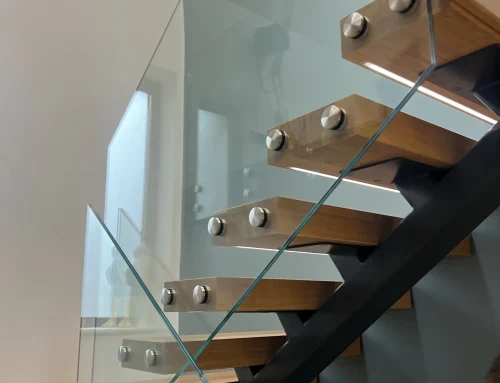
Integrated LED step lighting on an oak staircase — illuminating every tread edge for safe navigation
A safe staircase for elderly users has a shallow pitch (under 38°), consistent rise and going (ideally 170–190mm rise, 250mm+ going), dual handrails on both sides (900–1,000mm height, 32–50mm graspable diameter), solid risers (no open treads), non-slip tread surfaces, contrasting nosings, and bright, even lighting at the top and bottom of every flight. If an existing staircase is too steep, too narrow, or structurally compromised, a bespoke replacement designed around the user's needs is the safest long-term solution. Bespoke steel and oak staircases with all of these features start from £7,900.
Why Stairs Become Dangerous as We Age
Stairs are the single most hazardous element of a home environment for older adults. The risk isn't just about tripping — it's a compound effect of physiological changes that make every trip up and down more demanding with each passing year.
Muscle loss (sarcopenia) begins in our 30s but accelerates sharply after 65. The quadriceps — the primary muscles used to push the body upwards on stairs — can lose 30–50% of their strength by age 80. This makes ascending harder and descending riskier, because weakened legs struggle to control the deceleration on each step.
Balance deterioration compounds the problem. Changes in the inner ear, reduced proprioception (awareness of where your feet are in space), and slower reaction times all contribute. A young adult who catches a toe on a nosing will instinctively correct their balance. An 80-year-old in the same situation may not react quickly enough.
Vision decline is the third critical factor. Reduced depth perception, sensitivity to glare, and difficulty distinguishing contrasts make it harder to see step edges — particularly on staircases with uniform colouring and poor lighting. Open riser staircases are especially problematic, because the visual pattern of alternating treads and gaps can cause confusion and disorientation.
Medical conditions — arthritis, Parkinson's disease, the aftereffects of stroke or joint replacement surgery — add further layers of difficulty. Medication side effects (dizziness, drowsiness, low blood pressure) increase fall risk even on well-designed stairs.
Key statistic: One in three people over 65 — and half of those over 80 — fall at least once a year. Stairs are the number one location for fatal falls in the home. Over 60% of accident-related deaths among the elderly are caused by falls on stairs (RoSPA), and the resulting injuries carry a 10% mortality rate within 12 months (Age UK).
7 Features of a Senior-Safe Staircase
Whether you're adapting an existing staircase or commissioning a new one, these are the features that have the greatest impact on safety for elderly users.
1 Shallow, consistent rise and going
Part K of the UK Building Regulations allows a domestic rise of up to 220mm and a going as low as 220mm — but those maximums produce a steep, uncomfortable staircase that's challenging for anyone with reduced mobility. For elderly users, a rise between 170mm and 190mm and a going of 250mm or more is significantly safer and easier to climb.
Consistency matters just as much as dimension. Every step in a flight must have identical rise and going — the brain expects each step to be the same, and even a 5mm variation can cause a stumble. This is a particular risk in older properties where decades of wear, settlement, or poor original construction have created uneven treads.
The 2R+G rule: Twice the rise plus the going should equal 550–700mm for a comfortable staircase. The ideal target is 620–630mm. For example, a 180mm rise with a 260mm going gives 2(180) + 260 = 620mm — right in the sweet spot. Staircases at the upper end of this range feel gentle and easy to climb; those above 700mm are too steep for regular elderly use.
2 Dual handrails — both sides, full length
Part K requires a handrail on at least one side for flights with two or more risers. But for elderly users, handrails on both sides are essential. After knee surgery, a stroke, or simply due to a weaker grip on one side, the ability to choose which rail to hold makes a meaningful difference to confidence and stability.
Handrails should be continuous from bottom to top with no breaks, positioned at 900–1,000mm above the pitch line, and graspable — a circular profile of 32–50mm diameter is ideal. They should also extend horizontally beyond the top and bottom steps by at least one tread width, giving the user something to hold as they step on and off the staircase.
Fixing is critical: rails must be securely anchored to studs or masonry and capable of supporting a person's full body weight without flex or movement.
3 Solid risers (no open treads)
Open riser staircases — where there's a visible gap between each tread — are a recognised hazard for elderly users. The visual pattern of alternating treads and voids tricks depth perception, particularly for anyone with reduced eyesight or cognitive impairment such as dementia. Walking aids and the toe of a shoe can also catch in the gap.
If you have an existing open-tread staircase, boxing in the risers with solid panels is one of the simplest and most effective safety improvements you can make. For new staircases, always specify solid risers for elderly users.
Where open risers are used in other contexts, Part K requires each tread to overlap the one below by at least 16mm, and a 100mm sphere must not pass through the gap — but for senior safety, closed risers are always preferable.
4 Contrasting nosings
The nosing — the front edge of each tread — must be clearly visible. For older eyes, the step edge can disappear entirely on a staircase with uniform colour, especially in low light. Contrasting nosing strips (a different colour or material applied to each step edge) make every tread instantly identifiable.
This is already a mandatory requirement under Approved Document M (Part M) for non-domestic buildings and new-build dwellings designed to accessibility standards. For existing homes, it's an inexpensive retrofit — adhesive aluminium nosing strips cost a few pounds per step and can be fitted in an afternoon.
5 Non-slip tread surfaces
Worn carpet, polished timber, and smooth tiles are all slip hazards. The tread surface needs to provide reliable grip in both dry and potentially damp conditions (socks, spilled drinks, wet shoes coming in from outside).
Options include rubber anti-slip strips, textured tread overlays, properly fitted short-pile carpet with secure gripper rods, or — for bespoke timber staircases — a factory-applied anti-slip finish on each oak or hardwood tread. Rugs at the top and bottom of stairs should be removed entirely, as they're one of the most common trip hazards in the home.
6 Bright, even lighting
A well-lit staircase is a safer staircase. Two-way switches at the top and bottom of every flight are essential — many older people will attempt to navigate stairs in the dark rather than walk to a distant switch.
The best lighting solutions for elderly users include recessed LED step lights built into the wall alongside each tread, which illuminate the step edge without creating glare. Under-tread LED strip lighting is another effective option, casting a soft wash of light across each step. Warm white (2,700–3,000K) is preferable — cool white can produce harsh shadows that reduce depth perception.
For existing staircases, plug-in motion-activated LED night lights on landings are a quick win. Battery-powered adhesive strip lights along staircase walls are another low-cost retrofit.
7 Generous width
Although Part K sets no minimum width for private domestic stairs, a staircase intended for elderly use should be at least 900mm clear width — and ideally wider. This allows comfortable passage with a walking frame, provides space for a carer to walk alongside, and leaves room for a stairlift rail if one is needed in future.
If a stairlift is installed, the remaining clear width must still allow other household members to pass safely. Planning for this from the design stage avoids costly modifications later.
Quick Fixes vs Full Replacement — When to Do What
| Improvement | Type | Cost | Impact |
|---|---|---|---|
| Anti-slip nosing strips | Quick fix (DIY) | £3–£8 per step | High — defines step edge, prevents slips |
| Second handrail | Quick fix (tradesperson) | £150–£400 | High — support on both sides |
| LED step lighting | Retrofit | £200–£600 | High — eliminates dark stairways |
| Boxing in open risers | Retrofit | £300–£800 | High — removes visual confusion |
| New carpet + gripper rods | Retrofit | £400–£1,200 | Medium — improves grip, covers worn treads |
| Motion-sensor landing lights | Quick fix (DIY) | £15–£40 each | Medium — nighttime visibility |
| Stairlift (straight rail) | Major adaptation | £2,000–£3,500 | Very high — eliminates climbing |
| Bespoke replacement staircase | Full replacement | From £7,900 | Highest — solves every issue permanently |
When to replace rather than retrofit: If the existing staircase has a pitch steeper than 42°, inconsistent rises, structural movement (creaking, flexing, loose fixings), or is too narrow for a handrail on both sides, retrofitting will only mask the underlying problem. A bespoke replacement designed around the user's needs — with shallow pitch, solid risers, dual rails, integrated lighting, and future stairlift provision — is the safest and most cost-effective long-term solution.
UK Regulations That Apply to Senior-Safe Stairs
Two sets of regulations are relevant when designing or modifying a staircase for elderly users: Part K (Protection from Falling) sets the safety minimums, and Part M (Access to and Use of Buildings) sets higher accessibility standards.
| Requirement | Part K (Domestic) | Recommended for Seniors |
|---|---|---|
| Maximum rise per step | 220mm | 170–190mm |
| Minimum going per step | 220mm | 250mm+ |
| Maximum pitch | 42° | Under 38° (ideally 33–35°) |
| Handrails | One side (flights <1m wide) | Both sides, continuous, 32–50mm Ø |
| Handrail height | 900–1,000mm above pitch line | Same — at elbow height |
| Minimum headroom | 2,000mm | 2,000mm |
| Open risers | Permitted (16mm overlap, 100mm sphere) | Avoid — use solid risers |
| Contrasting nosings | Not required (domestic) | Strongly recommended |
| 2R+G comfort zone | 550–700mm | 600–650mm (ideal) |
| Stair width | No minimum (domestic) | 900mm+ clear width |
If you're commissioning a new staircase for a property where elderly occupants will be the primary users, ask your manufacturer to design to Part M (easy access) dimensions rather than the more relaxed Part K domestic minimums. The result is a gentler, wider, more comfortable staircase that's safer for everyone — not just older adults. For a full breakdown of every Part K and Part M dimension, see our complete UK staircase regulations guide.
Best Staircase Designs for Elderly Users
Not all staircase configurations are equally suitable for seniors. Some designs that look stunning in architectural magazines present real challenges for anyone with reduced mobility.
Straight flight with mid-landing
The safest configuration for elderly users. A straight staircase with a flat landing partway up divides the climb into two shorter flights, providing a natural rest point. Part K allows up to 16 risers per flight before a landing is required — but for elderly users, 8–10 risers per flight with a generous landing between is ideal.
Quarter-turn and half-turn with landings
Winder steps (tapered treads at the turn) introduce a variable going that can catch users off guard. Where possible, replace winder treads with a flat quarter or half landing. This adds to the overall footprint but significantly reduces fall risk at the most dangerous point of the staircase.
Designs to avoid for elderly users
Spiral and helical staircases — constant curvature and tapered treads make these inherently unsuitable for anyone with balance or mobility issues. Open-tread floating staircases — visually striking but the lack of risers and the cantilevered structure can feel insecure. Paddle (alternating tread) staircases — designed for space-saving, these require a specific left-right stepping pattern that is difficult for elderly users. See our paddle staircase guide for more detail on why these should be avoided as primary access.
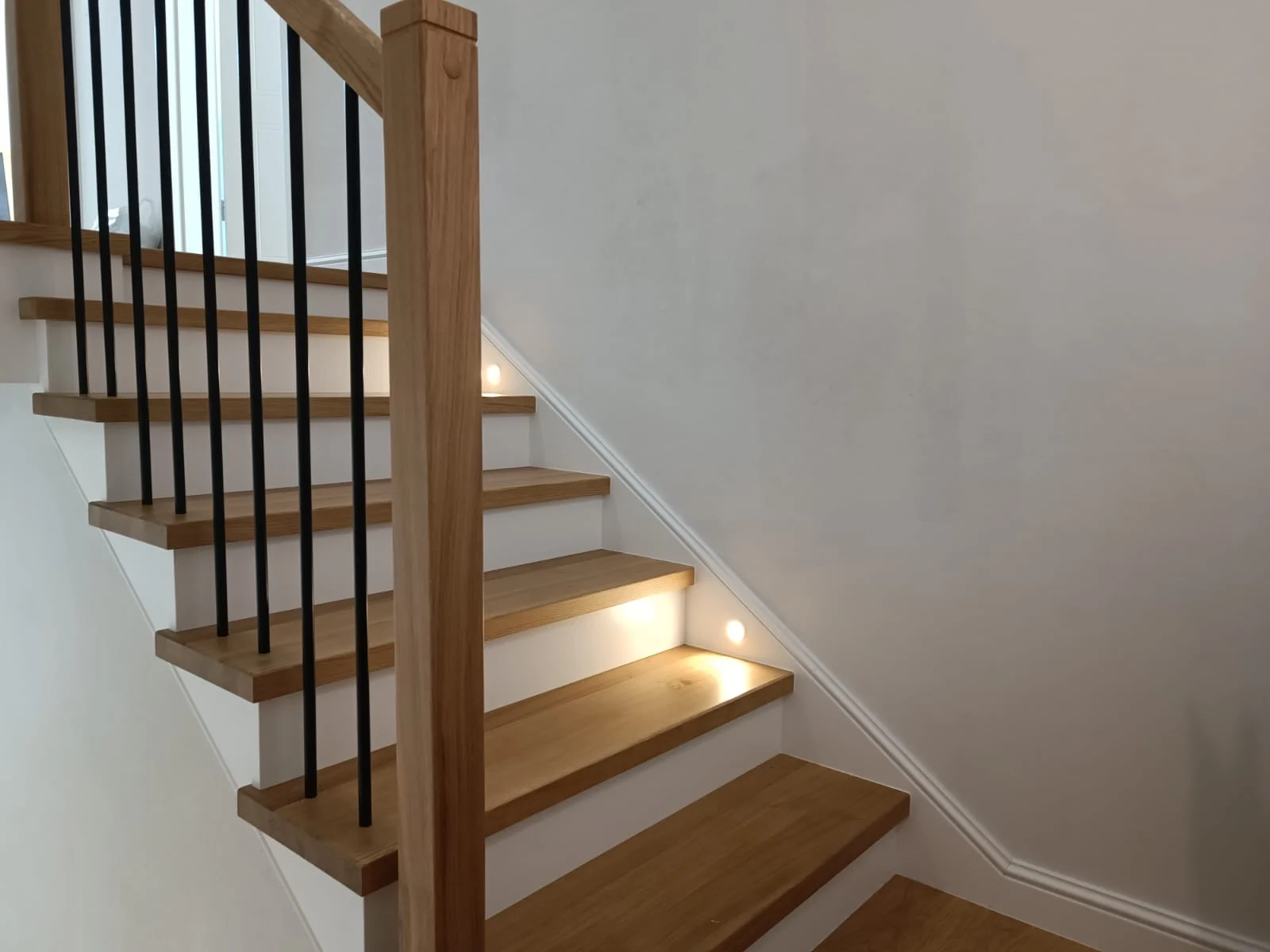 LED-integrated oak treads — step edges clearly defined for safe navigation
 Central spine with mid-landing — provides a rest point between flights
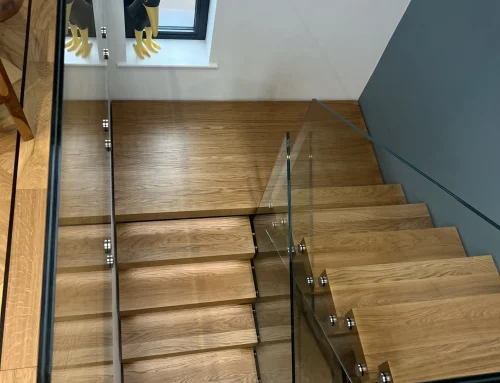
 Glass balustrade allows light into the stairwell — improving visibility on every step
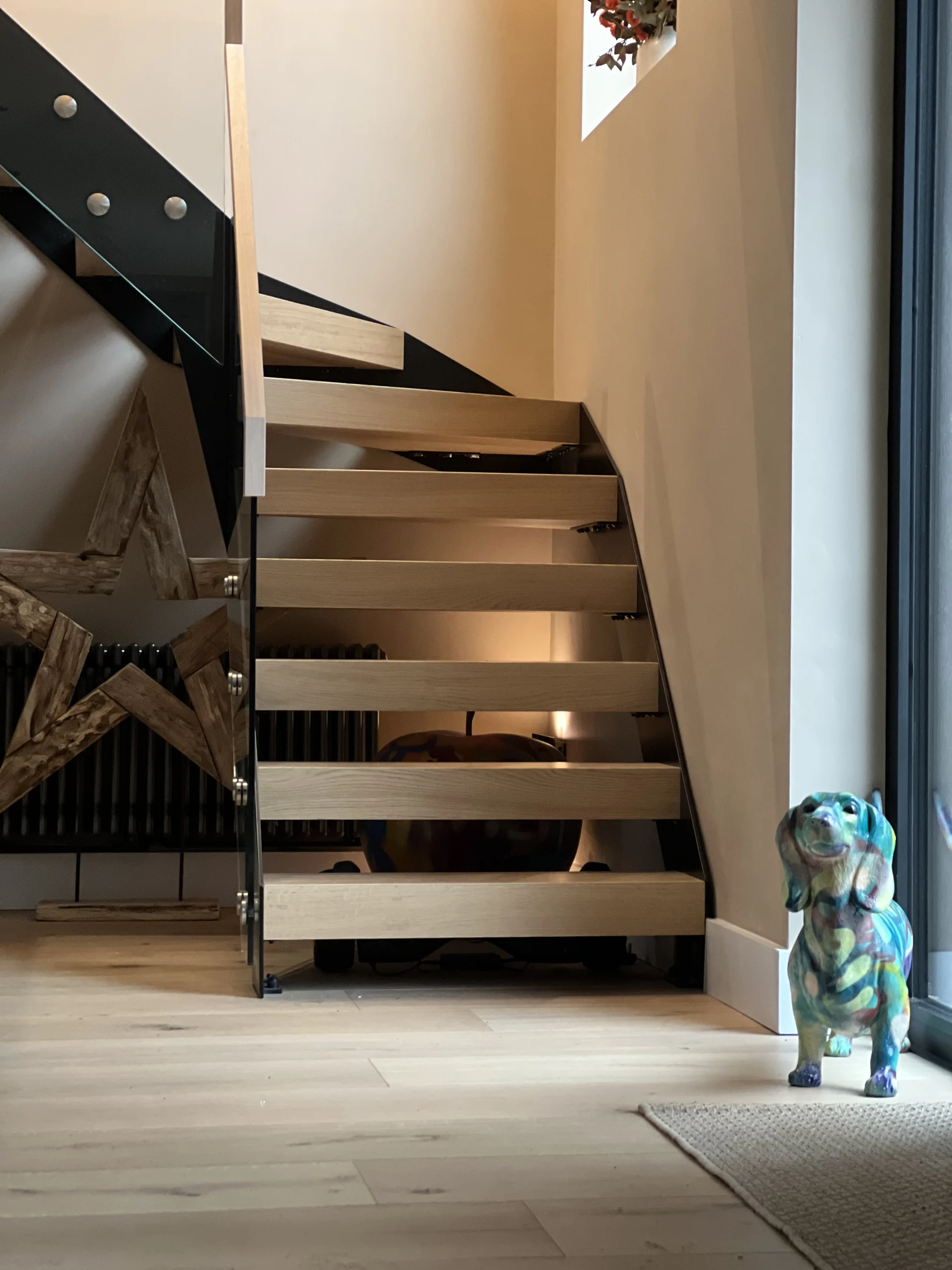
 Solid risers and LED platform — no gaps, no confusion, maximum safety
Glass Balustrade — Safe or Not for Elderly Users?
A common concern is whether glass balustrade is appropriate alongside a staircase used by elderly occupants. The answer is yes — when correctly specified.
Toughened or laminated glass panels to BS EN 12150 / BS EN 14449 meet all Part K guarding requirements. A glass balustrade at 1,100mm height provides a secure barrier with no openings for a 100mm sphere to pass through. The visual transparency of glass actually benefits elderly users by allowing light to flow through the stairwell — darker, enclosed staircases with solid walls on both sides are harder to navigate.
The key is to ensure the top rail is graspable. A frameless glass balustrade with a polished top edge is a guarding barrier, not a handrail — a separate wall-mounted handrail on the opposite side (or a steel handrail integrated into the balustrade system) is required for safe use.
External Stairs and Elderly Users
Front steps, garden steps, and external staircases to raised decking or balconies are just as hazardous as internal stairs — more so in wet, icy, or leaf-covered conditions. For elderly users living in properties with external steps:
Ensure all treads have a non-slip surface — galvanised open-mesh treads, chequer plate, or anti-slip coatings. Install handrails on both sides, extending beyond the top and bottom steps. Consider motion-activated lighting for paths and steps used after dark. Where possible, eliminate steps entirely with a ramped access — Part M recommends a gradient no steeper than 1:12 for wheelchair and mobility-aid access, with level landings at top and bottom.
If you need a new external staircase or need to modify an existing one, our galvanised steel external staircases are designed with anti-slip treads, dual handrails, and full compliance with BS 9991. Residential external staircases start from £3,500.
Senior Stair Safety Checklist
Use this checklist to assess any staircase for elderly suitability. If three or more items fail, consider professional advice on modification or replacement.
| Check | Pass | Fail — Action Needed |
|---|---|---|
| Rise consistent on every step? | All risers identical | Any variation = trip risk. May need replacement. |
| Rise ≤ 190mm? | 170–190mm | Over 200mm = too steep for regular elderly use |
| Going ≥ 250mm? | 250mm+ | Under 240mm = reduced foot placement area |
| Pitch under 38°? | Under 38° | Over 38° = consider replacement |
| Handrail both sides? | Dual, continuous, graspable | Add second handrail |
| Solid risers? | No gaps between treads | Box in open risers |
| Contrasting nosings? | Step edge clearly visible | Fit nosing strips |
| Non-slip treads? | Secure grip surface | Fit anti-slip strips or replace carpet |
| Lighting adequate? | Bright, even, two-way switches | Install LED step lights or landing lights |
| Width ≥ 900mm? | 900mm+ clear | Consider widening or stairlift compatibility |
| Structural integrity? | No movement, creaking, loose fixings | Professional structural assessment needed |
What Does a Senior-Safe Staircase Cost?
The cost depends on whether you're retrofitting an existing staircase or commissioning a new one. Quick fixes can be done for under £500. A full bespoke replacement designed specifically for elderly accessibility starts from £7,900.
| Solution | Price Range | Notes |
|---|---|---|
| Basic retrofit (nosings + lighting + second rail) | £350–£1,000 | DIY or handyman — minimal disruption |
| New carpet + gripper rods (full flight) | £400–£1,200 | Short-pile, securely fitted |
| Stairlift (straight rail) | £2,000–£3,500 | Curved models £4,000–£8,000+ |
| Bespoke floating staircase (steel + oak) | From £7,900 | Custom dimensions, solid risers, dual handrails |
| Bespoke floating staircase with LED | From £8,500 | Under-tread or nosing-recessed LED included |
| Central spine + glass balustrade | From £9,500 | Open stairwell, maximum light |
| Frameless glass balustrade (add to existing) | From £450/m | Secure guarding with light transmission |
| External staircase (residential) | From £3,500 | Galvanised steel, anti-slip treads, dual rails |
For a detailed breakdown of staircase pricing across all types, see our bespoke staircase cost guide.
Stairlift vs Staircase Replacement — Which Is Better?
A stairlift eliminates the need to climb, which makes it the right solution when a person can no longer safely use stairs at all. But a stairlift doesn't fix the underlying problem — the staircase itself remains steep, dark, and hazardous for anyone else in the household, and for the user on the occasions when the lift breaks down or during a power cut (battery backup lasts a limited number of trips).
A bespoke replacement staircase designed for elderly use does both: it makes climbing safe and comfortable for the current user, and it future-proofs the home. A well-designed staircase with adequate width can also accept a stairlift rail if needs change later, without requiring further structural work.
In many cases, the total cost of a stairlift (£2,000–£5,000) plus ongoing maintenance, plus eventual removal and staircase repair, approaches the cost of a bespoke replacement that solves the problem permanently.
Disabled Facilities Grants — Funding for Staircase Adaptations
If cost is a barrier, Disabled Facilities Grants (DFGs) are available through local councils in England and Wales for essential adaptations that help disabled or elderly residents remain in their home. Stairlift installation is commonly covered. Staircase modifications or full replacements may qualify if assessed as necessary by an occupational therapist.
The maximum DFG in England is currently £30,000. The grant is means-tested for adults but not for children. Contact your local council's housing adaptations team to request an assessment — the process typically takes 8–16 weeks from initial contact to approval.
The Centre for Ageing Better estimates that removing serious fall hazards from older people's homes — including staircase upgrades — would save the NHS £330 million a year. Taking away the risk of falls on stairs from homes headed by someone aged 55+ would cost less than £1,500 per property on average. The case for investment is clear — both for individuals and for the public purse.
Frequently Asked Questions — Safe Staircases for Seniors
A straight flight with a mid-landing is the safest configuration. It provides a rest point between flights, eliminates the trip risk of winder (tapered) treads, and allows dual handrails on both sides. Ideally, the pitch should be under 38° with a rise of 170–190mm, a going of 250mm+, solid risers, contrasting nosings, and integrated LED lighting.
Start with the highest-impact, lowest-cost changes: add a second handrail (both sides), fit contrasting anti-slip nosing strips to every step, improve lighting with two-way switches and LED step lights, and remove any rugs or clutter from the top and bottom of the staircase. If the stairs have open risers, box them in with solid panels. If the staircase is fundamentally too steep (pitch over 42°), professional replacement may be necessary.
Part K allows a maximum pitch of 42° for domestic stairs, but this is too steep for comfortable elderly use. A pitch of 33–38° is recommended, with under 35° being ideal. This requires a shallower rise and deeper going, which in turn needs more horizontal space — something a bespoke staircase manufacturer can optimise within your home's footprint.
No. Open riser staircases are a recognised hazard for elderly users. The visual pattern of gaps between treads reduces depth perception and can cause confusion, particularly for people with dementia or impaired vision. Walking aids can also catch in the openings. If you have open treads, boxing them in with solid riser panels is one of the most effective safety improvements you can make.
Yes. Any new staircase installation in England and Wales requires Building Regulations approval under Part K. A Building Control officer will inspect the completed staircase to verify compliance with rise, going, pitch, headroom, handrail, and balustrade requirements. A reputable staircase manufacturer will design to these standards and liaise with Building Control on your behalf.
A bespoke steel and oak staircase designed for elderly accessibility starts from £7,900 for a floating design, from £8,500 with integrated LED lighting, and from £9,500 for a central spine with glass balustrade. These prices include design, fabrication, powder coating, and installation — all carried out in-house with zero subcontractors. The final cost depends on the number of treads, configuration, material choices, and balustrade type.
Potentially, yes. Disabled Facilities Grants are available through local councils in England and Wales for essential home adaptations. Stairlift installation is commonly covered. Staircase modifications or full replacements may qualify if assessed as necessary by an occupational therapist. The maximum DFG in England is currently £30,000. Contact your local council's housing adaptations team for an assessment.
Yes — when correctly specified. Toughened or laminated glass to BS EN 12150 / BS EN 14449 at 1,100mm height meets all Part K guarding requirements. Glass allows light into the stairwell, which benefits visibility. However, a frameless glass top edge is not a handrail — a separate graspable handrail (wall-mounted or integrated into the balustrade) is required alongside for elderly users.
Need a Safer Staircase for Your Home?
Continox designs, manufactures and installs bespoke staircases with elderly safety built in from the ground up — shallow pitch, solid risers, dual handrails, integrated LED lighting, and future stairlift provision. Based in Hampshire, serving the UK. Free quote within 24 hours.