
UK Stair Safety Report: how many people fall on stairs – and why design matters
Official figures on deaths, hospital admissions and dangerous stairs in England’s homes, brought together in one place, with the building regulations and design choices that reduce the risk.
Falls on stairs kill close to three people a day in England. Death registrations coded to stairs and steps rose from 642 to 1,001 between 2013 and 2025, an increase of 56%. Around one million homes have stairs serious enough to count as a Category 1 hazard, costing the NHS an estimated £219m a year. Most of that risk comes down to how the stair is designed.
01 · DeathsStair-fall deaths in England have risen by more than half
Every death in England is registered with an underlying cause, coded using the international ICD-10 classification. Code W10 covers falls on and from stairs and steps. Between 2013 and 2025, registrations under this code grew from 642 a year to 1,001 – roughly 2.7 deaths every day.
The figure held fairly steady at 650–720 a year for most of the 2010s. It then stepped up sharply: 804 in 2022, 948 in 2023, and 1,001 in 2025.
Deaths from falls on stairs and steps, England
Show the data as a table
| Year registered | All ages | Aged 65+ | Under 65 | Share 65+ |
|---|---|---|---|---|
| 2013 | 642 | 467 | 175 | 73% |
| 2014 | 680 | 503 | 177 | 74% |
| 2015 | 717 | 564 | 153 | 79% |
| 2016 | 719 | 549 | 170 | 76% |
| 2017 | 682 | 518 | 164 | 76% |
| 2018 | 708 | 545 | 163 | 77% |
| 2019 | 700 | 532 | 168 | 76% |
| 2020 | 665 | 518 | 147 | 78% |
| 2021 | 689 | 534 | 155 | 78% |
| 2022 | 804 | 636 | 168 | 79% |
| 2023 | 948 | 781 | 167 | 82% |
| 2024 | 934 | 784 | 150 | 84% |
| 2025 | 1,001 | 805 | 196 | 80% |
Almost all of the increase is among older people. Deaths of people aged 65+ rose 72% (467 → 805), while deaths under 65 stayed within a narrow band of roughly 150–200 a year.
Two caveats matter. First, these are counts, not rates: England’s population is ageing, so more older people are living with stairs every year. Second, the true number is almost certainly higher. Official analysis of accidental deaths found that falls from stairs and steps were the most commonly identified cause of fall-related deaths, but that 83% of fall deaths were recorded as “unspecified”. A fall that happened on a staircase but was never coded as one does not appear in these figures.
02 · AgeWho falls: eight in ten deaths are people aged 65+
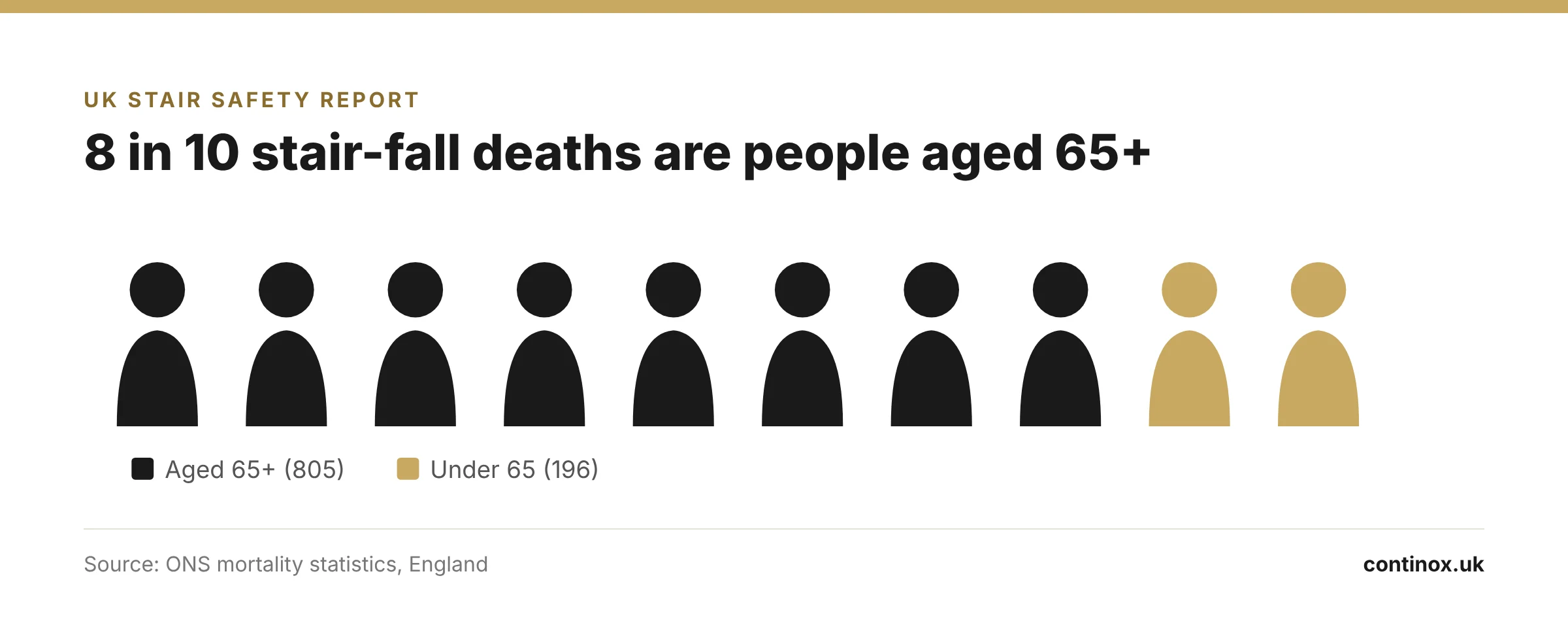
Of the 1,001 stair-fall deaths registered in 2025, 805 were people aged 65 or over – 80%. Older adults are more likely to fall because of balance, eyesight and medication, and they are more likely to suffer a serious injury when they do. A stair that a 30-year-old manages without thinking can be the most dangerous place in the house for their parents.
Stair-fall deaths by age group
At the other end of life, toddlers are the age group most likely to be admitted to hospital after a stair fall. A national birth cohort study found admission rates peaked at around one year of age, at 1.28 per 1,000 child-years. Public Health England reported more than 11,000 hospital admissions of children under five for falls on or from stairs in England and Wales over five years. Local data tells the same story: in East Sussex, for example, falls on stairs and steps are the most common cause of fall admissions among one- and two-year-olds.
03 · InjuriesFor every death, hundreds of injuries
Deaths are the tip of the problem. The Royal Society for the Prevention of Accidents (RoSPA) estimates that falls on stairs in the home kill more than 700 people and put over 43,000 in hospital across the UK every year.
≈ 338,000 A&E visits a year
RoSPA’s modelled estimate of A&E attendances for falls on stairs in England’s housing stock – about one every 93 seconds, around the clock.
Falls are the No. 1 cause of accidental death
Falls account for 46% of accidental deaths in the UK and 61% of accident-related hospital admissions in England, according to RoSPA. More than half of fatal falls happen at home.
Those numbers come from different years and definitions, so they should not be added together. What they show is scale: a stair-fall death is one outcome in a much larger pattern of fractures, head injuries and lost independence.
04 · HomesAround one million homes have a dangerous staircase
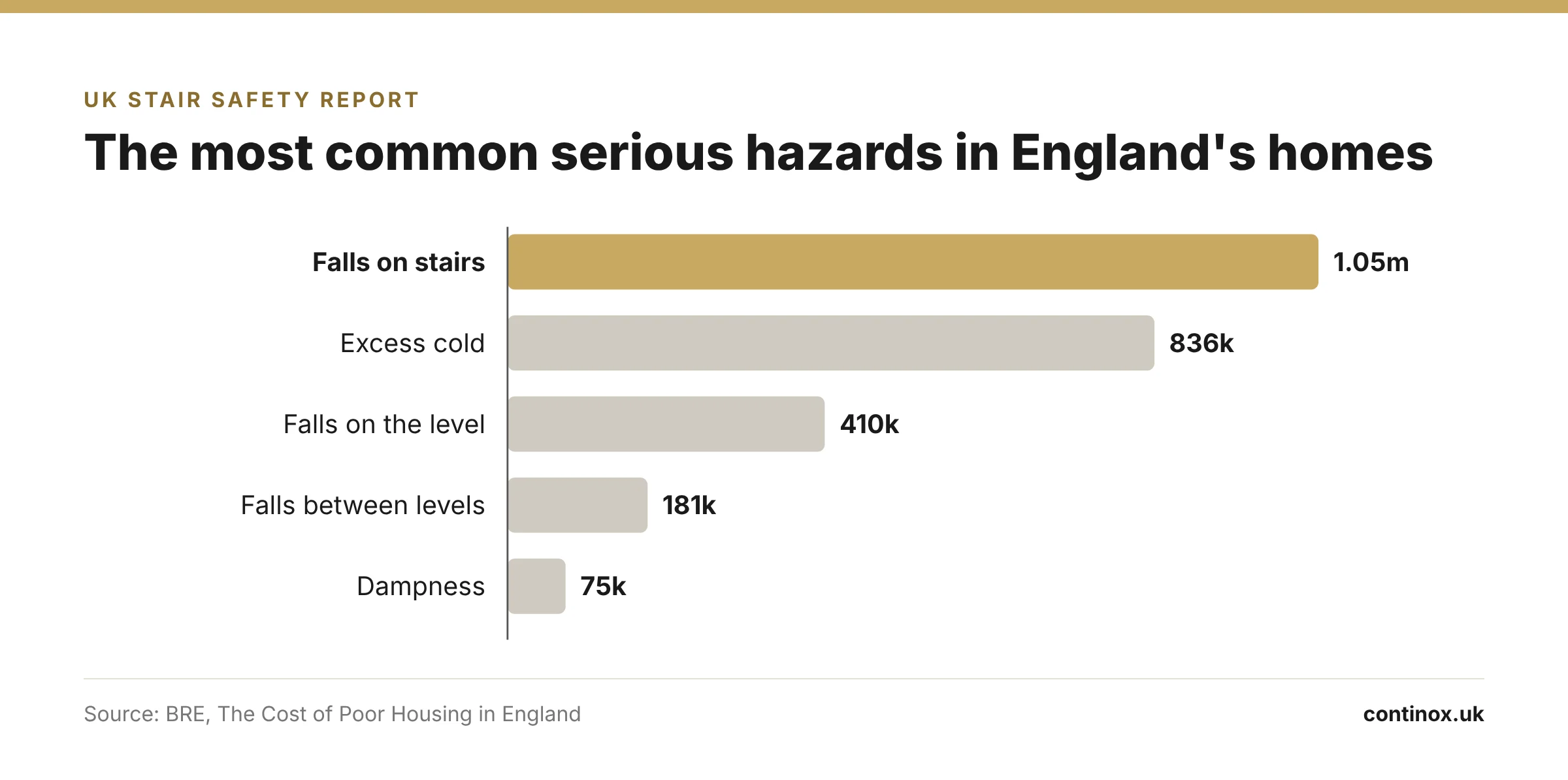
Local authorities assess homes using the Housing Health and Safety Rating System (HHSRS). A Category 1 hazard is the most serious level, one the council has a duty to act on. Using English Housing Survey data, BRE (the Building Research Establishment) found that falls on stairs are the single most common Category 1 hazard in England’s homes. They are ahead of excess cold, and well ahead of everything else.
The most common serious hazards in England’s homes
Show the data as a table
| Category 1 hazard | Homes affected | First-year NHS cost / year |
|---|---|---|
| Falls on stairs | 1,048,000 | £219m |
| Excess cold | 836,000 | £857m |
| Falls on the level | 410,000 | £104m |
| Falls between levels | 181,000 | £51m |
| Dampness | 75,000 | £38m |
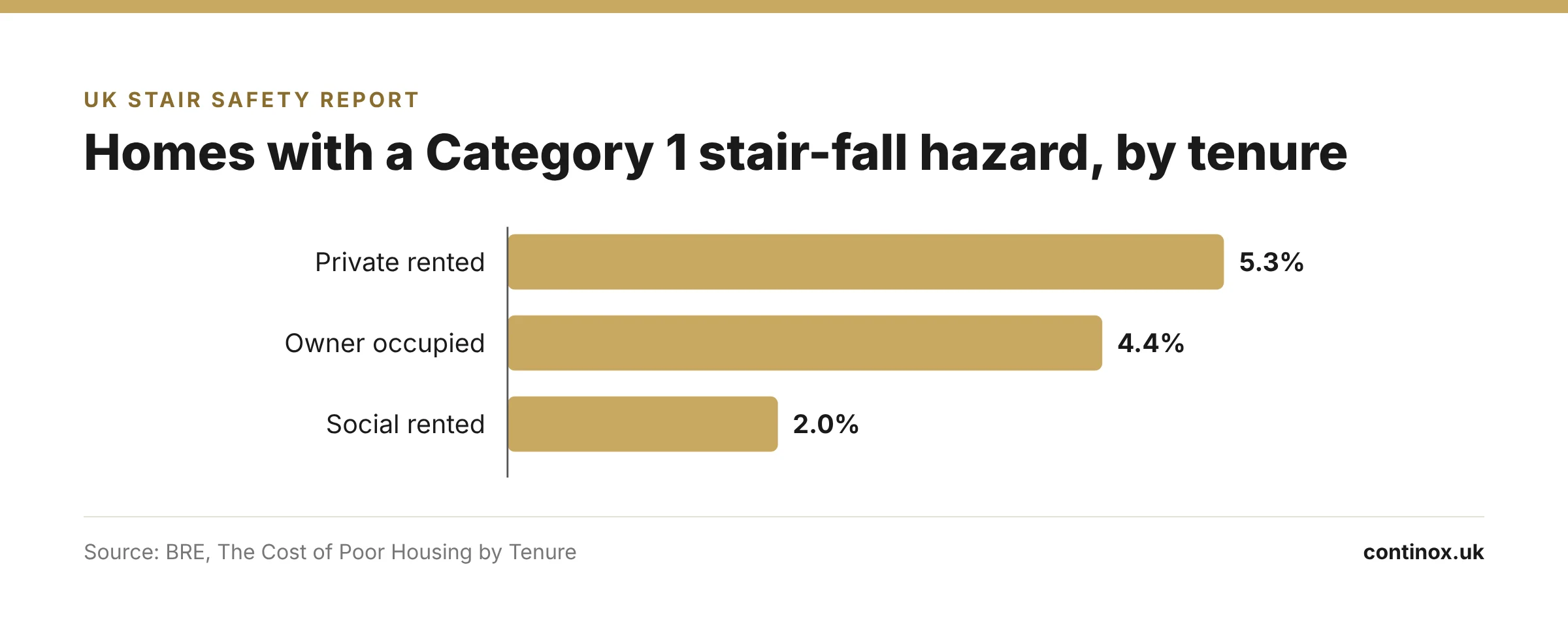
BRE links these hazards mainly to disrepair, missing handrails and missing balustrades. It also found that the problem is spread across every kind of home, not concentrated in one sector. Privately rented homes carry the highest share, but owner-occupied homes carry by far the largest number: more than 680,000.
Share of homes with a Category 1 stair-fall hazard, by tenure
Show the data as a table
| Tenure | Homes with a stair hazard | Share of homes |
|---|---|---|
| Private rented | 251,348 | 5.3% |
| Owner occupied | 682,763 | 4.4% |
| Social rented | 80,262 | 2.0% |
05 · Building ageWhy older homes carry more risk
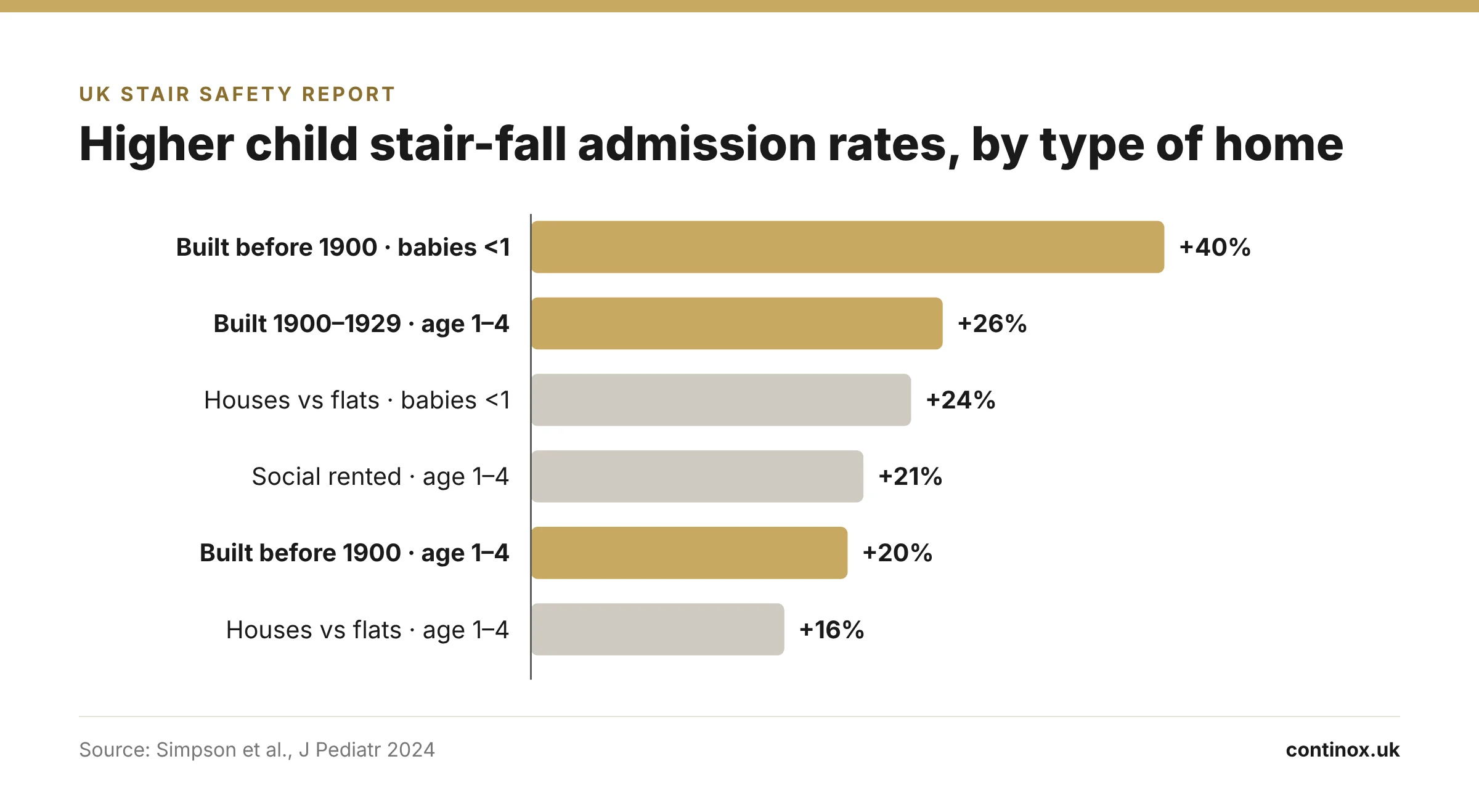
The strongest evidence linking stair design to injuries comes from a national study published in The Journal of Pediatrics. Researchers linked the hospital records of 3.9 million children born in England between 2008 and 2014 to housing data from Energy Performance Certificates. Over the study period, 9,179 of those children were admitted to hospital after a fall on stairs.
How much higher child stair-fall admission rates are, by type of home
Show the data as a table
| Comparison (children) | Higher admission rate |
|---|---|
| Built before 1900 · babies under 1 | +40% |
| Built 1900–1929 · age 1–4 | +26% |
| Houses vs flats · babies under 1 | +24% |
| Social rented · age 1–4 | +21% |
| Built before 1900 · age 1–4 | +20% |
| Houses vs flats · age 1–4 | +16% |
Babies living in areas of homes built before 1900 were admitted for stair falls at a 40% higher rate than those in areas built from 2003 onwards. The researchers suggest that changes in building regulations may explain the lower rates in newer homes.
This makes sense on the ground. Many Victorian and Edwardian staircases were built steep and narrow to save floor space. They often have tall risers, shallow treads, winders at the top and a single handrail, or none. Modern regulations rule most of that out, which is why replacing an old stair can change the risk as well as the look.
06 · CostWhat hazardous stairs cost – and what fixing them saves
BRE put a price on the problem by combining English Housing Survey hazard data with NHS treatment costs.
BRE also found that more than half of the stair hazards in owner-occupied homes could be fixed for under £500 – for example by fitting handrails. Few public health measures pay back as quickly.
Replacing an old or awkward staircase?
Continox designs and manufactures bespoke staircases and balustrades built around current UK regulations, from the first sketch to installation.
07 · RegulationsWhat the regulations require
In England, stairs in new homes and new staircases in existing homes have to meet Approved Document K of the Building Regulations. The core limits for a private stair (one serving a single dwelling) are below. Wales, Scotland and Northern Ireland have their own versions, with broadly similar principles.
Key stair dimensions for a private stair in England
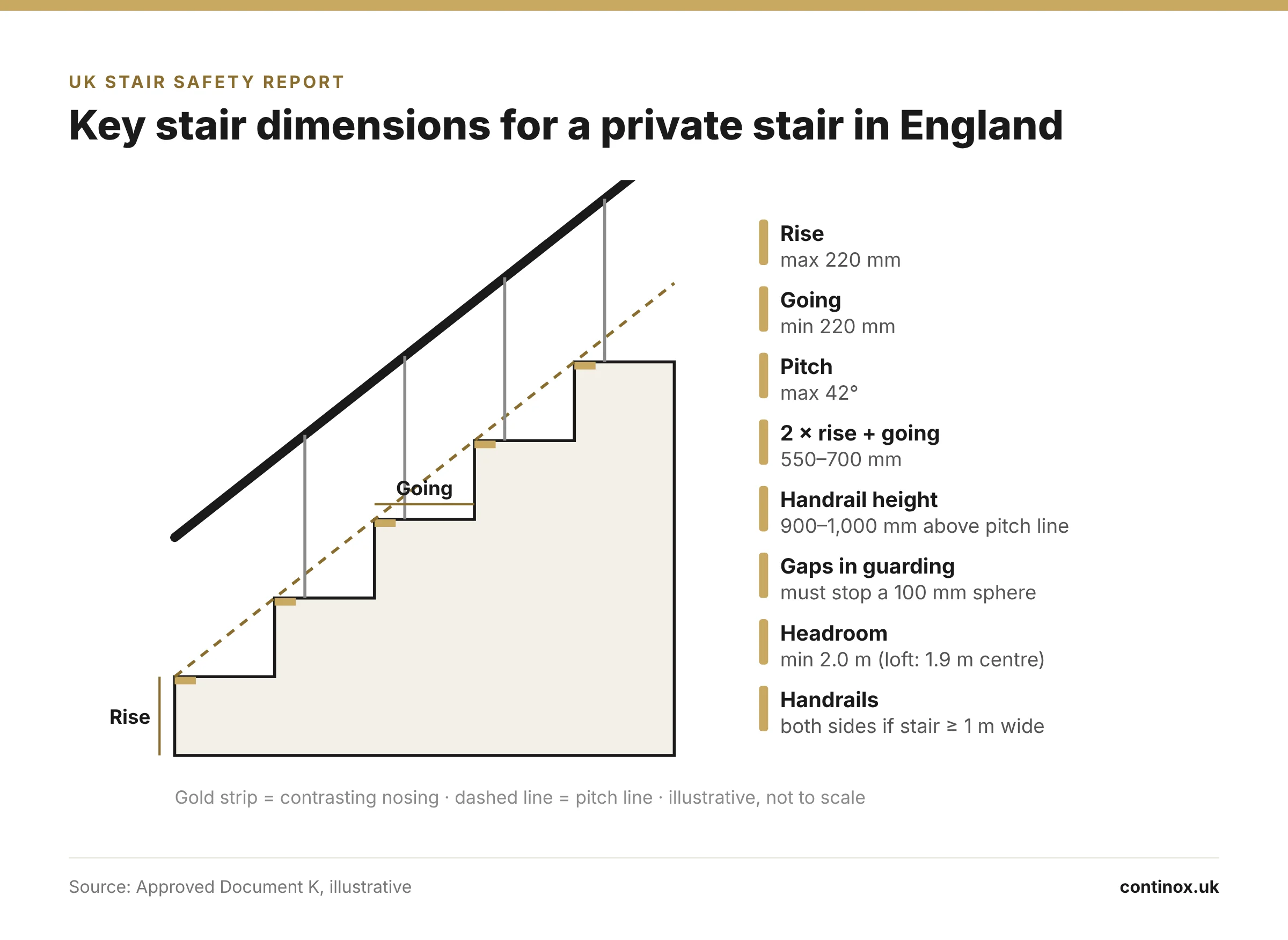
The regulations set the minimum. A staircase that just meets every limit – 220 mm risers at a 42° pitch – is legal but steep. A comfortable everyday stair usually sits well inside them, with a gentler pitch and deeper treads. If you are planning a new stair, our free stairwell opening calculator shows how much space a compliant layout needs.
08 · DesignSeven design features that reduce stair falls
The data points to the same practical measures again and again. Each one can be built into a staircase from the start.
- Consistent geometry. Every rise and every going should be identical. People stumble when one step is different from the rest, often at the top or bottom of a flight.
- A gentler pitch. Deeper treads and lower risers give more of the foot somewhere to land, especially when coming down. Our modern staircase systems are designed around comfortable geometry, not just the legal limits.
- Handrails people can actually grip. Continuous rails at a consistent height, on both sides where width allows, that run the full length of the flight.
- Guarding with no climbable gaps. Balustrades must stop a 100 mm sphere. A glass balustrade closes the gap completely and keeps light moving through the stairwell.
- Visible nosings. A contrasting edge on each tread tells the eye where the step ends, which matters most for older people and in low light.
- Light where feet land. Switches at the top and bottom, plus integrated LED tread or wall lighting, remove the shadows that hide a step edge at night.
- Slip resistance outdoors. External staircases and balcony railings face rain, frost and leaves, so treads need an anti-slip finish and drainage built in.
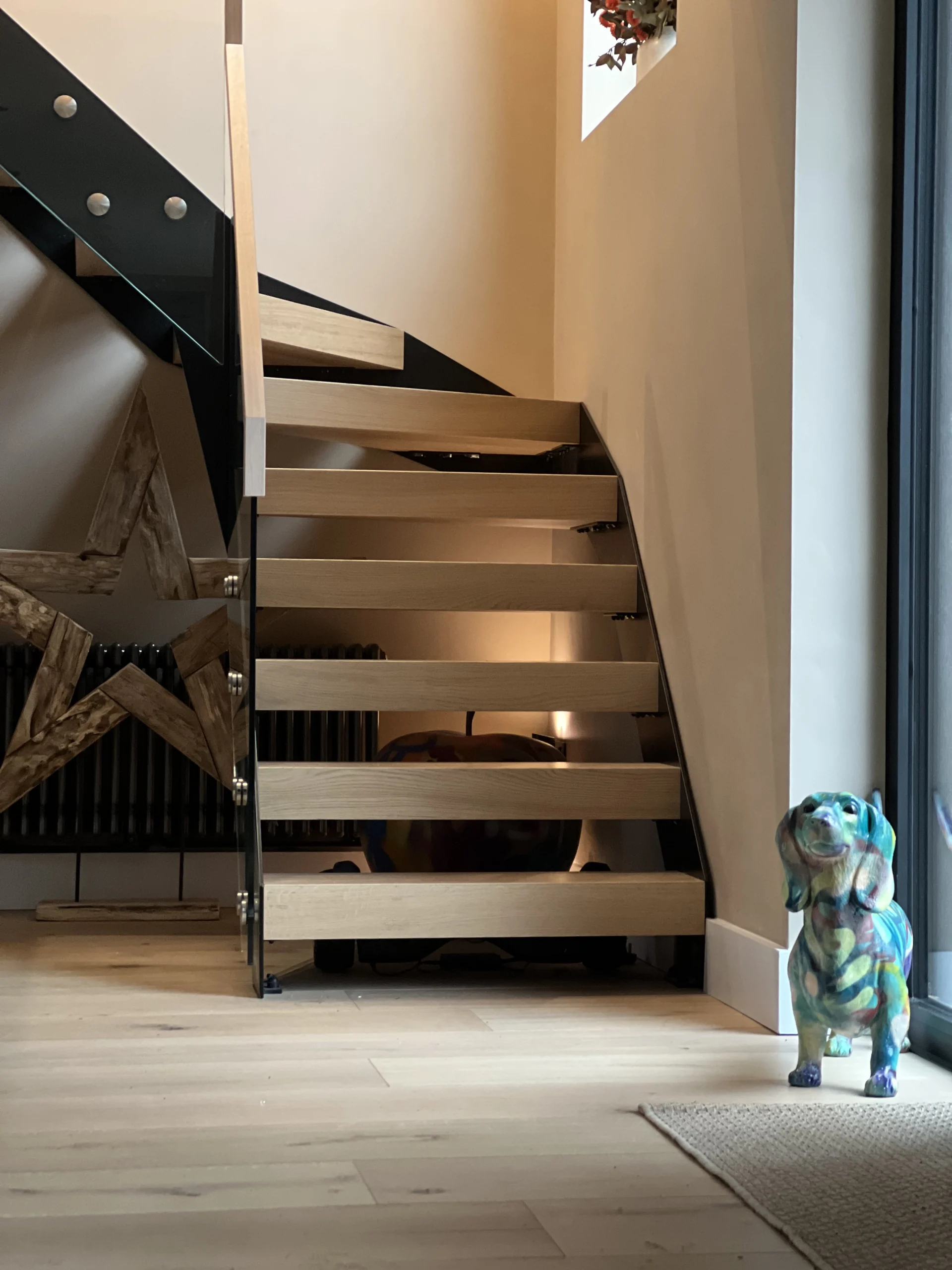
You can see how these features come together in real homes in our recent projects, from floating staircases with glass guarding to steel fire-escape stairs.
09 · MethodMethodology and sources
Deaths. Annual death registrations in England where the underlying cause is ICD-10 W10 (fall on and from stairs and steps), from ONS mortality statistics by underlying cause, sex and age (NOMIS dataset NM_161_1). Figures are by year of registration, not year of death. Deaths investigated by a coroner can be registered months after they happen. W10 covers stairs and steps in any setting, not just homes. Counts are not adjusted for population size or age.
Hazards and costs. BRE analyses of English Housing Survey data: The Cost of Poor Housing in England (2021, 2018 data) for hazard counts and costs, and The Cost of Poor Housing by Tenure (2023, 2019 reference date) for tenure splits.
Children and housing age. Simpson C.H. et al., Housing Characteristics and Hospital Admissions due to Falls on Stairs: A National Birth Cohort Study, The Journal of Pediatrics, 2024;275:114191.
Injuries. RoSPA, Safer Lives, Stronger Nation (November 2024) and RoSPA Safer by Design statistics and methodology (2019).
We will update this report when new ONS and NHS figures are published.
Use this data
Journalists, researchers, safety organisations and bloggers are welcome to use the figures and charts in this report. Please credit Continox and link to this page. Copy the line below:
Source: UK Stair Safety Report, Continox
Download the charts (free to use with credit): Figure 2 · Figure 3 · Figure 4 · Figure 5 · Figure 6
Need a chart in another format or a specific breakdown? Contact us via the quote page and mention the report.
10 · FAQFrequently asked questions
How many people die from falling on stairs in England?
Death registrations in England coded to falls on and from stairs and steps (ICD-10 W10) reached 1,001 in 2025, up from 642 in 2013 – a rise of 56%. That is close to three deaths every day. RoSPA estimates that more than 700 people are killed and over 43,000 hospitalised each year by falls on stairs in the home across the UK.
Who is most at risk of falling on stairs?
Older people. Around eight in ten stair-fall deaths in England (805 of 1,001 registrations in 2025) were people aged 65 or over, and deaths in that group rose 72% between 2013 and 2025. Among young children, hospital admission rates for stair falls peak at about one year of age.
Are stairs in older houses more dangerous?
The evidence points that way. A national study of 3.9 million children born in England found stair-fall admission rates were up to 40% higher in neighbourhoods of homes built before 1900 than in those built from 2003, and the authors suggest changes in building regulations may explain the lower rates in newer homes.
What are the building regulations for stair dimensions in England?
For a private stair, Approved Document K sets a maximum rise of 220 mm, a minimum going of 220 mm, a maximum pitch of 42° and a combined 2 × rise + going of 550–700 mm. Handrails sit 900–1,000 mm above the pitch line, are needed on both sides of stairs 1 m wide or more, and guarding must not let a 100 mm sphere pass through.
How much do falls on stairs cost the NHS?
BRE estimates that hazardous stairs in England’s homes cost the NHS around £219 million a year in first-year treatment alone. Fixing every Category 1 stair hazard would cost about £1.3 billion – paid back in roughly six years through NHS savings, with wider savings to society of about £1.7 billion a year.
What makes a staircase safer?
Consistent rise and going on every step, continuous handrails on both sides, visible contrasting nosings, slip-resistant treads, good lighting at top and bottom, and guarding with no gaps a 100 mm sphere can pass. Most of these can be designed into a new or replacement staircase from the start.
Can I use the data and charts from this report?
Yes. You are free to reuse the figures and charts in this report, including in articles and presentations, as long as you credit Continox and link to this page as the source.
Design a safer staircase with Continox
Bespoke staircases, glass balustrades and external stairs, manufactured to BS EN 1090-1 EXC2 and designed to current UK regulations. 5-year warranty against manufacturing defects.
Sources
- Office for National Statistics – Mortality statistics: underlying cause, sex and age (NOMIS, NM_161_1), ICD-10 W10, England.
- ONS – Freedom of information responses on deaths from falls on stairs and steps (FOI-2024-1748; FOI-2026-3728).
- BRE – The Cost of Poor Housing in England (2021).
- BRE – The Cost of Poor Housing by Tenure (2023).
- Simpson et al. – Housing Characteristics and Hospital Admissions due to Falls on Stairs, J Pediatr 2024.
- RoSPA – Safer Lives, Stronger Nation (November 2024); Safer by Design: statistics and methodology (2019).
- Official accidental deaths and injuries analysis, as reported by LBC, on the 83% of fall deaths recorded as unspecified.
- East Sussex in Figures – JSNA: Unintentional and deliberate injuries in under 5s.
- Ministry of Housing, Communities & Local Government – Approved Document K: Protection from falling, collision and impact.